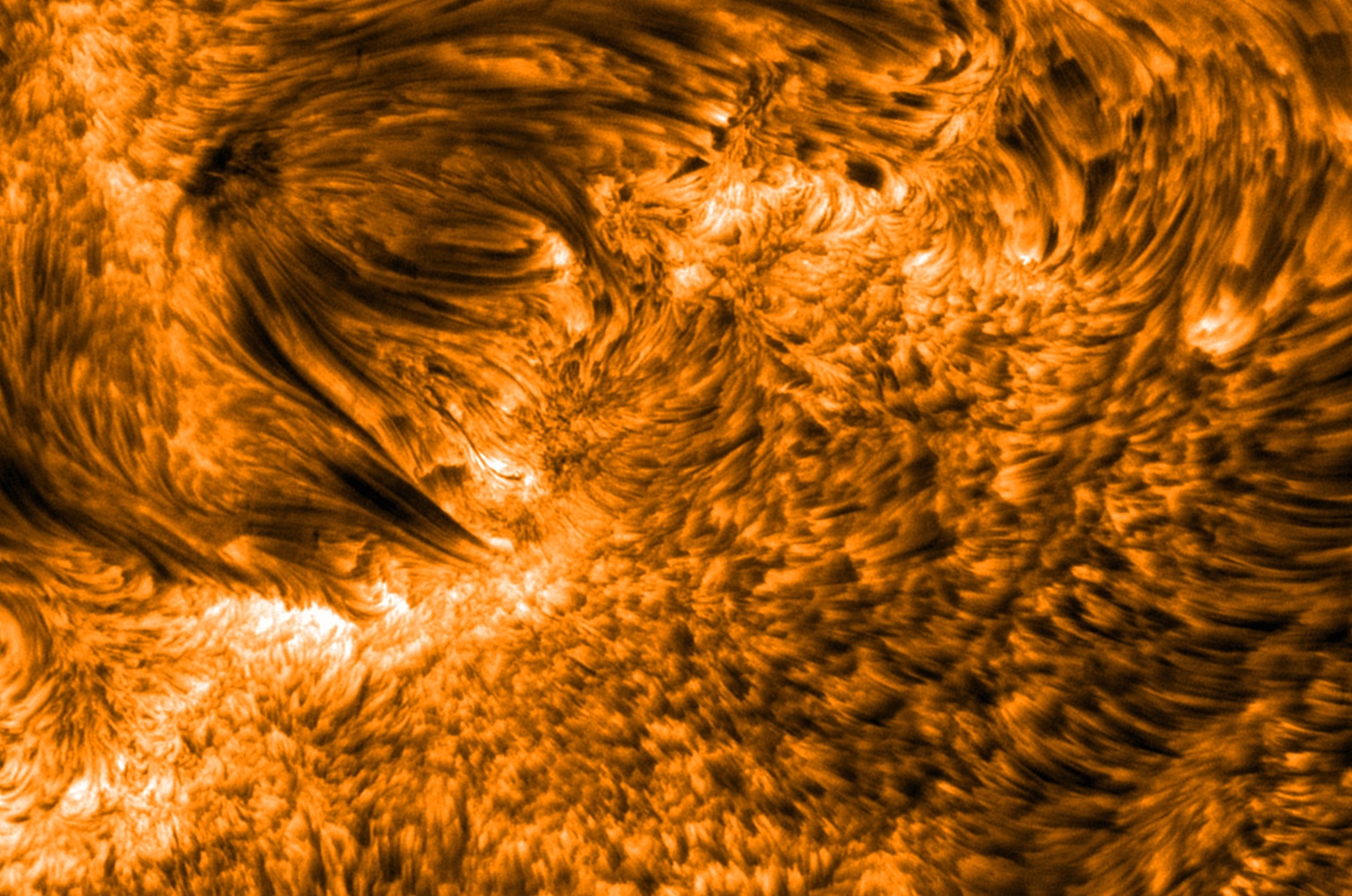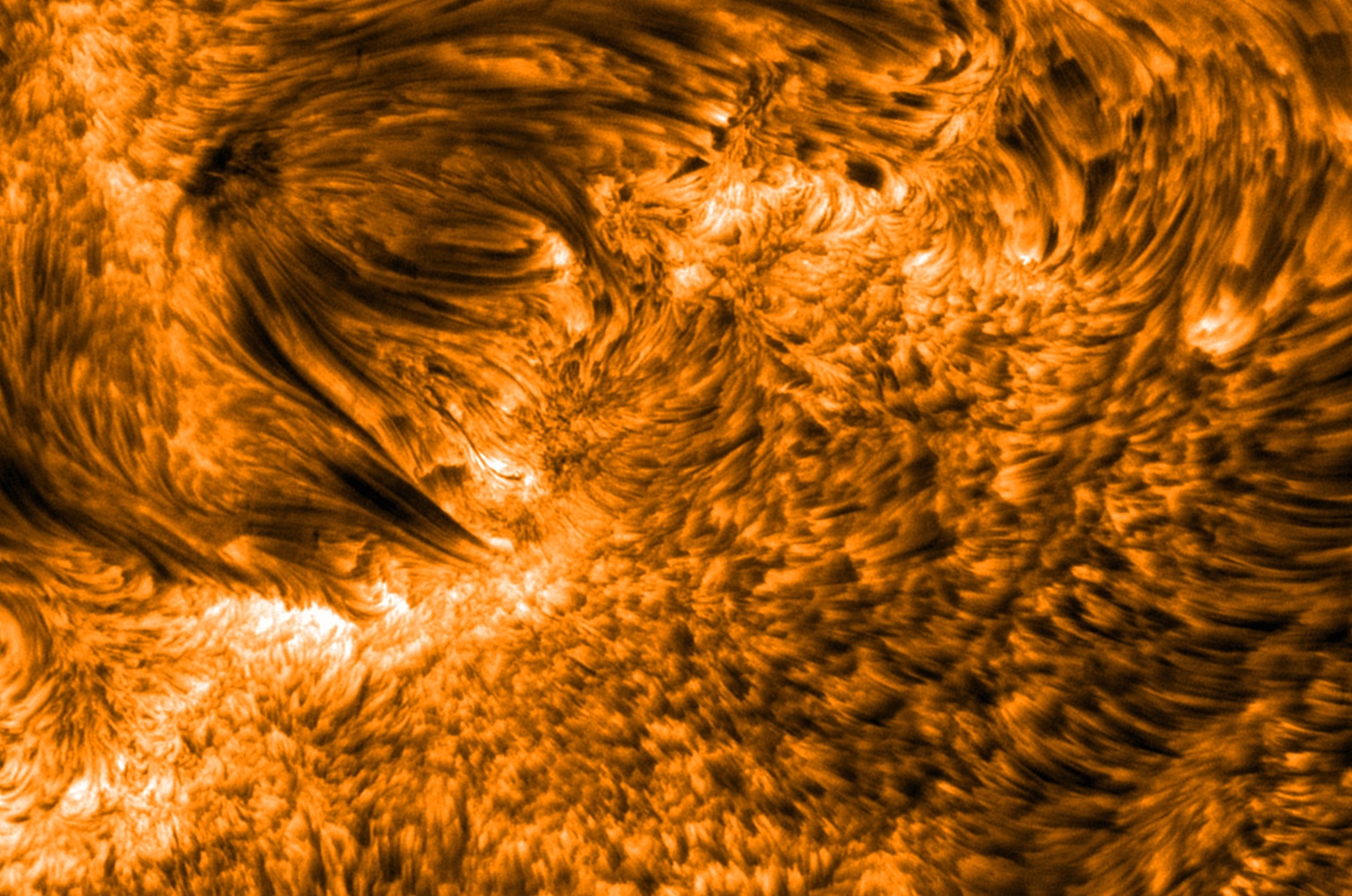
Imagine a pipe as wide as a state and as long as half the Earth. Now imagine that this pipe is filled with hot gas moving 50,000 kilometers per hour. Further imagine that this pipe is not made of metal but a transparent magnetic field. You are envisioning just one of thousands of young spicules on the active Sun. Pictured above is perhaps the highest resolution image yet of these enigmatic solar flux tubes. Spicules dot the above frame of solar active region 10380 that crossed the Sun in 2004 June, but are particularly evident as a carpet of dark tubes on the right. Time-sequenced images have recently shown that spicules last about five minutes, starting out as tall tubes of rapidly rising gas but eventually fading as the gas peaks and falls back down to the Sun. These images also indicate that the ultimate cause of spicules is sound-like waves that flow over the Sun's surface but leak into the Sun's atmosphere.
Imagina un tubo tan ancho como un estado y tan largo como la mitad de la Tierra. Ahora imagina que este tubo está lleno de gas caliente moviéndose a 50.000 kilómetros por hora. Además, imagina que este tubo no está hecho de metal sino de un campo magnético transparente. Estás visualizando solo una de miles de espículas jóvenes en el Sol activo. La imagen anterior es quizás la de mayor resolución hasta ahora de estos enigmáticos tubos de flujo solar. Las espículas salpican el fotograma de la región activa solar 10380 que cruzó el Sol en junio de 2004, pero son particularmente evidentes como una alfombra de tubos oscuros a la derecha. Las imágenes con secuencia temporal han mostrado recientemente que las espículas duran aproximadamente cinco minutos, comenzando como tubos altos de gas que asciende rápidamente pero eventualmente desapareciendo cuando el gas alcanza su punto máximo y cae de nuevo hacia el Sol. Estas imágenes también indican que la causa última de las espículas son ondas similares al sonido que fluyen sobre la superficie del Sol pero se filtran en la atmósfera solar.