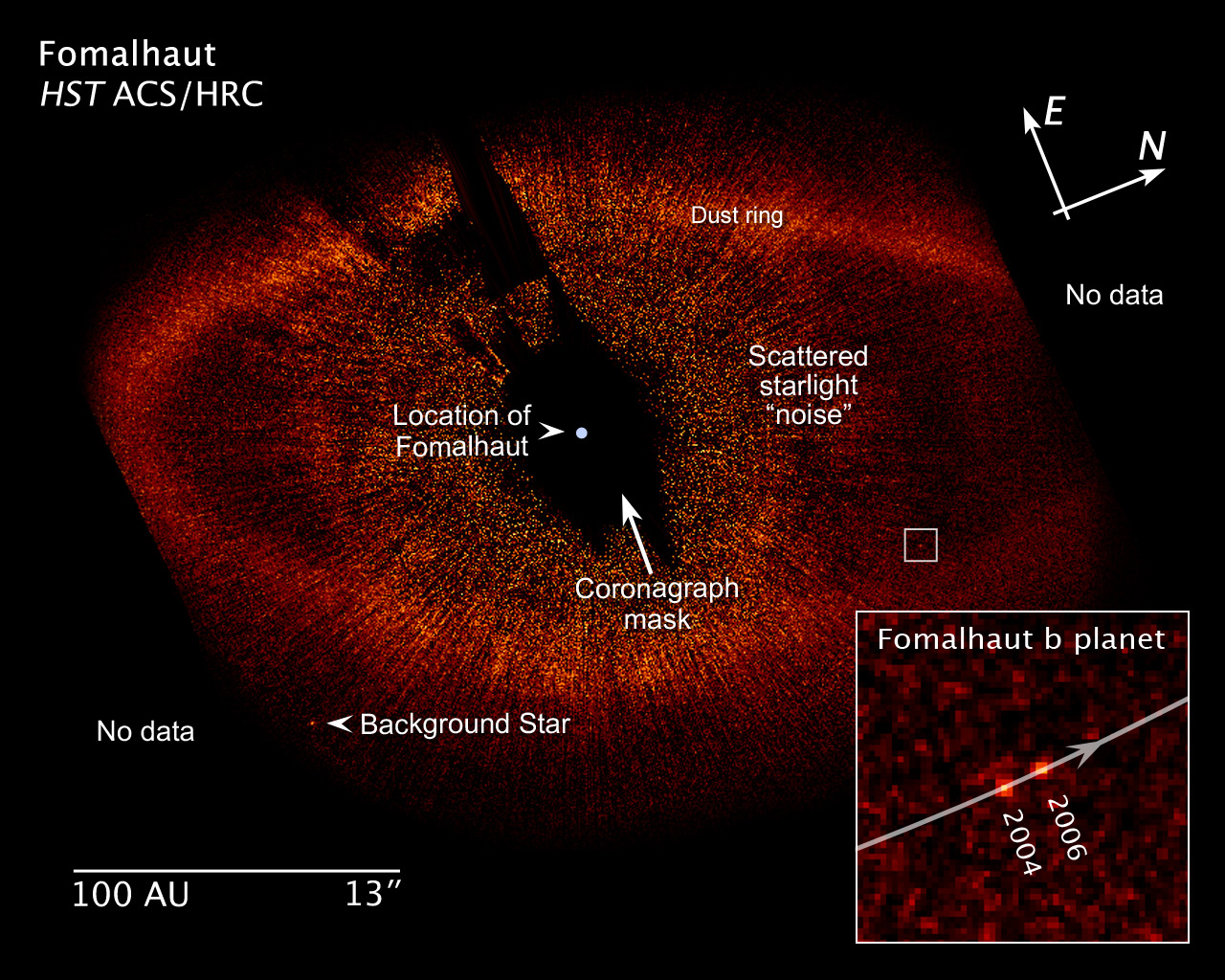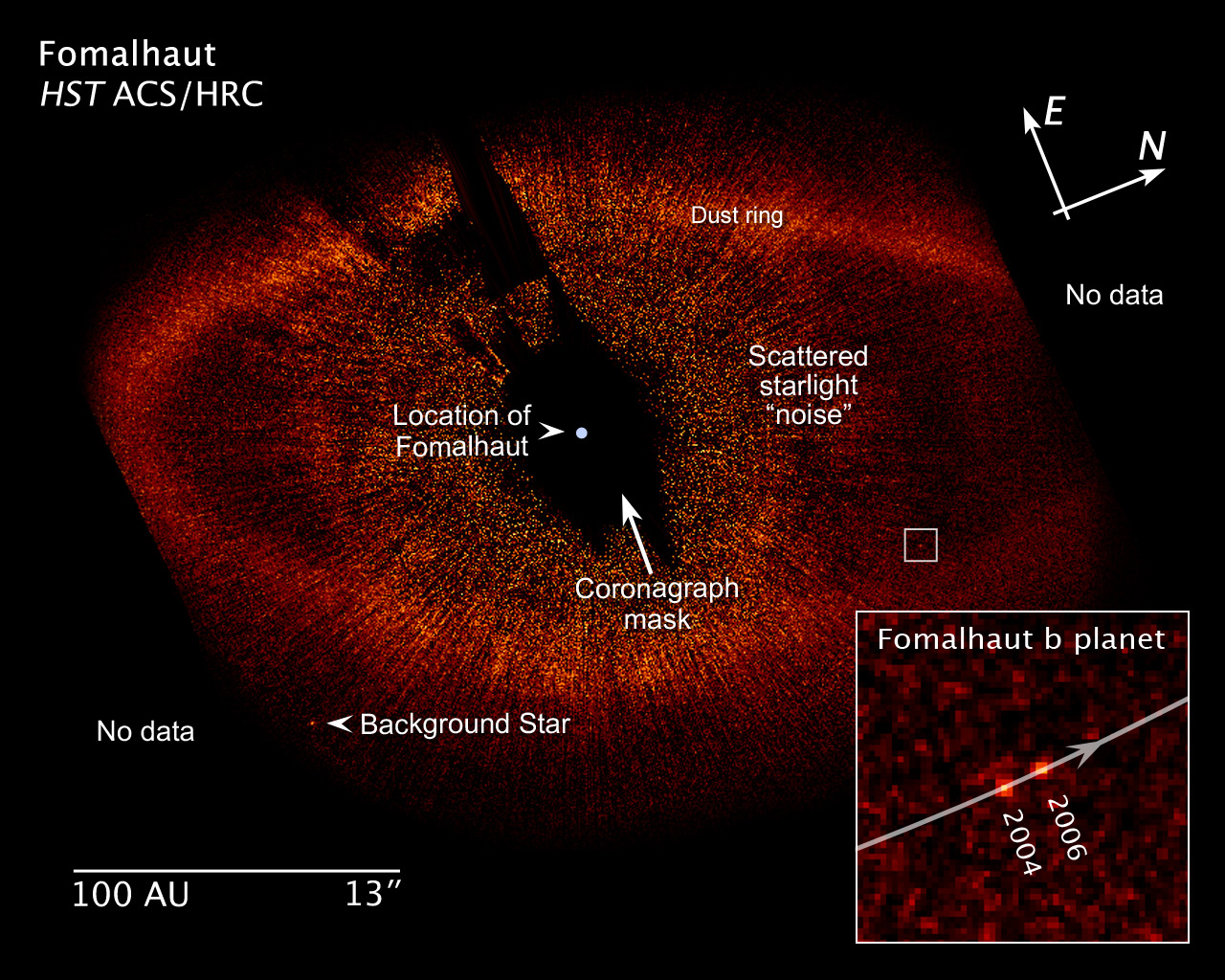
Fomalhaut (sounds like "foam-a-lot") is a bright, young, star, a short 25 light-years from planet Earth in the direction of the constellation Piscis Austrinus. In this sharp composite from the Hubble Space Telescope, Fomalhaut's surrounding ring of dusty debris is imaged in detail, with overwhelming glare from the star masked by an occulting disk in the camera's coronagraph. Astronomers now identify, the tiny point of light in the small box at the right as a planet about 3 times the mass of Jupiter orbiting 10.7 billion miles from the star (almost 23 times the Sun-Jupiter distance). Designated Fomalhaut b, the massive planet probably shapes and maintains the ring's relatively sharp inner edge, while the ring itself is likely a larger, younger analog of our own Kuiper Belt - the solar system's outer reservoir of icy bodies. The Hubble data represent the first visible-light image of a planet circling another star.
Fomalhaut es una estrella joven y brillante, situada a tan solo 25 años luz del planeta Tierra en la dirección de la constelación de Piscis Austrinus. En este nítido composite del Telescopio Espacial Hubble, el anillo de escombros polvorientos que rodea a Fomalhaut se observa en detalle, con el deslumbrante brillo de la estrella enmascarado por un disco oclusor en el coronógrafo de la cámara. Los astrónomos han identificado ahora el diminuto punto de luz en la pequeña caja de la derecha como un planeta con una masa aproximada de 3 veces la de Júpiter, que orbita a 10.7 mil millones de millas de la estrella (casi 23 veces la distancia Sol-Júpiter). Designado como Fomalhaut b, el planeta masivo probablemente forma y mantiene el borde interior relativamente definido del anillo, mientras que el anillo mismo es probablemente un análogo más grande y joven de nuestro propio Cinturón de Kuiper, el depósito exterior del sistema solar de cuerpos helados. Los datos del Hubble representan la primera imagen en luz visible de un planeta que orbita alrededor de otra estrella.