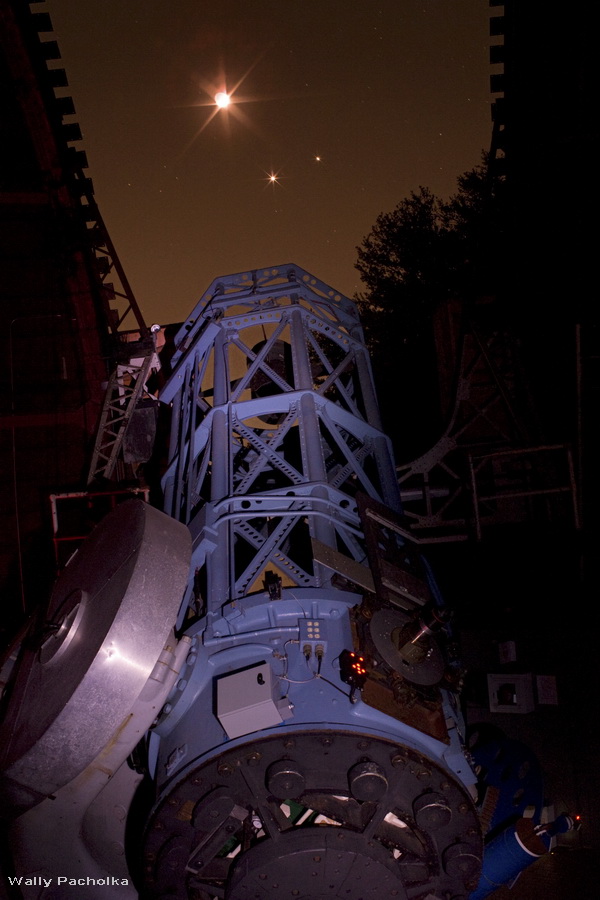
On the night of December 13, 1908, 100 years ago today, the 60-inch diameter reflecting telescope of Mount Wilson Observatory was first tested on the stars. It became the first successful large reflecting telescope. The 60-inch reflector demonstrated a scalable design that used a mirror to gather faint starlight, rather than a large and more difficult to support lens, becoming the granddaddy of all, even larger, modern telescopes. Now-famous astronomers, including Harlow Shapley and Edwin Hubble, were able to use the 60-inch reflector to embark on a new kind of exploration of stars, distant galaxies, and the nature of the universe. Still looking skyward a century after its first light, the historic telescope is seen here pointing toward one of the most recognizable celestial events of 2008, the remarkable conjunction of Moon, Venus, and Jupiter.
La noche del 13 de diciembre de 1908, hace exactamente 100 años, el telescopio reflector de 60 pulgadas de diámetro del Observatorio de Mount Wilson fue probado por primera vez con las estrellas. Se convirtió en el primer telescopio reflector grande de gran éxito. El reflector de 60 pulgadas demostró un diseño escalable que utilizaba un espejo para captar la débil luz de las estrellas, en lugar de una lente grande y más difícil de sostener, convirtiéndose en el precursor de todos los telescopios modernos, aún más grandes. Astrónomos ahora famosos, como Harlow Shapley y Edwin Hubble, pudieron utilizar el reflector de 60 pulgadas para embarcarse en una nueva clase de exploración de estrellas, galaxias distantes y la naturaleza del universo. Aún mirando hacia el cielo un siglo después de su primer registro, el telescopio histórico se ve aquí apuntando hacia uno de los eventos celestes más reconocibles de 2008, la notable conjunción de la Luna, Venus y Júpiter.