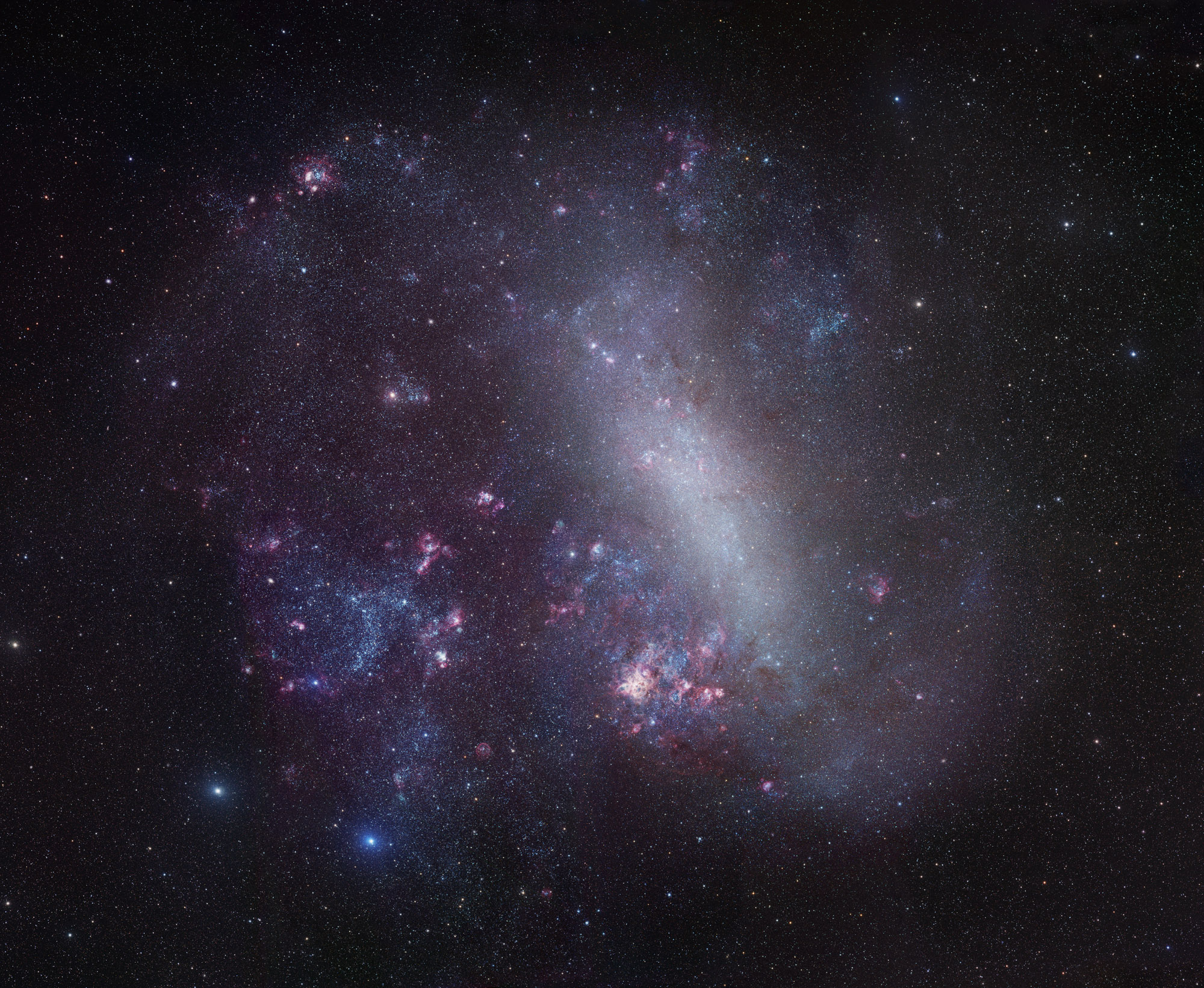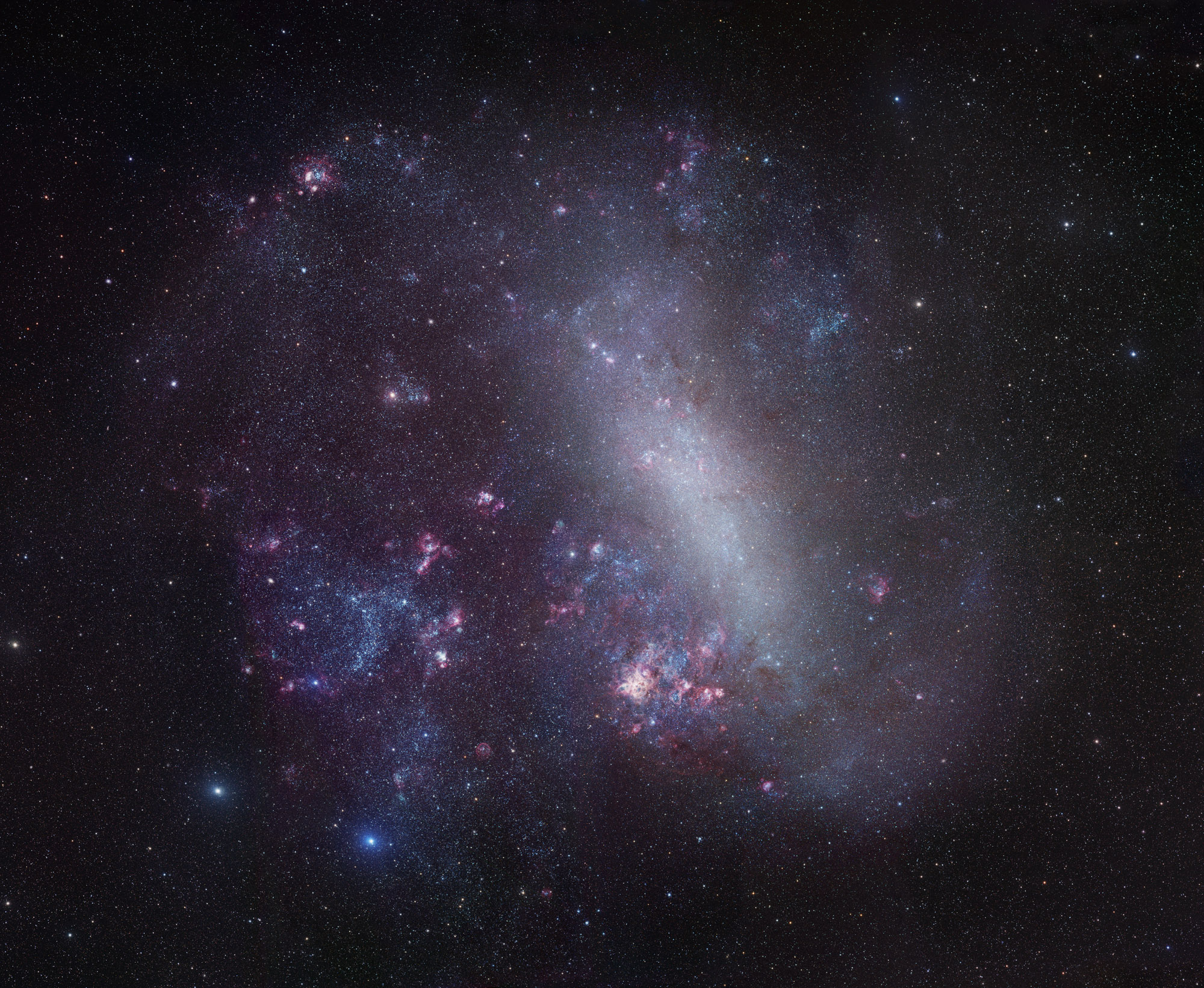
The 16th century Portuguese navigator Ferdinand Magellan and his crew had plenty of time to study the southern sky during the first circumnavigation of planet Earth. As a result, two fuzzy cloud-like objects easily visible to southern hemisphere skygazers are known as the Clouds of Magellan, now understood to be satellite galaxies of our much larger, spiral Milky Way galaxy. About 160,000 light-years distant in the constellation Dorado, the Large Magellanic Cloud (LMC) is seen here in a remarkably detailed, 10 frame mosaic image. Spanning about 30,000 light-years or so, it is the most massive of the Milky Way's satellite galaxies and is the site of the closest supernova in modern times, SN 1987A. The prominent reddish knot near the bottom is 30 Doradus, or the Tarantula Nebula, a giant star-forming region in the Large Magellanic Cloud. To identify the location of the supernova and navigate your way around the many star clusters and nebulae of the LMC, just consult this well-labeled view.
Durante el siglo XVI, el navegante portugués Fernando de Magallanes y su tripulación tuvieron abundante tiempo para estudiar el cielo austral durante la primera circunnavegación del planeta Tierra. Como resultado, dos objetos difusos similares a nubes, fácilmente visibles para los observadores del hemisferio sur, se conocen como las Nubes de Magallanes, ahora entendidas como galaxias satélites de nuestra mucho más grande galaxia espiral Vía Láctea. Ubicada a aproximadamente 160.000 años luz de distancia en la constelación de Dorado, la Gran Nube de Magallanes (LMC) se muestra aquí en una imagen de mosaico notablemente detallada de 10 fotogramas. Con un tamaño de aproximadamente 30.000 años luz, es la más masiva de las galaxias satélites de la Vía Láctea y es el sitio de la supernova más cercana en tiempos modernos, SN 1987A. El nudo rojizo prominente cerca de la parte inferior es 30 Doradus, o la Nebulosa de la Tarántula, una región gigante de formación estelar en la Gran Nube de Magallanes. Para identificar la ubicación de la supernova y navegar por los numerosos cúmulos estelares y nebulosas de la LMC, simplemente consulte esta vista bien etiquetada.