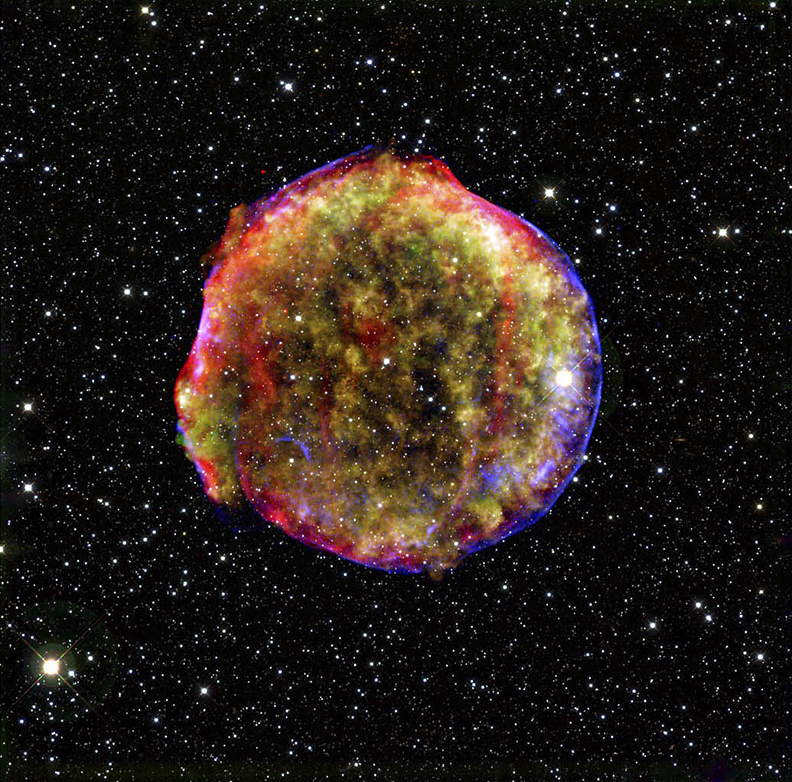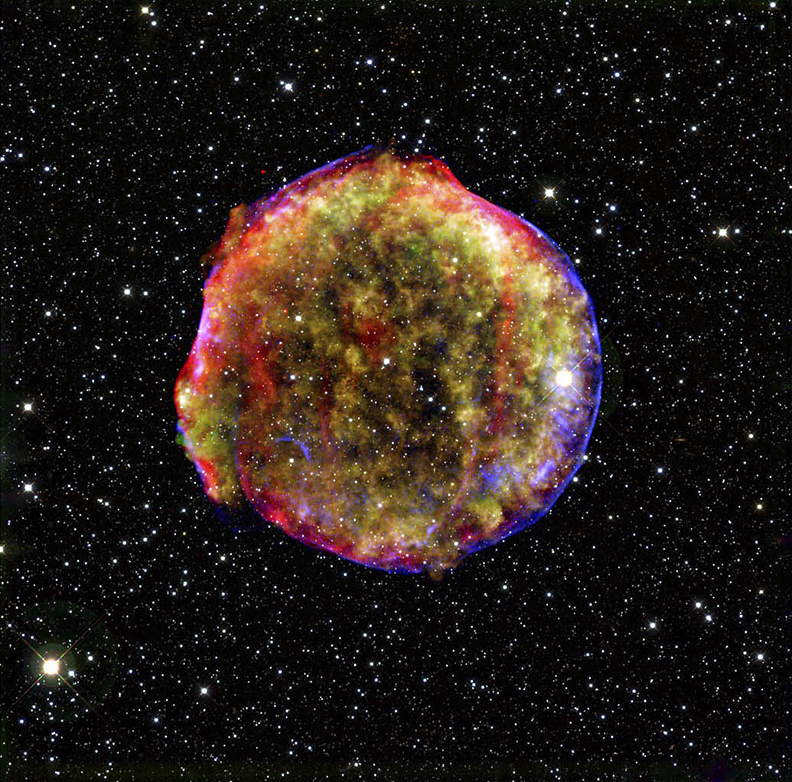
What star created this huge puffball? Pictured above is the best multi-wavelength image yet of Tycho's supernova remnant, the result of a stellar explosion first recorded over 400 years ago by the famous astronomer Tycho Brahe. The above image is a composite of an X-ray image taken by the orbiting Chandra X-ray Observatory, an infrared image taken by the orbiting Spitzer Space Telescope, and an optical image taken by the 3.5-meter Calar Alto telescope located in southern Spain. The expanding gas cloud is extremely hot, while slightly different expansion speeds have given the cloud a puffy appearance. Although the star that created SN 1572, is likely completely gone, a star dubbed Tycho G, too dim to be easily discerned here, is being studied as the possible companion. Finding progenitor remnants of Tycho's supernova is particularly important because the supernova was recently determined to be of Type Ia. The peak brightness of Type Ia supernovas is thought to be well understood, making them quite valuable in calibrating how our universe dims distant objects.
¿Qué estrella creó esta nube gigantesca? La imagen mostrada es la mejor imagen multibanda hasta la fecha del remanente de la supernova de Tycho, resultado de una explosión estelar registrada por primera vez hace más de 400 años por el famoso astrónomo Tycho Brahe. La imagen mostrada es una composición de una imagen en rayos X obtenida por la observatorio espacial Chandra, una imagen en infrarrojo obtenida por el telescopio espacial Spitzer, y una imagen óptica obtenida por el telescopio de 3.5 metros del Observatorio de Calar Alto ubicado en el sur de España. La nube de gas en expansión es extremadamente caliente, y velocidades ligeramente diferentes de expansión le han dado a la nube una apariencia puffy. Aunque la estrella que creó la SN 1572 probablemente esté completamente desaparecida, una estrella llamada Tycho G, demasiado tenue para ser fácilmente discernible aquí, se está estudiando como posible compañera. Encontrar restos progenitores de la supernova de Tycho es particularmente importante porque se ha determinado recientemente que la supernova es de tipo Ia. Se cree que el brillo máximo de las supernovas tipo Ia se entiende bien, lo que las hace muy valiosas para calibrar cómo nuestro universo atenúa objetos distantes.