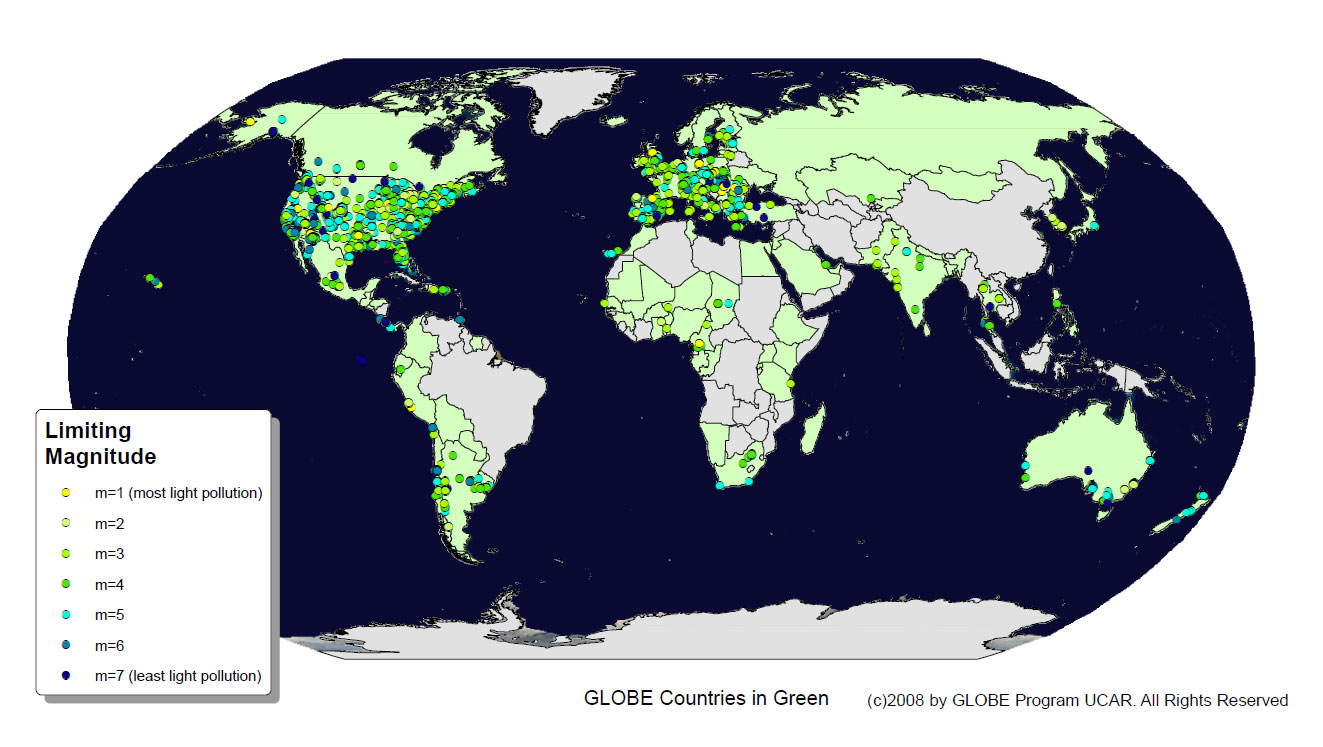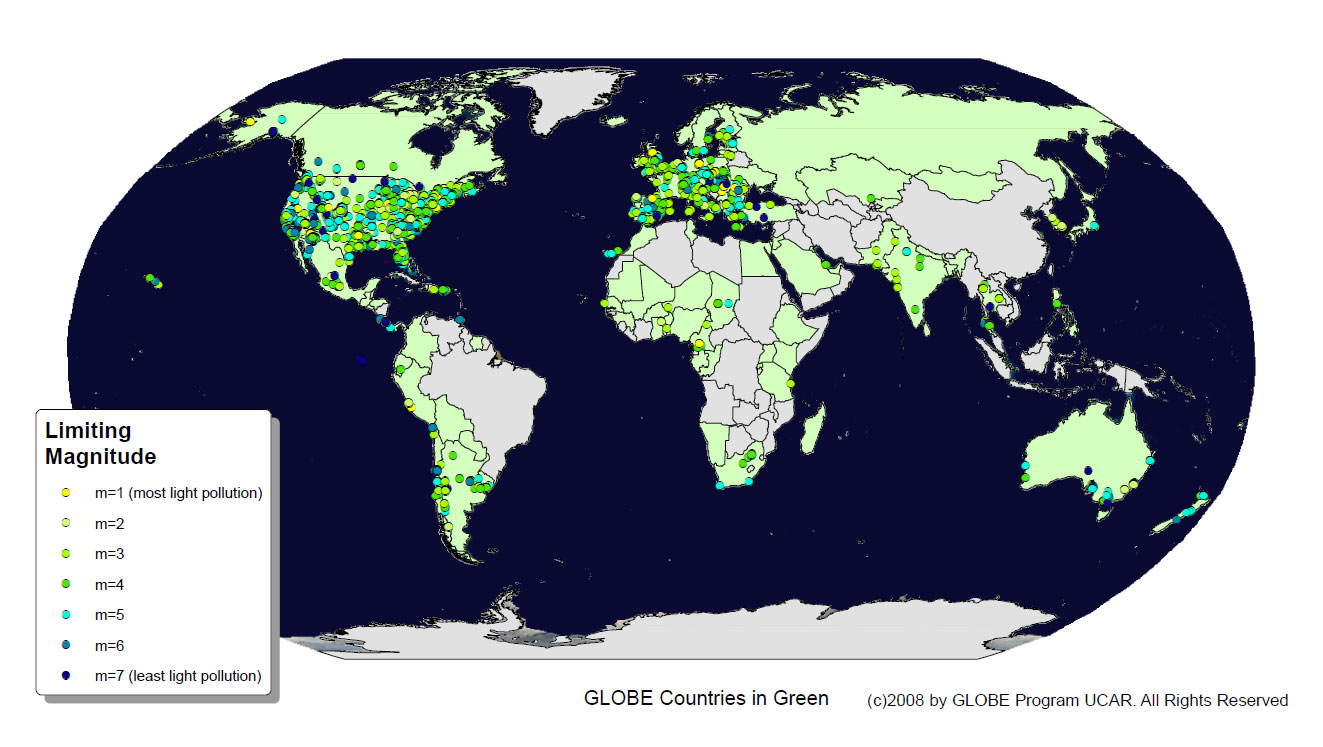
How many stars can you see? Through next week, the GLOBE at Night project invites people from all over the world to go outside at night, look up, and see! Specifically, people are invited to go out an hour after sunset and look for the constellation Orion toward the west. Rather than count Orion's stars directly, however, the GLOBE at Night website has made things easier by providing several star charts to which you can compare your view of Orion. Possible matches extend from a bright sky where only a few Orion stars are visible, to a very dark sky where over 100 Orion stars are visible. Pictured above are results from last year's sky observation campaign. Since 2009 is the International Year of Astronomy, it is hoped that an even better map can be created this year. By participating in this easy and fun activity, you are helping humanity to better understand how light pollution is changing across the Earth.
¿Cuántas estrellas puedes ver? Hasta la próxima semana, el proyecto GLOBE at Night invita a personas de todo el mundo a salir por la noche, mirar hacia arriba y observar. Específicamente, se invita a las personas a salir una hora después de la puesta de sol y buscar la constelación de Orión hacia el oeste. Sin embargo, en lugar de contar directamente las estrellas de Orión, el sitio web de GLOBE at Night ha facilitado el proceso proporcionando varios mapas estelares con los que puedes comparar tu visión de Orión. Las posibles coincidencias van desde un cielo brillante donde solo se ven unas pocas estrellas de Orión, hasta un cielo muy oscuro donde se ven más de 100 estrellas de Orión. En la imagen de arriba se muestran los resultados de la campaña de observación del cielo del año pasado. Dado que 2009 es el Año Internacional de la Astronomía, se espera que este año se pueda crear un mapa aún mejor. Al participar en esta actividad fácil y divertida, estás ayudando a la humanidad a comprender mejor cómo está cambiando la contaminación luminosa en la Tierra.