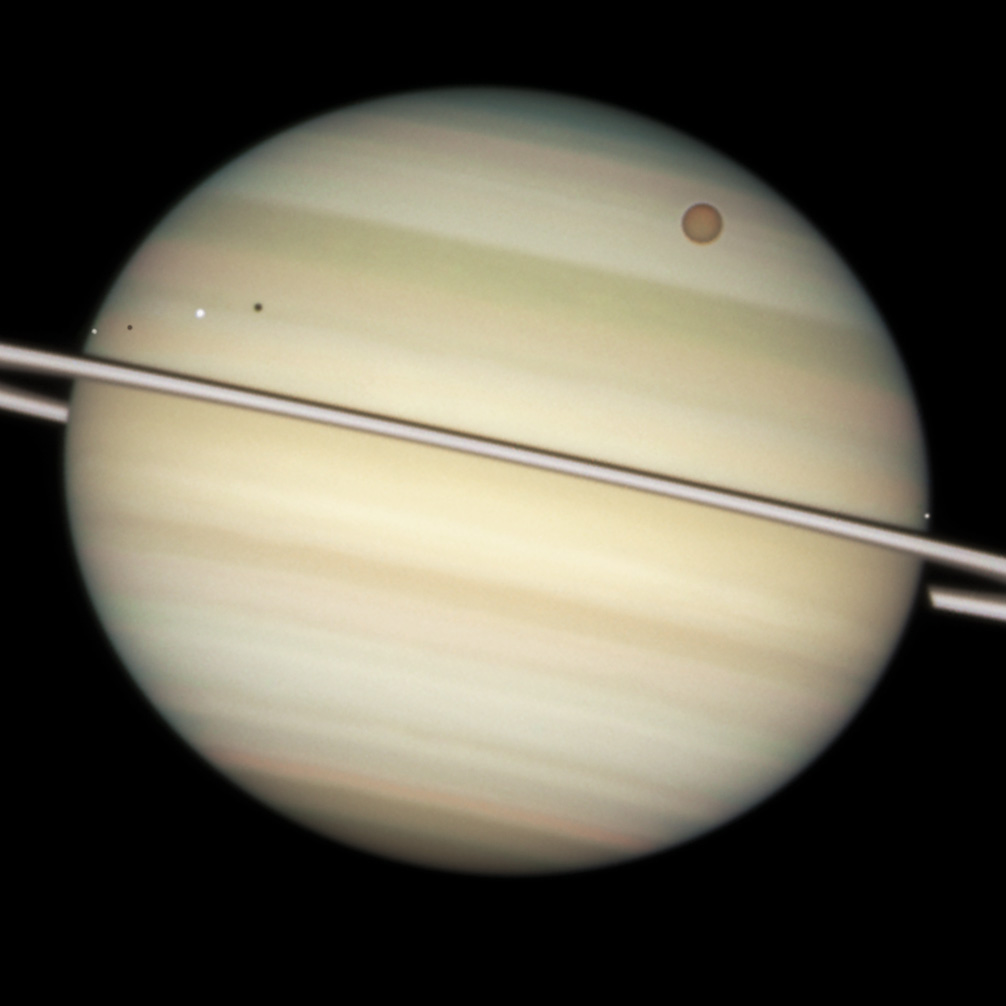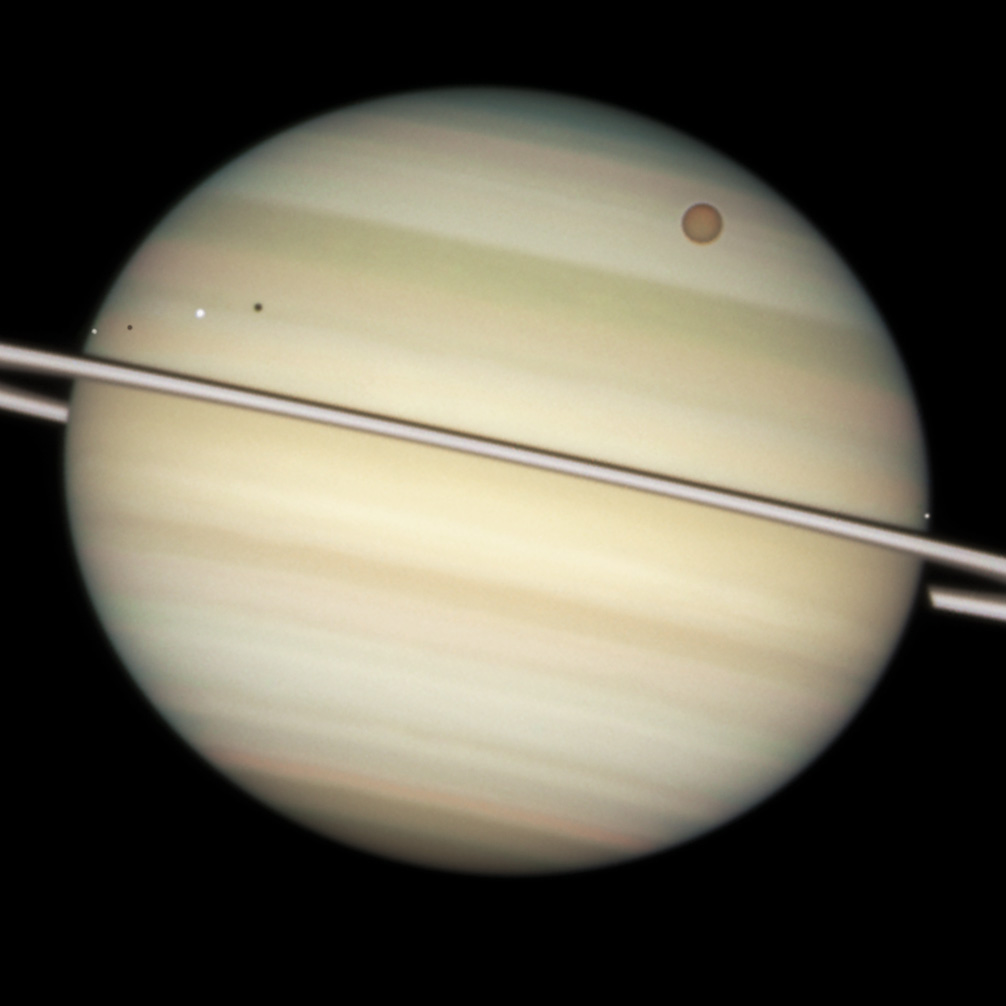
very 14 to 15 years, Saturn's rings are tilted edge-on to our line of sight. As the bright, beautiful rings seem to grow narrower it becomes increasingly difficult to see them, even with large telescopes. But it does provide the opportunity to watch multiple transits of Saturn's moons. During a transit, a sunlit moon and its shadow glide across the cloudy face of the gas giant. Recorded on February 24, this Hubble image is part of a sequence showing the transit of four of Saturn's moons. From left to right are Enceladus and shadow, Dione and shadow, and Saturn's largest moon Titan. Small moon Mimas is just touching Saturn's disk near the ring plane at the far right. The shadows of Titan and Mimas have both moved off the right side of the disk. Saturn itself has an equatorial diameter of about 120,000 kilometers.
Cada 14 a 15 años, los anillos de Saturno se inclinan en dirección a nosotros, mostrando su borde. A medida que estos anillos brillantes y hermosos parecen volverse más estrechos, se vuelve cada vez más difícil verlos, incluso con telescopios grandes. Pero esto proporciona la oportunidad de observar múltiples tránsitos de las lunas de Saturno. Durante un tránsito, una luna iluminada por el Sol y su sombra se deslizan sobre la superficie nublada del gigante gaseoso. Esta imagen obtenida por el Hubble el 24 de febrero forma parte de una secuencia que muestra el tránsito de cuatro de las lunas de Saturno. De izquierda a derecha aparecen Encelado y su sombra, Rea y su sombra, y la luna más grande de Saturno, Titán. La pequeña luna Mimas apenas toca el disco de Saturno cerca del plano de los anillos en la parte más alejada a la derecha. Las sombras de Titán y Mimas ya se han desplazado del lado derecho del disco. Saturno mismo tiene un diámetro ecuatorial de aproximadamente 120 000 kilómetros.