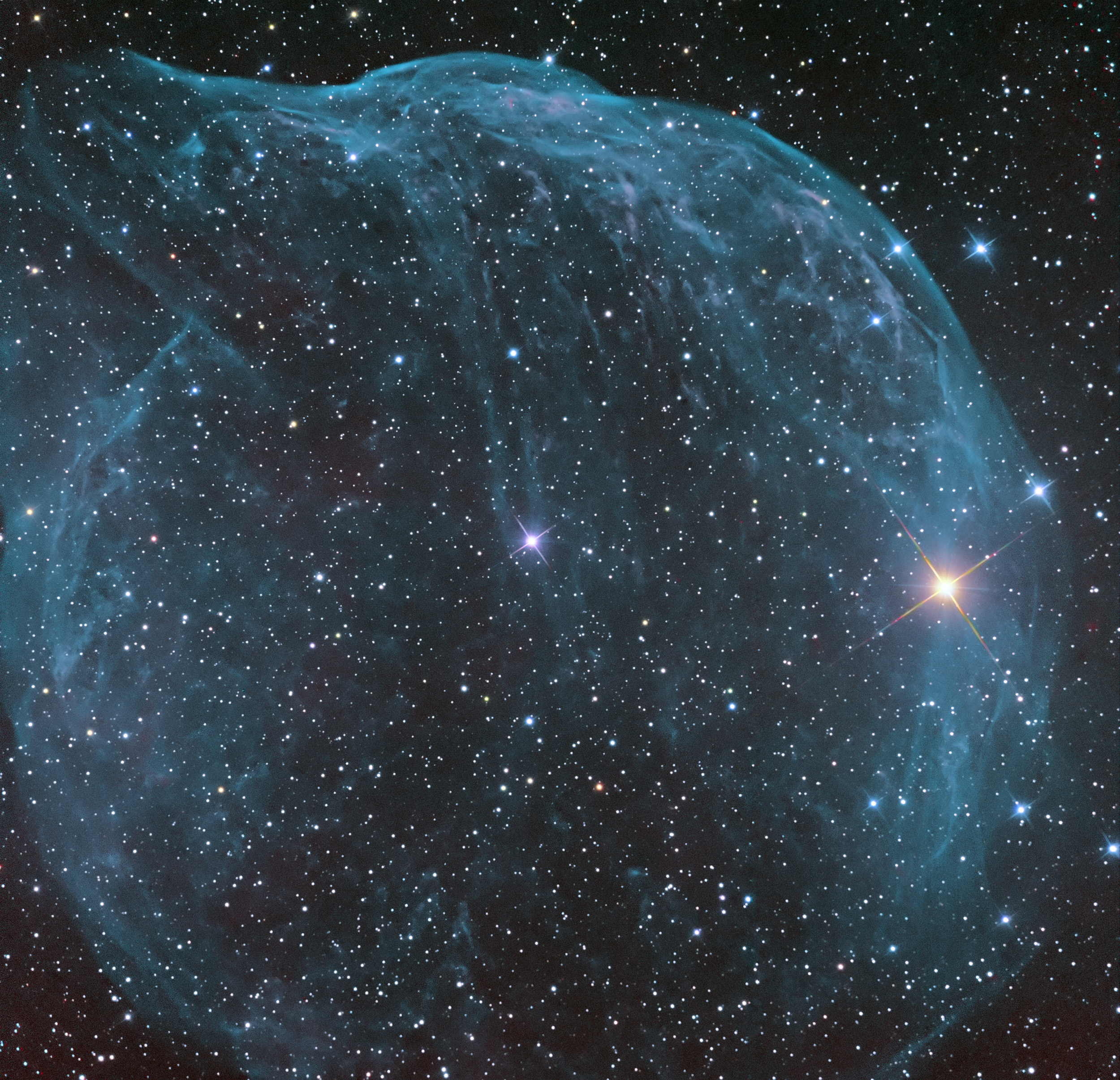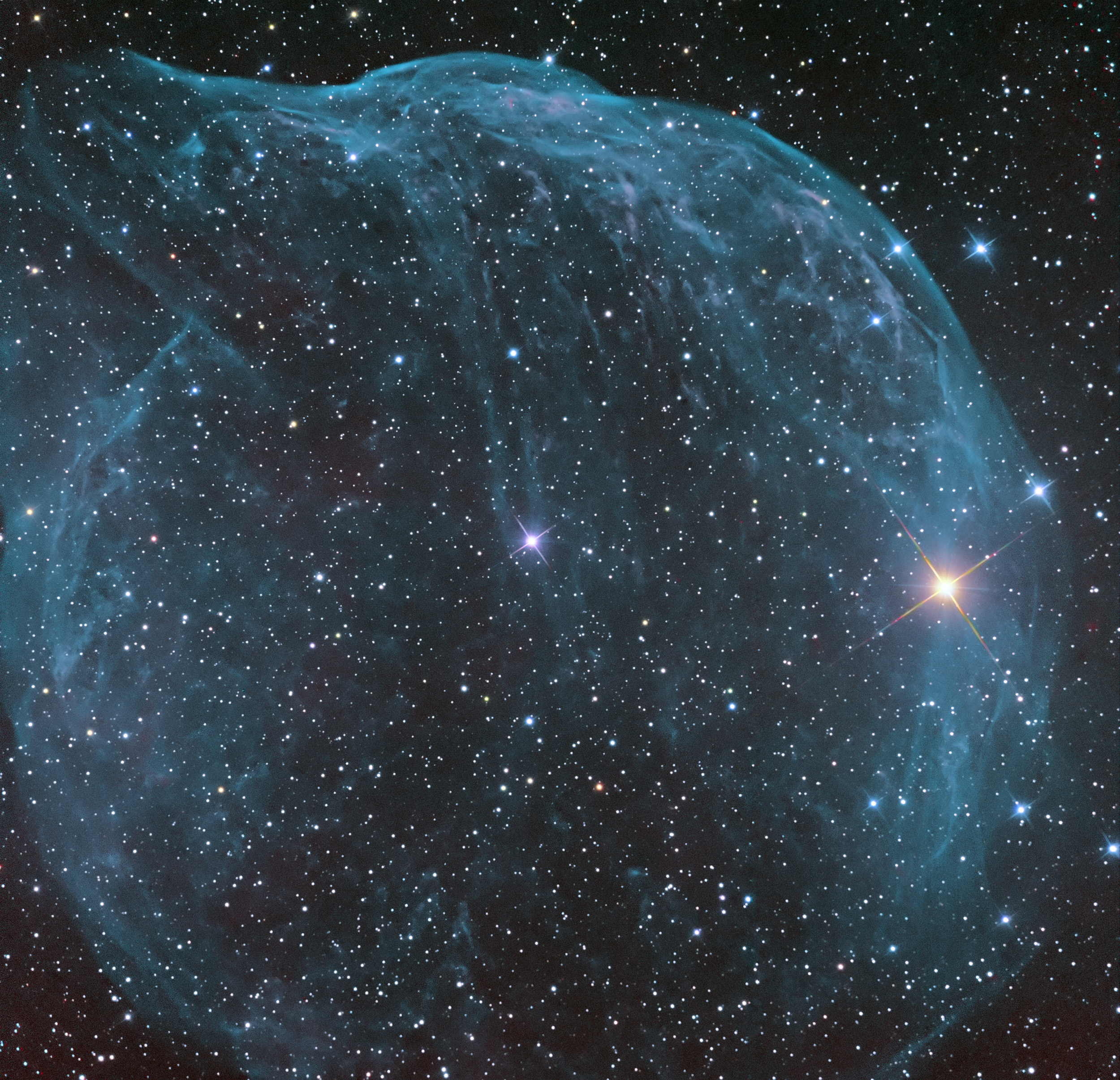
Blown by fast winds from a hot, massive star, this cosmic bubble is huge. Cataloged as Sharpless 308 it lies some 5,200 light-years away in the constellation Canis Major and covers over 2/3 degree on the sky (compared with 1/2 degree for the Full Moon). That corresponds to a diameter of 60 light-years at its estimated distance. The massive star itself, a Wolf-Rayet star, is the bright blue one near the center of the nebula. Wolf-Rayet stars have over 20 times the mass of the Sun and are thought to be in a brief, pre-supernova phase of massive star evolution. Fast winds from this Wolf-Rayet star create the bubble-shaped nebula as they sweep up slower moving material from an earlier phase of evolution. The windblown nebula has an age of about 70,000 years. Relatively faint emission captured in the expansive image is dominated by the glow of ionized oxygen atoms mapped to bluish hues.
Crédito: NASA, ESA, Hubble Heritage Team (STScI/AURA) Este burbuja cósmica, inflada por vientos rápidos provenientes de una estrella caliente y masiva, es enorme. Catalogada como Sharpless 308, se encuentra a unos 5200 años luz de distancia en la constelación de Canis Major y cubre más de 2/3 de grado en el cielo (en comparación con 1/2 grado para la Luna Llena). Eso corresponde a un diámetro de 60 años luz a su distancia estimada. La estrella masiva en sí, una estrella Wolf-Rayet, es la brillante de color azul cerca del centro de la nebulosa. Las estrellas Wolf-Rayet tienen más de 20 veces la masa del Sol y se cree que están en una fase breve, pre-supernova, de la evolución de las estrellas masivas. Los vientos rápidos de esta estrella Wolf-Rayet crean la nebulosa de forma de burbuja a medida que recogen material de movimiento más lento de una fase anterior de evolución. La nebulosa inflada por el viento tiene una edad de aproximadamente 70000 años. La emisión relativamente tenue capturada en la imagen expansiva está dominada por el brillo de átomos de oxígeno ionizados mapeados a tonos azulados.