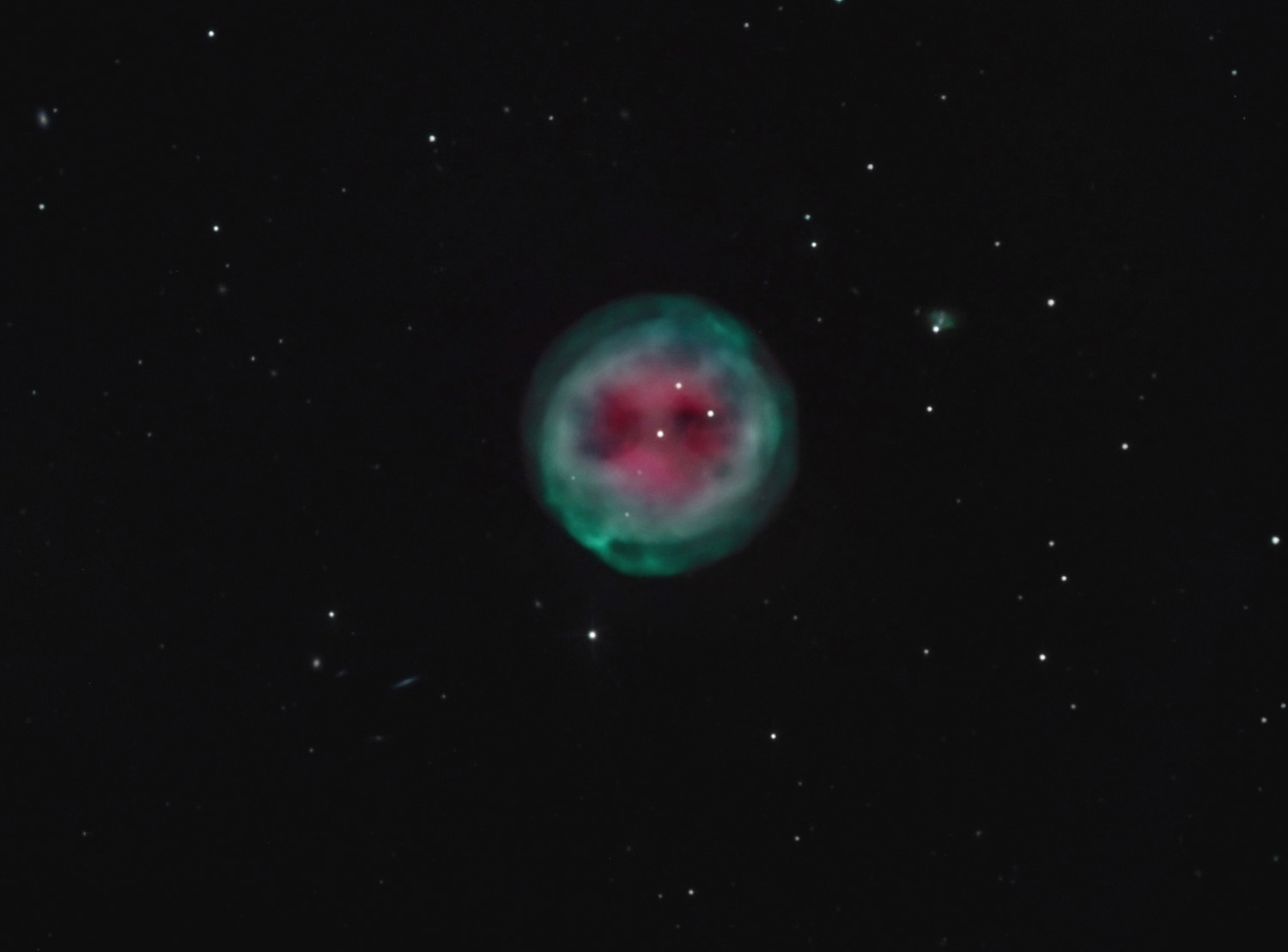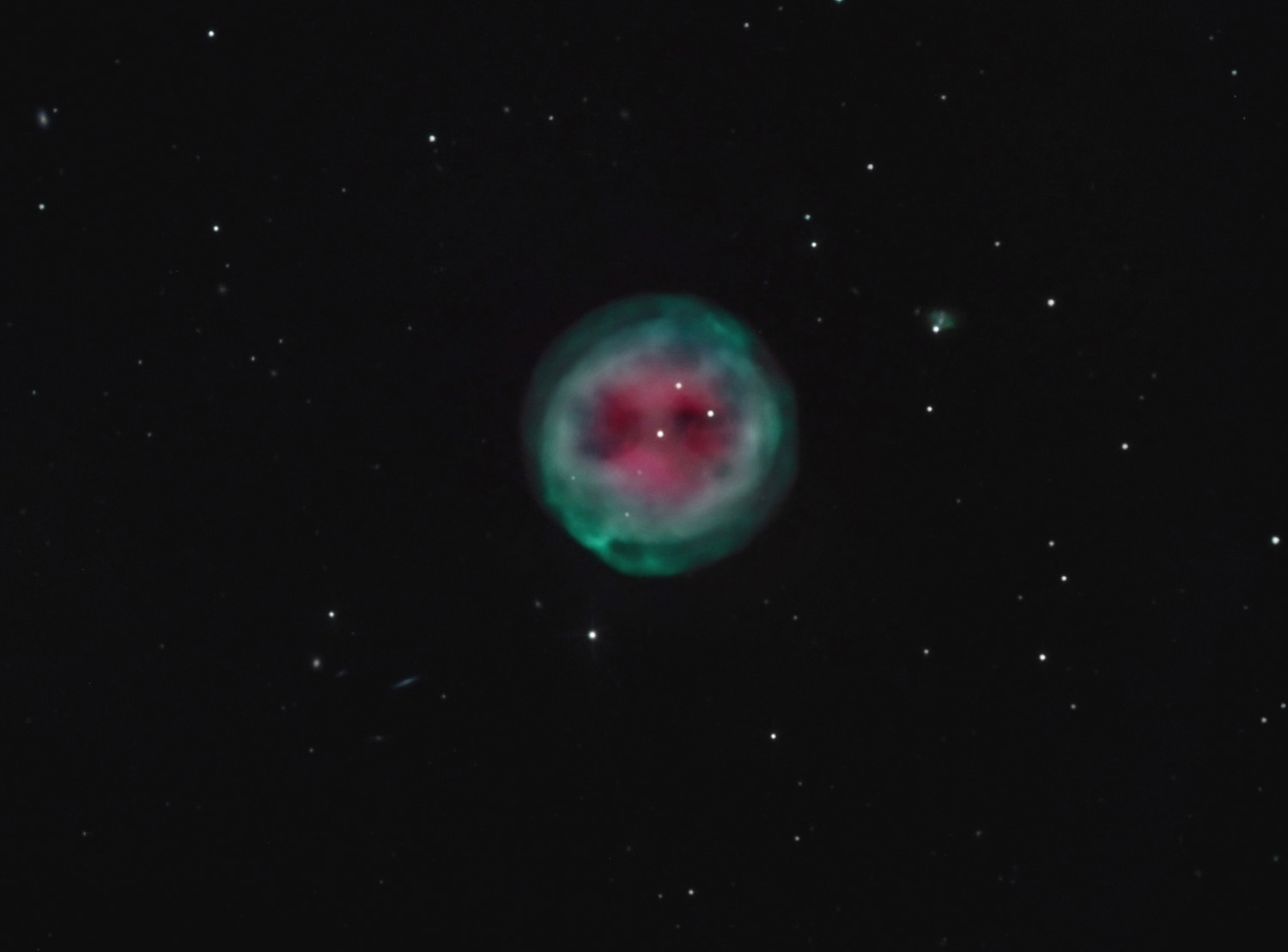
The Owl Nebula is perched in the sky about 2,600 light-years away toward the bottom of the Big Dipper's bowl. Also cataloged as M97, the 97th object in Messier's well-known list, its round shape along with the placement of two large, dark "eyes" do suggest the face of a staring owl. One of the fainter objects in Messier's catalog, the Owl Nebula is a planetary nebula, the glowing gaseous envelope shed by a dying sun-like star as it runs out of nuclear fuel. In fact, the Owl Nebula offers an example of the fate of our Sun as it runs out of fuel in another 5 billion years. As we see it, the nebula spans over 2 light-years making it roughly 2,000 times the diameter of Neptune's orbit. Beautiful to look at, this color image shows impressive details within the cosmic owl. The composite includes images made through narrow-band filters for a total of 24 hours of exposure time.
La Nebulosa Buho se encuentra en el cielo a unos 2.600 años luz de distancia, hacia la parte inferior del recipiente de la Cuchara Mayor. También catalogada como M97, el 97º objeto en la conocida lista de Messier, su forma redonda junto con la colocación de dos grandes y oscuros 'ojos' sí sugieren la cara de un búho observador. Uno de los objetos más tenues en el catálogo de Messier, la Nebulosa Buho es una nebulosa planetaria, el envoltorio gaseoso luminoso expulsado por una estrella moribunda similar al Sol cuando se le agota el combustible nuclear. De hecho, la Nebulosa Buho ofrece un ejemplo del destino de nuestro Sol cuando se le agote el combustible en unos 5.000 millones de años. Como la vemos, la nebulosa abarca más de 2 años luz, lo que la hace aproximadamente 2.000 veces más ancha que la órbita de Neptuno. Hermosa de ver, esta imagen en color muestra detalles impresionantes dentro del búho cósmico. La imagen compuesta incluye imágenes tomadas a través de filtros de banda estrecha, con un tiempo total de exposición de 24 horas.