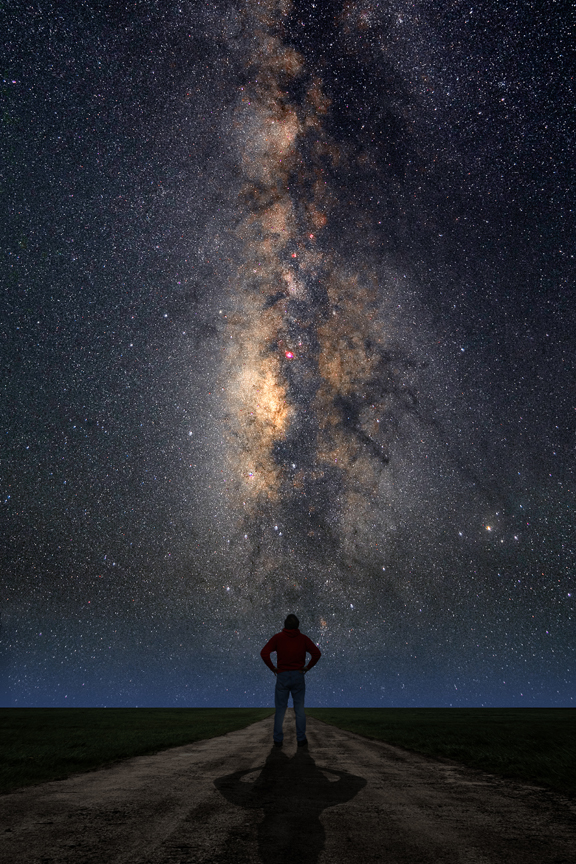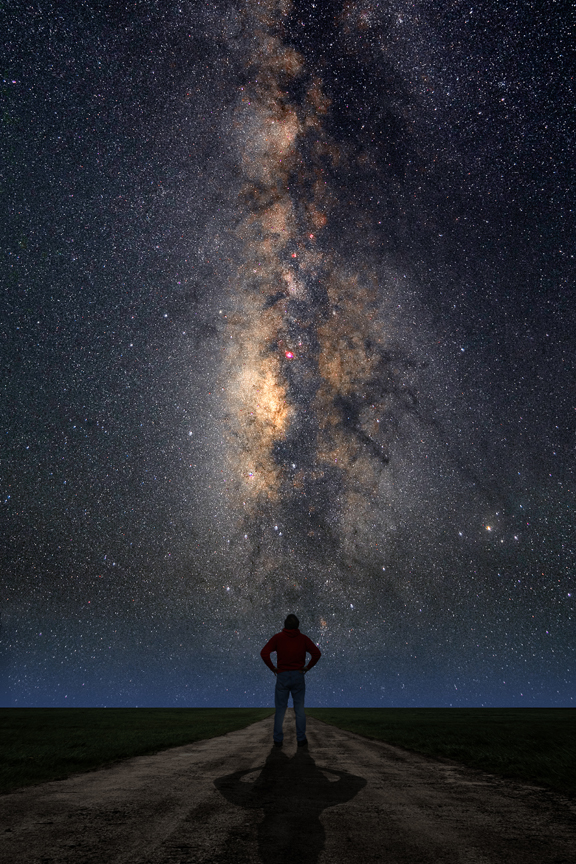
Inspired by the night skies of planet Earth in the International Year of Astronomy, photographer Larry Landolfi created this tantalizing fantasy view. The composited image suggests a luminous Milky Way is the heavenly extension of a country road. Of course, the name for our galaxy, the Milky Way (in Latin, Via Lactea), does refer to its appearance as a milky band or path in the sky. In fact, the word galaxy itself derives from the Greek for milk. Visible on moonless nights from dark sky areas, though not so bright or colorful as in this image, the glowing celestial band is due to the collective light of myriad stars along the plane of our galaxy, too faint to be distinguished individually. The diffuse starlight is cut by dark swaths of obscuring galactic dust clouds. Four hundred years ago, Galileo turned his telescope on the Milky Way and announced it to be "... a congeries of innumerable stars ..."
Inspirado por los cielos nocturnos del planeta Tierra en el Año Internacional de la Astronomía, el fotógrafo Larry Landolfi creó esta sugerente visión fantástica. La imagen compuesta sugiere que una luminosa Vía Láctea es la extensión celestial de una carretera rural. Por supuesto, el nombre de nuestra galaxia, la Vía Láctea (en latín, Via Lactea), sí se refiere a su apariencia como una banda o camino lechoso en el cielo. De hecho, la palabra galaxia misma deriva del griego para leche. Visible en noches sin luna desde zonas con cielos oscuros, aunque no tan brillante ni colorida como en esta imagen, la banda celestial luminosa se debe a la luz colectiva de innumerables estrellas a lo largo del plano de nuestra galaxia, demasiado tenues como para distinguirse individualmente. La luz difusa de las estrellas es cortada por oscuros sectores de nubes galácticas de polvo que la obscurecen. Hace cuatrocientos años, Galileo apuntó su telescopio hacia la Vía Láctea y anunció que era "... una congeries de innumerables estrellas..."