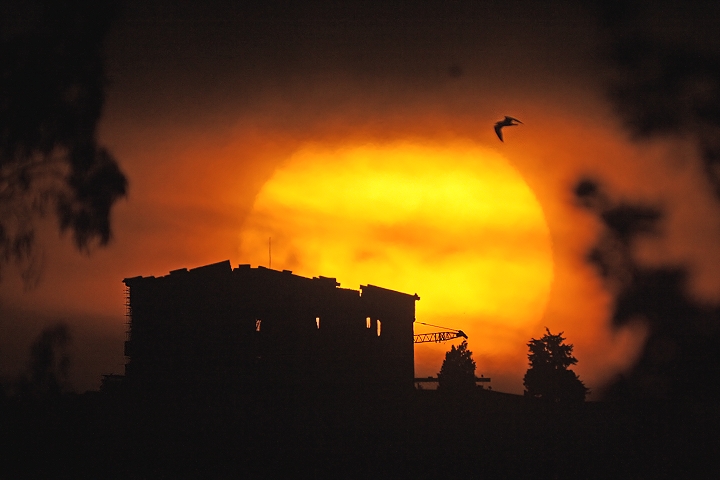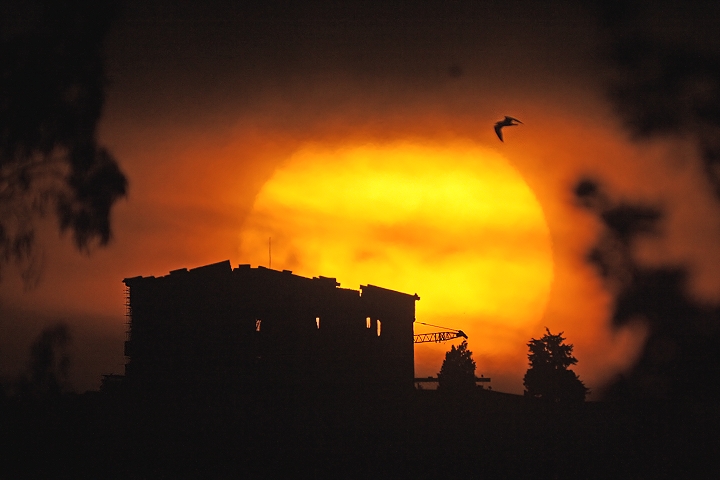
Today, the sun will stay in the sky longer than any other day of the year, as seen from the northern hemisphere of Earth. Named the Summer Solstice, today's maximum daylight is indicative of the high amount of sunlight this time of year that is primarily responsible for the heat of the summer season. At the north pole and for all places above the arctic circle, there will be no night -- the entire day today will be lit by sunlight. The situation is reversed in Earth's southern hemisphere, where today has the least sunlight of any day. Today's solstice is commemorated above by a well-planned picture of our five billion year old Sun rising behind the 2,500 year old Parthenon in Greece. Trees and birds occupy the foreground, while a modern crane is shown restoring parts of this historic symbol of a cultural civilization.
Hoy, el Sol permanecerá en el cielo más tiempo que cualquier otro día del año, visto desde el hemisferio norte de la Tierra. Conocido como el Solsticio de Verano, el máximo de luz diurna de hoy es indicativo de la gran cantidad de luz solar que caracteriza esta época del año y que es principalmente responsable del calor de la estación veraniega. En el polo norte y en todos los lugares situados al norte del círculo ártico, no habrá noche alguna — todo el día de hoy estará iluminado por la luz solar. La situación es inversa en el hemisferio sur de la Tierra, donde hoy es el día con menos luz solar del año. El solsticio de hoy se conmemora en la imagen superior con una fotografía bien planificada de nuestro Sol de cinco mil millones de años de antigüedad, que se eleva detrás del Partenón de 2500 años de antigüedad en Grecia. Árboles y aves ocupan el primer plano, mientras que se muestra una grúa moderna restaurando partes de este histórico símbolo de una civilización cultural.