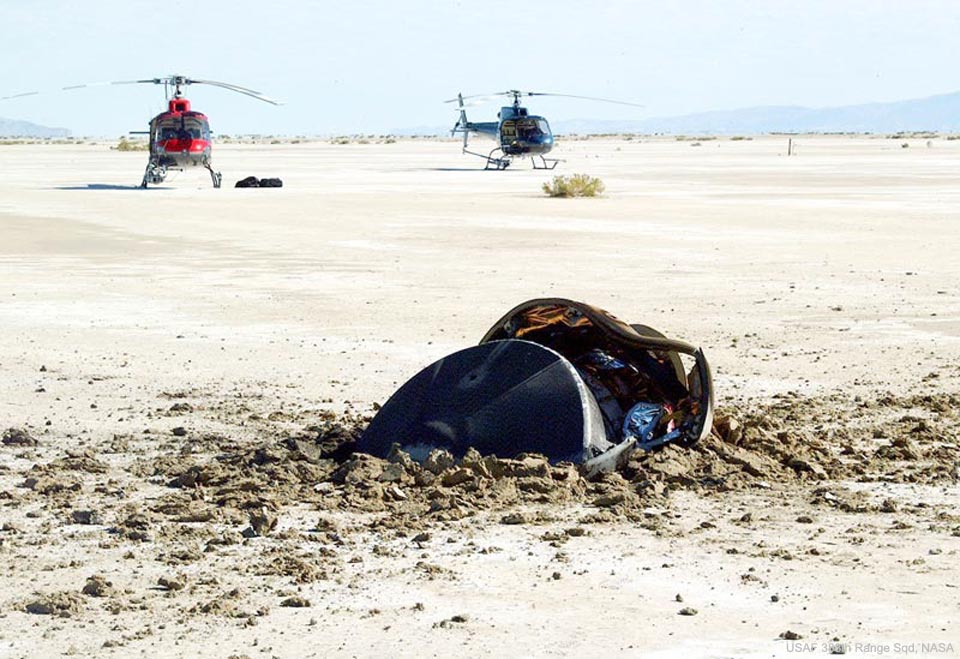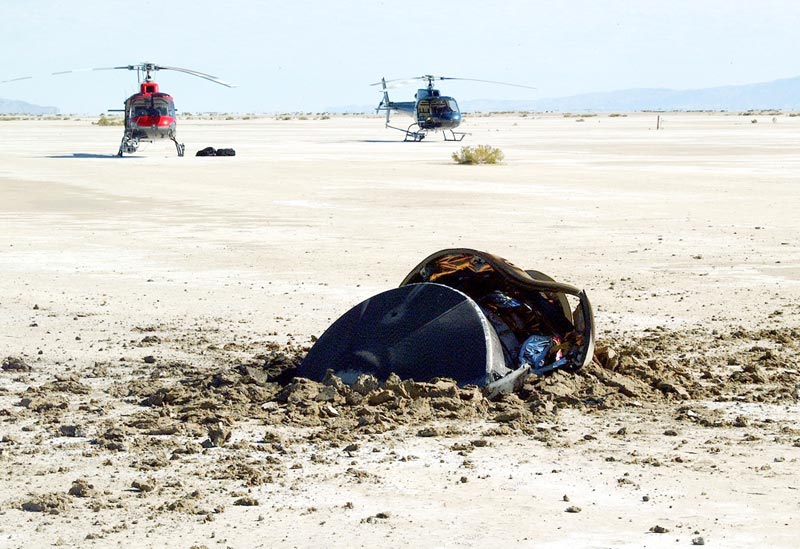
A flying saucer from outer space crash-landed in the Utah desert in 2004 after being tracked by radar and chased by helicopters. No space aliens were involved, however. The saucer, pictured above, was the Genesis sample return capsule, part of a human-made robot Genesis spaceship launched in 2001 by NASA itself to study the Sun. The unexpectedly hard landing at over 300 kilometers per hour occurred because the parachutes did not open as planned. The Genesis mission had been orbiting the Sun collecting solar wind particles that are usually deflected away by Earth's magnetic field. Despite the crash landing, many return samples remained in good enough condition to analyze and research is ongoing. So far, discoveries include new details about the composition of the Sun and the effects of the solar wind on unprotected material.
Un platillo volante proveniente del espacio exterior aterrizó en el desierto de Utah en 2004 después de ser rastreado por radar y perseguido por helicópteros. Sin embargo, no estaban involucrados extraterrestres. El platillo, mostrado en la imagen, era la cápsula de retorno de muestras Genesis, parte de una nave espacial robótica fabricada por el hombre, Genesis, lanzada por NASA en 2001 para estudiar al Sol. El aterrizaje inesperadamente duro, a más de 300 kilómetros por hora, ocurrió porque los paracaídas no se abrieron como se planeaba. La misión Genesis había estado orbitando al Sol recolectando partículas del viento solar que normalmente son desviadas por el campo magnético terrestre. A pesar del aterrizaje accidentado, muchas muestras de retorno permanecieron en condiciones suficientemente buenas para analizar, y la investigación continúa. Hasta ahora, los descubrimientos incluyen nuevos detalles sobre la composición del Sol y los efectos del viento solar sobre materiales no protegidos.