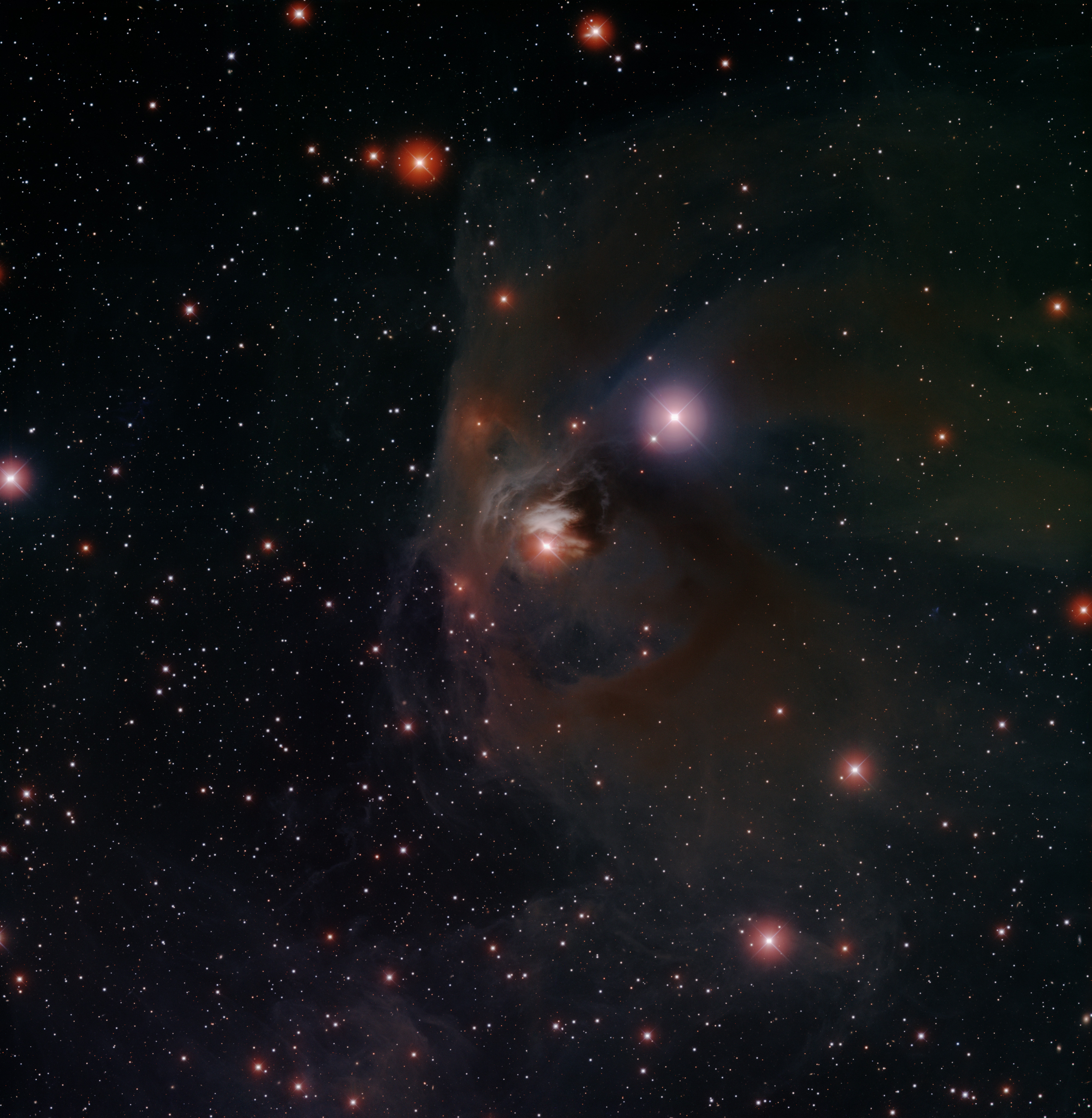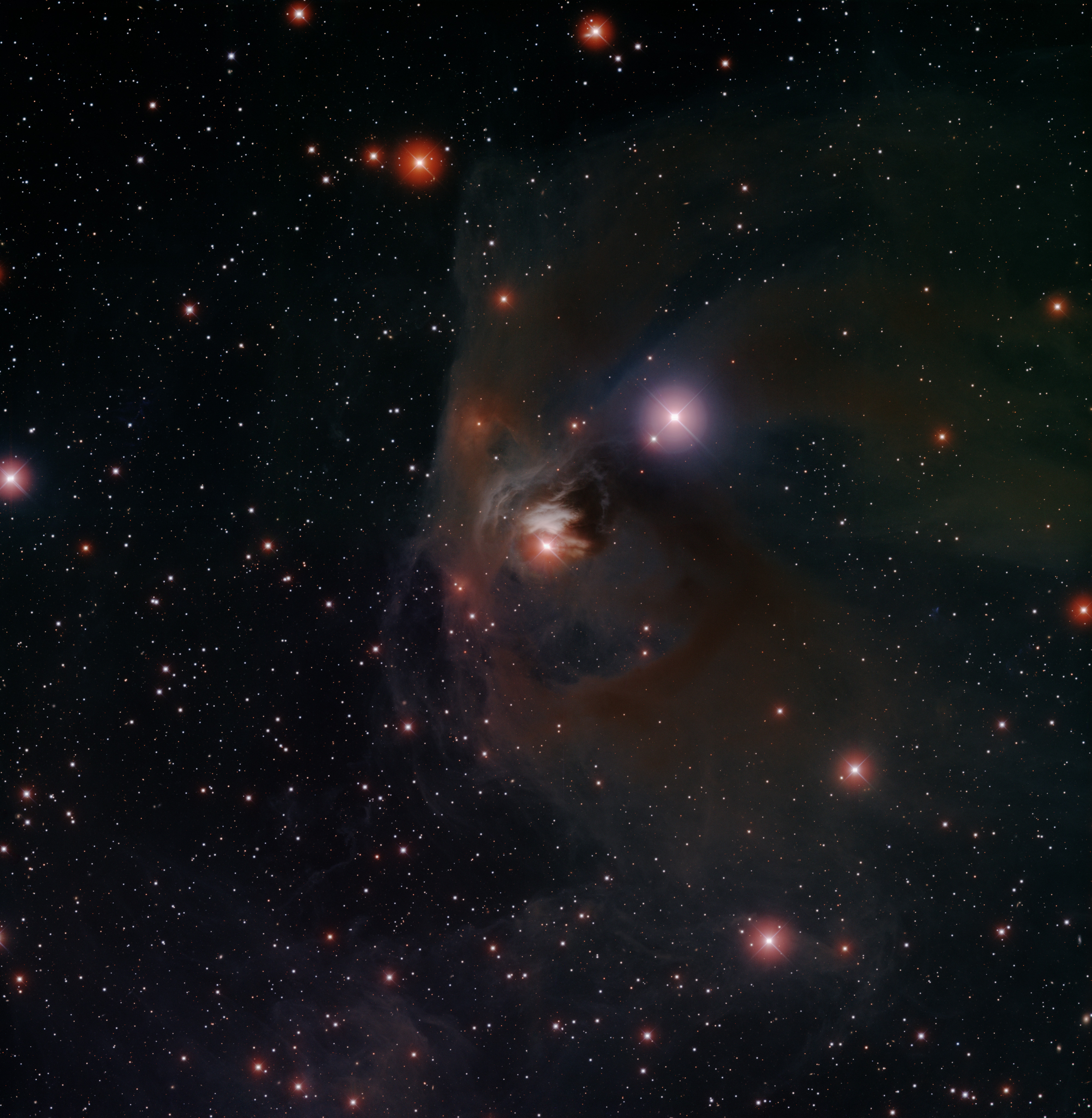
What does a star look like when it is forming? The prototypical example is the variable star T Tauri, visible as the bright orange star near the image center. The orange star centered in this remarkable telescopic skyview is T Tauri, prototype of the class of T Tauri variable stars. Surrounding T Tauri is a dusty yellow cosmic cloud named the Hind's Variable Nebula (NGC 1555/1554). Over 400 light-years away, at the edge of a molecular cloud, both star and nebula are seen to vary significantly in brightness but not necessarily at the same time, adding to the mystery of the intriguing region. T Tauri stars are now generally recognized as young -- less than a few million years old -- sun-like stars still in the early stages of formation. To further complicate the picture, infrared observations indicate that T Tauri itself is part of a multiple star system. Surprisingly, due to a close gravitational pass near one of these stars, T Tauri may now be headed out of the system. The dramatic color image above captures a region that spans about 4 light-years.
¿Cómo se ve una estrella cuando está en formación? El ejemplo prototípico es la estrella variable T Tauri, visible como la estrella naranja brillante cerca del centro de la imagen. La estrella naranja centrada en esta asombrosa vista telescópica del cielo es T Tauri, prototipo de la clase de estrellas variables T Tauri. Alrededor de T Tauri se encuentra una nube cósmica amarilla y polvorienta llamada la Nebulosa Variable de Hind (NGC 1555/1554). A más de 400 años luz de distancia, en el borde de una nube molecular, tanto la estrella como la nebulosa se ven variar significativamente en brillo, pero no necesariamente al mismo tiempo, lo que añade misterio a esta región intrigante. Las estrellas T Tauri se reconocen ahora generalmente como jóvenes —menos de unos pocos millones de años— estrellas similares al Sol aún en las primeras etapas de formación. Para complicar aún más la imagen, observaciones en el infrarrojo indican que T Tauri en sí misma forma parte de un sistema de múltiples estrellas. Sorprendentemente, debido a un paso gravitacional cercano cerca de una de estas estrellas, T Tauri podría ahora estar saliendo del sistema. La dramática imagen en color captura una región que abarca aproximadamente 4 años luz.