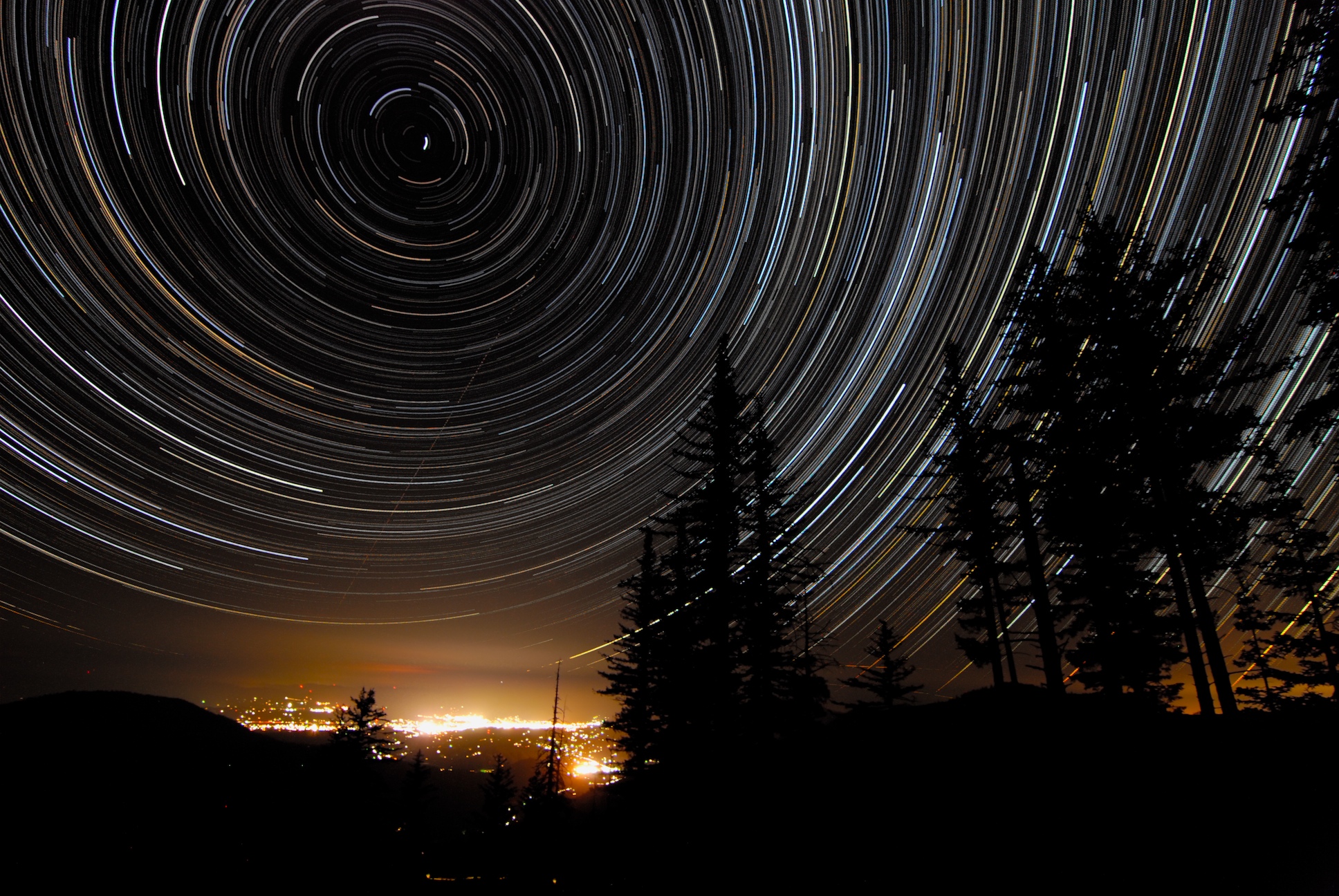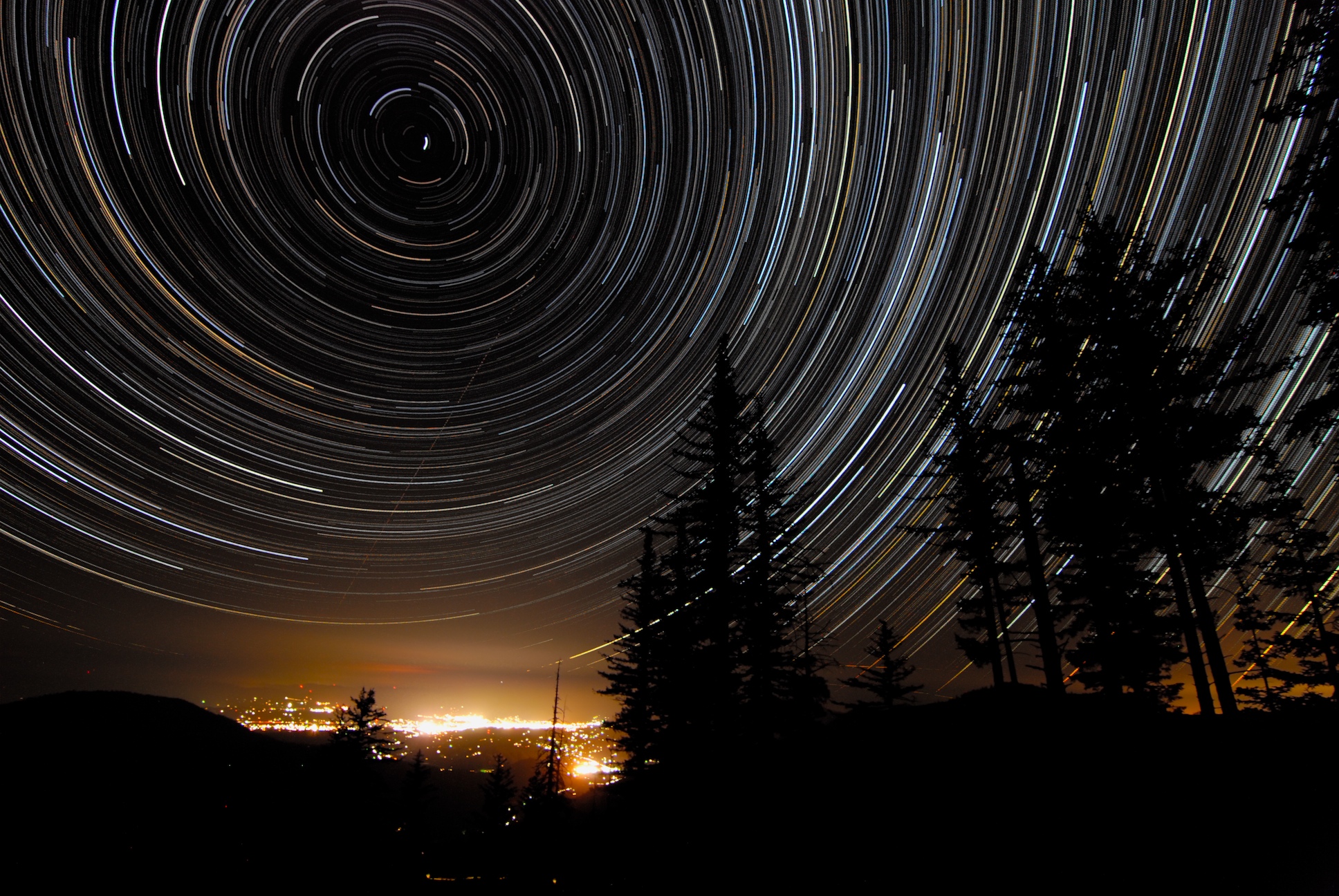
As the Earth spins on its axis, the sky seems to rotate around us. This motion, called diurnal motion, produces the beautiful concentric trails traced by stars during time exposures. Partial-circle star trails are pictured above over Grants Pass, Oregon, USA last month. Near the middle of the circles is the North Celestial Pole (NCP), easily identified as the point in the sky at the center of all the star trail arcs. The star Polaris, commonly known as the North Star, made the very short bright circle near the NCP. About 12,000 years ago, the bright star Vega was the North Star, and in about 14,000 years, as the Earth's spin axis slowly continues to precess, Vega will become the North Star again.
A medida que la Tierra gira sobre su eje, el cielo parece girar a nuestro alrededor. Este movimiento, llamado movimiento diurno, produce las hermosas trayectorias concéntricas trazadas por las estrellas durante exposiciones prolongadas. En la imagen de arriba, captada el mes pasado sobre Grants Pass, Oregón, EE. UU., se ven rastros parciales de estrellas en forma de círculo. En el centro aproximado de los círculos se encuentra el Polo Celeste Norte (PCN), fácilmente identificable como el punto del cielo alrededor del cual giran todas las trayectorias estelares. La estrella Polaris, comúnmente conocida como la Estrella del Norte, trazó un círculo muy corto y brillante cerca del PCN. Hace aproximadamente 12 000 años, la brillante estrella Vega era la Estrella del Norte, y en unos 14 000 años, a medida que el eje de rotación de la Tierra continúa precesando lentamente, Vega volverá a ser la Estrella del Norte.