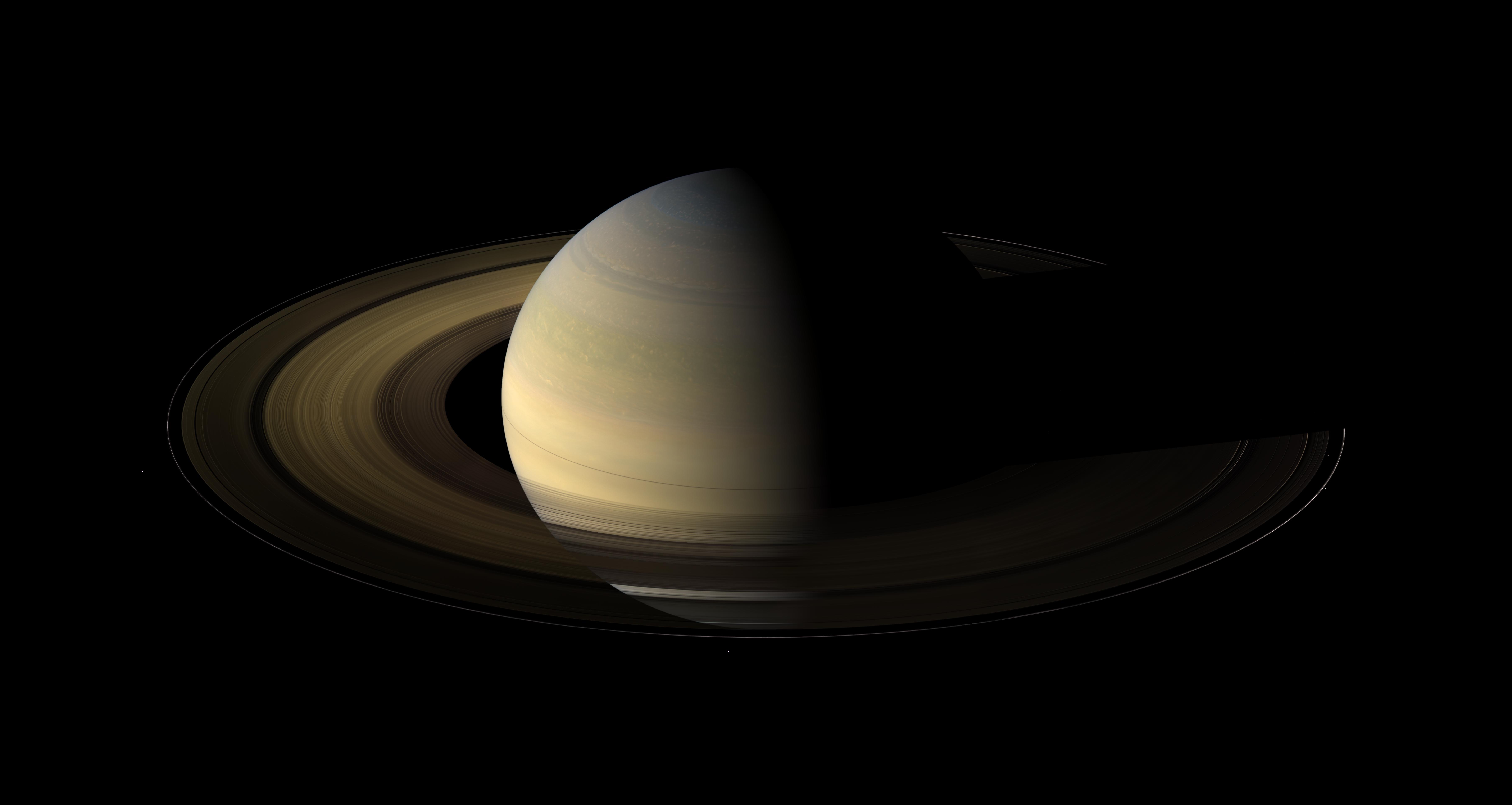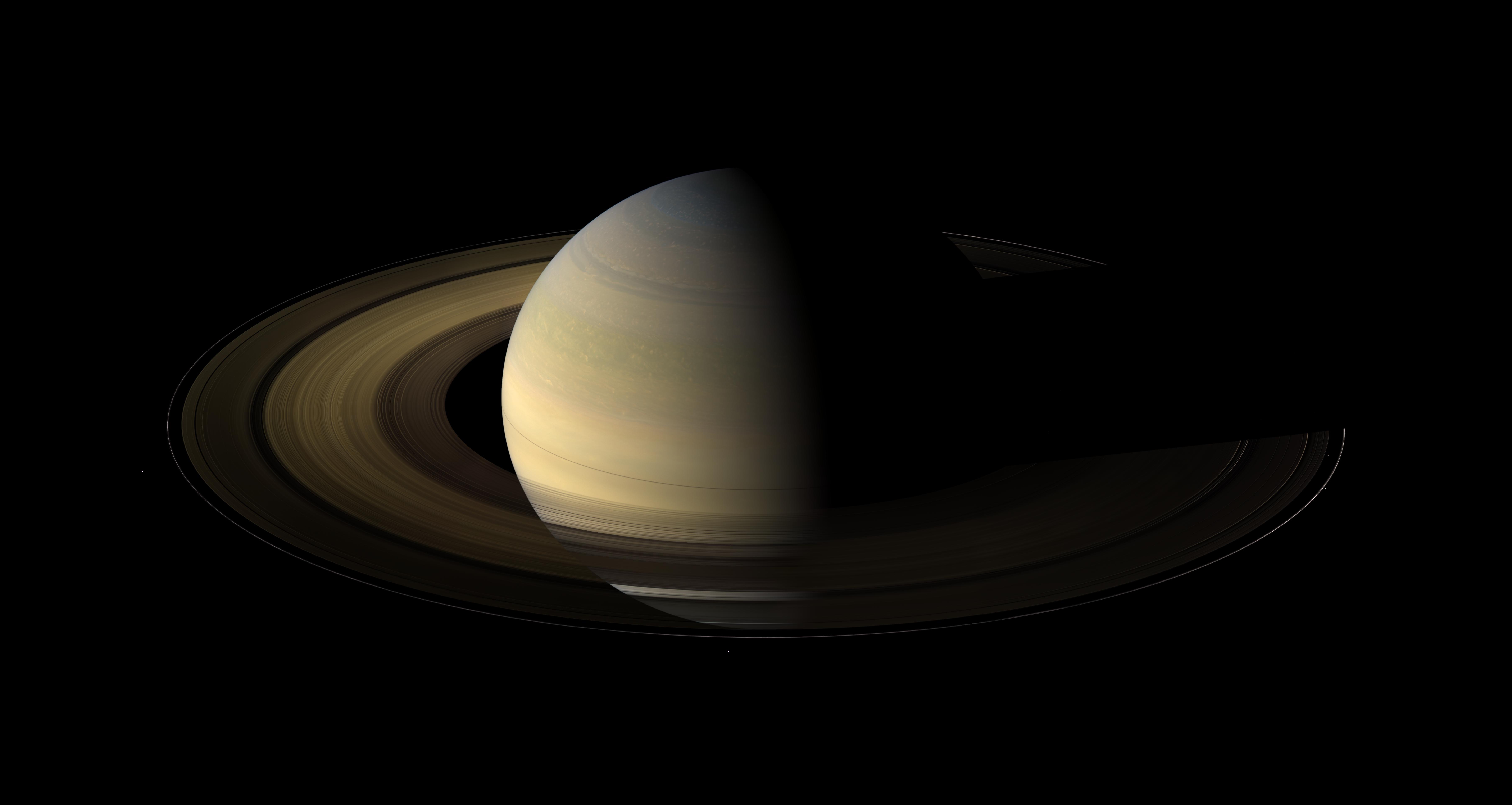
How would Saturn look if its ring plane pointed right at the Sun? Before last month, nobody knew. Every 15 years, as seen from Earth, Saturn's rings point toward the Earth and appear to disappear. The disappearing rings are no longer a mystery -- Saturn's rings are known to be so thin and the Earth is so near the Sun that when the rings point toward the Sun, they also point nearly edge-on at the Earth. Fortunately, in this third millennium, humanity is advanced enough to have a spacecraft that can see the rings during equinox from the side. Last month, that Saturn-orbiting spacecraft, Cassini, was able to snap a series of unprecedented pictures of Saturn's rings during equinox. A digital composite of 75 such images is shown above. The rings appear unusually dark, and a very thin ring shadow line can be made out on Saturn's cloud-tops. Objects sticking out of the ring plane are brightly illuminated and cast long shadows. Inspection of these images may help humanity understand the specific sizes of Saturn's ring particles and the general dynamics of orbital motion.
¿Cómo se vería Saturno si su plano de anillos apuntara directamente hacia el Sol? Antes del mes pasado, nadie lo sabía. Cada 15 años, visto desde la Tierra, los anillos de Saturno apuntan hacia la Tierra y parecen desaparecer. Los anillos desaparecidos ya no son un misterio: se sabe que los anillos de Saturno son extremadamente delgados y la Tierra está tan cerca del Sol que cuando los anillos apuntan hacia el Sol, también apuntan casi de perfil hacia la Tierra. Afortunadamente, en este tercer milenio, la humanidad ha avanzado lo suficiente como para tener una nave espacial que puede observar los anillos durante el equinoccio desde el lado. El mes pasado, esa nave espacial en órbita alrededor de Saturno, Cassini, pudo tomar una serie de imágenes sin precedentes de los anillos de Saturno durante el equinoccio. Se muestra una composición digital de 75 de esas imágenes. Los anillos aparecen inusualmente oscuros, y se puede distinguir una delgada línea de sombra de los anillos sobre las nubes de Saturno. Los objetos que sobresalen del plano de los anillos están brillantemente iluminados y proyectan sombras largas. La inspección de estas imágenes puede ayudar a la humanidad a comprender los tamaños específicos de las partículas de los anillos de Saturno y la dinámica general del movimiento orbital.