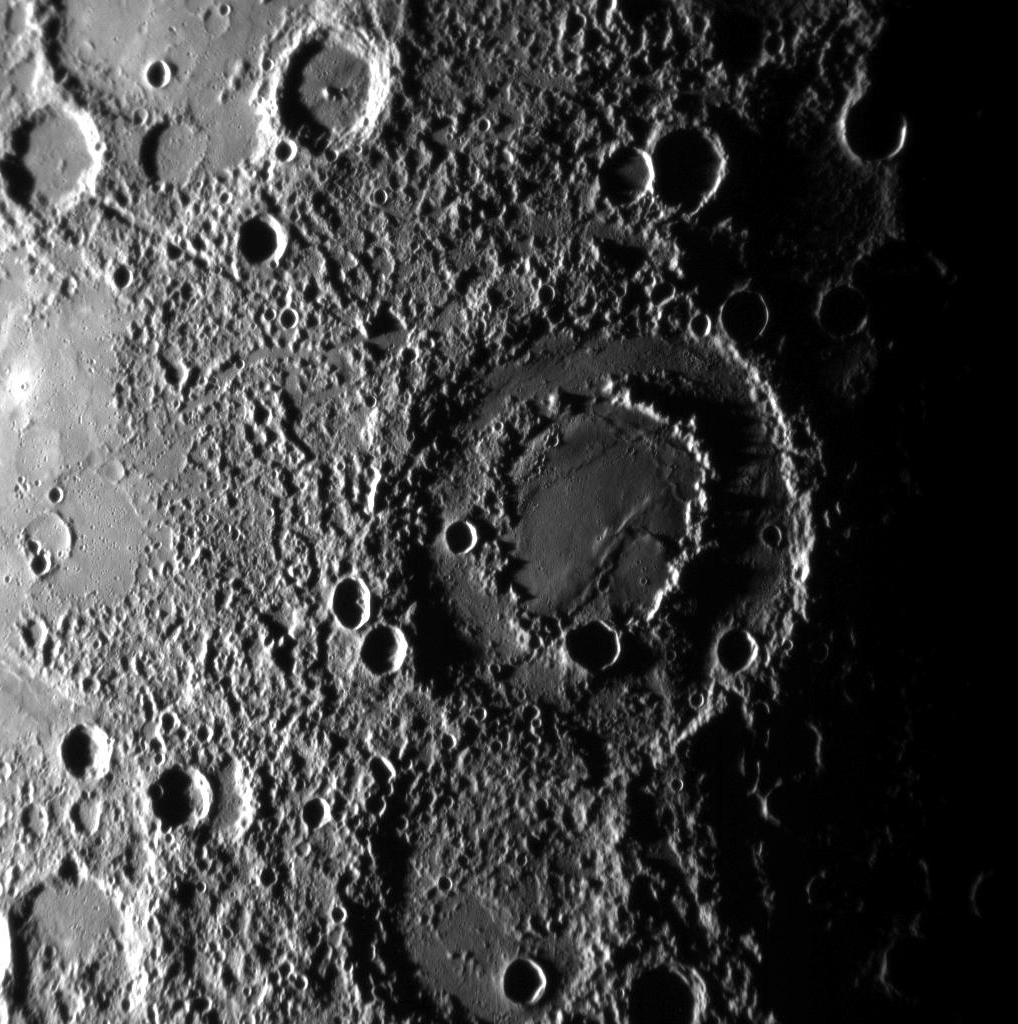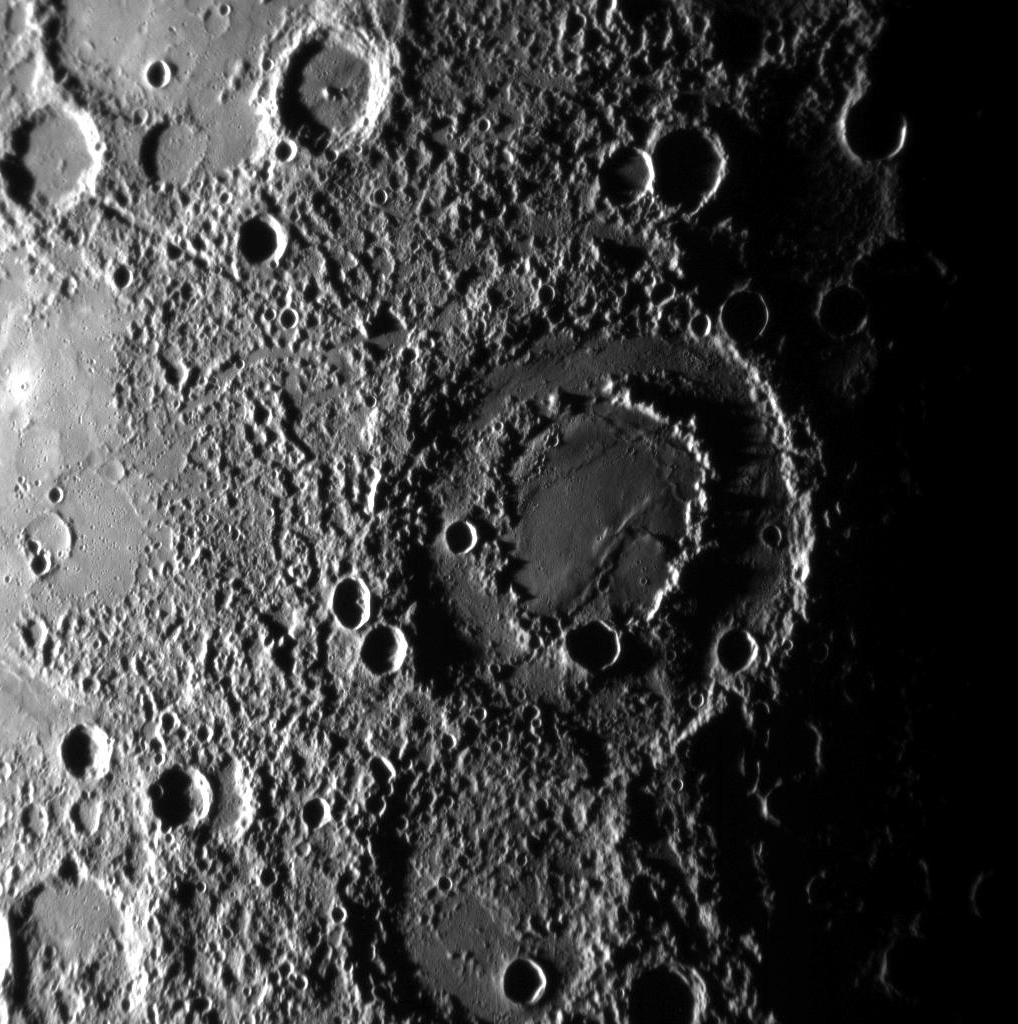
What caused the smooth floor inside the double ringed basin on Mercury? No one is sure. The unusual feature spans 160 kilometers and was imaged during the robotic MESSENGER spacecraft's swing past our Solar System's innermost planet last week. Double and multiple ringed basins, although rare, have also been imaged in years past on Mars, Venus, Earth, and Earth's Moon. Mercury itself has several doubles, including huge Caloris basin, Rembrandt basin, and enigmatic Raditladi basin. Most large multiple ringed basins on planets and moons are caused initially by a forceful impact by a single asteroid or comet fragment. One interesting feature of the above-imaged double ring is that the basin center appears much smoother than the region between the rings. Possibly, the internal floor was smoothed by later volcanic activity. Also possible, however, is that the floor was smoothed by melting and flowing of material upon impact. MESSENGER has now completed its last flyby of Mercury but will return and attempt to enter orbit in 2011 March. Note: The text of this APOD has been updated.
¿Qué causó el suelo liso dentro del cuenco doblemente anillado en Mercurio? Nadie está seguro. Esta característica inusual abarca 160 kilómetros y fue fotografiada durante el sobrevuelo del robot MESSENGER por el planeta más interno de nuestro Sistema Solar la semana pasada. Los cuencos doblemente anillados, aunque raros, también han sido fotografiados en años anteriores en Marte, Venus, la Tierra y la Luna de la Tierra. Mercurio mismo tiene varios dobles, incluyendo el enorme cuenco Caloris, el cuenco Rembrandt y el enigmático cuenco Raditladi. La mayoría de los grandes cuencos anillados múltiples en planetas y lunas son causados inicialmente por un impacto fuerte de un solo fragmento de asteroide o cometa. Una característica interesante del anillo doble mostrado arriba es que el centro del cuenco parece mucho más liso que la región entre los anillos. Posiblemente, el suelo interno fue aplanado por la actividad volcánica posterior. También es posible, sin embargo, que el suelo haya sido aplanado por el derretimiento y el flujo de material al momento del impacto. MESSENGER ha completado ahora su último sobrevuelo de Mercurio, pero regresará y tratará de entrar en órbita en marzo de 2011.