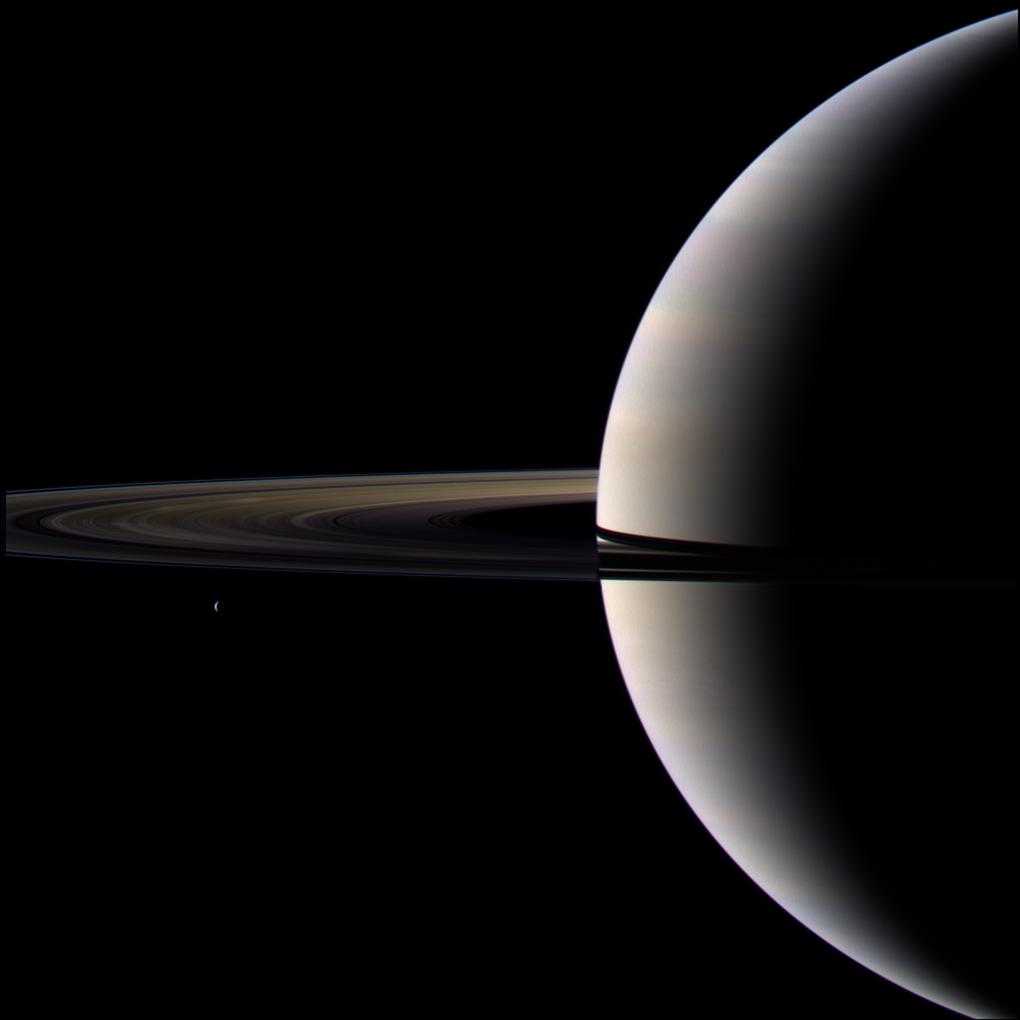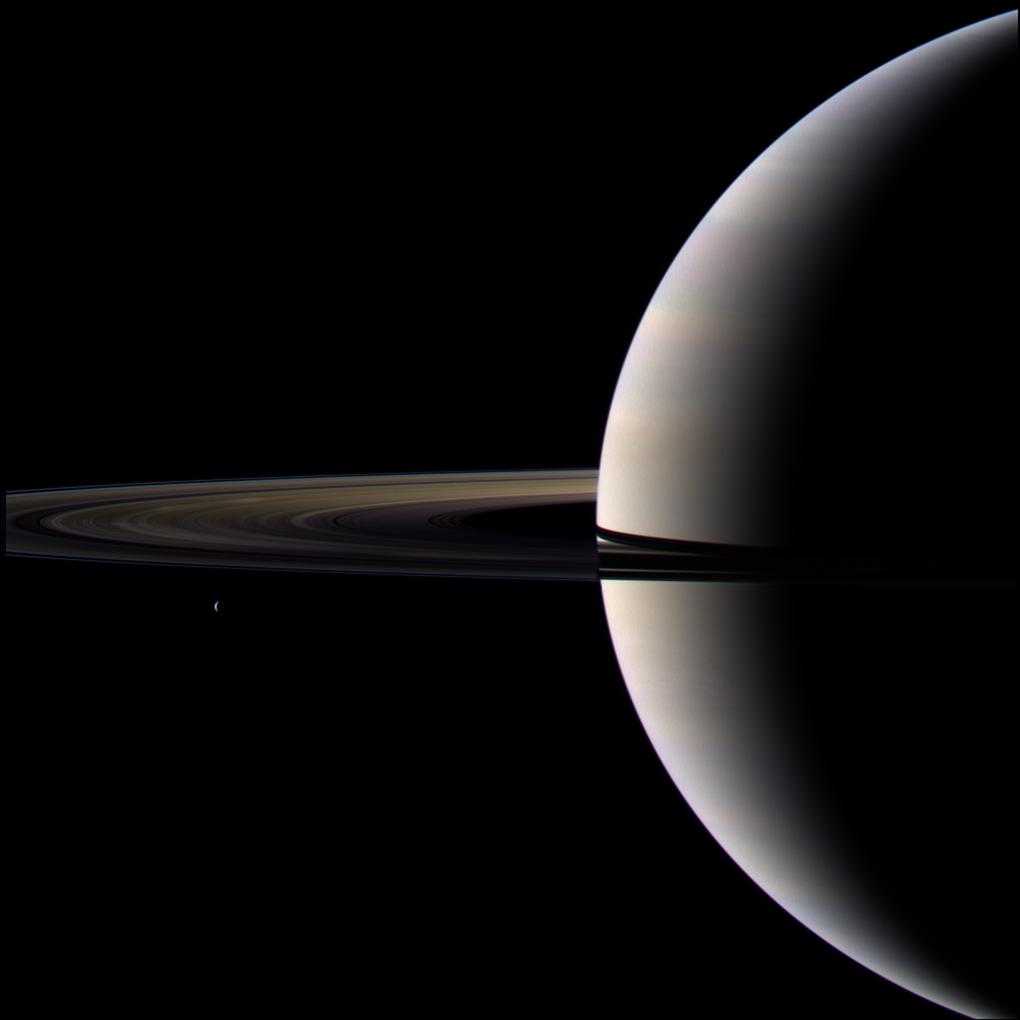
The other side of Saturn's ring plane is now directly illuminated by the Sun. For the previous 15 years, the southern side of Saturn and its rings were directly illuminated, but since Saturn's equinox in August, the orientation has reversed. Pictured above last month, the robotic Cassini spacecraft orbiting Saturn has captured the giant planet and its majestic rings soon after equinox. Imaged from nearly behind, Saturn and its moon Tethys each show a crescent phase to Cassini that is not visible from Earth. As the rings continue to point nearly toward the Sun, only a thin shadow of Saturn's rings is visible across the center of the planet. Close inspection of Saturn's rings, however, shows superposed bright features identified as spokes that are thought to be groups of very small electrically charged ice particles. Understanding the nature and dynamics of spokes is not fully understood and remains a topic of research.
El otro lado del plano de los anillos de Saturno ahora está directamente iluminado por el Sol. Durante los 15 años anteriores, el lado sur de Saturno y sus anillos estaban directamente iluminados, pero desde el equinoccio de Saturno en agosto, la orientación se ha invertido. Capturado la semana pasada, la nave espacial robótica Cassini que orbita Saturno ha fotografiado al gigantesco planeta y sus majestuosos anillos poco después del equinoccio. Vistos desde casi detrás, Saturno y su luna Tethys muestran una fase creciente para Cassini que no es visible desde la Tierra. A medida que los anillos continúan apuntando casi directamente hacia el Sol, solo se ve una sombra delgada de los anillos de Saturno sobre el centro del planeta. Una inspección más cercana de los anillos de Saturno, sin embargo, muestra características brillantes superpuestas identificadas como 'spokes' (rayos), que se cree que son grupos de partículas de hielo muy pequeñas y cargadas eléctricamente. Comprender la naturaleza y dinámica de los 'spokes' no está completamente comprendida y sigue siendo un tema de investigación.