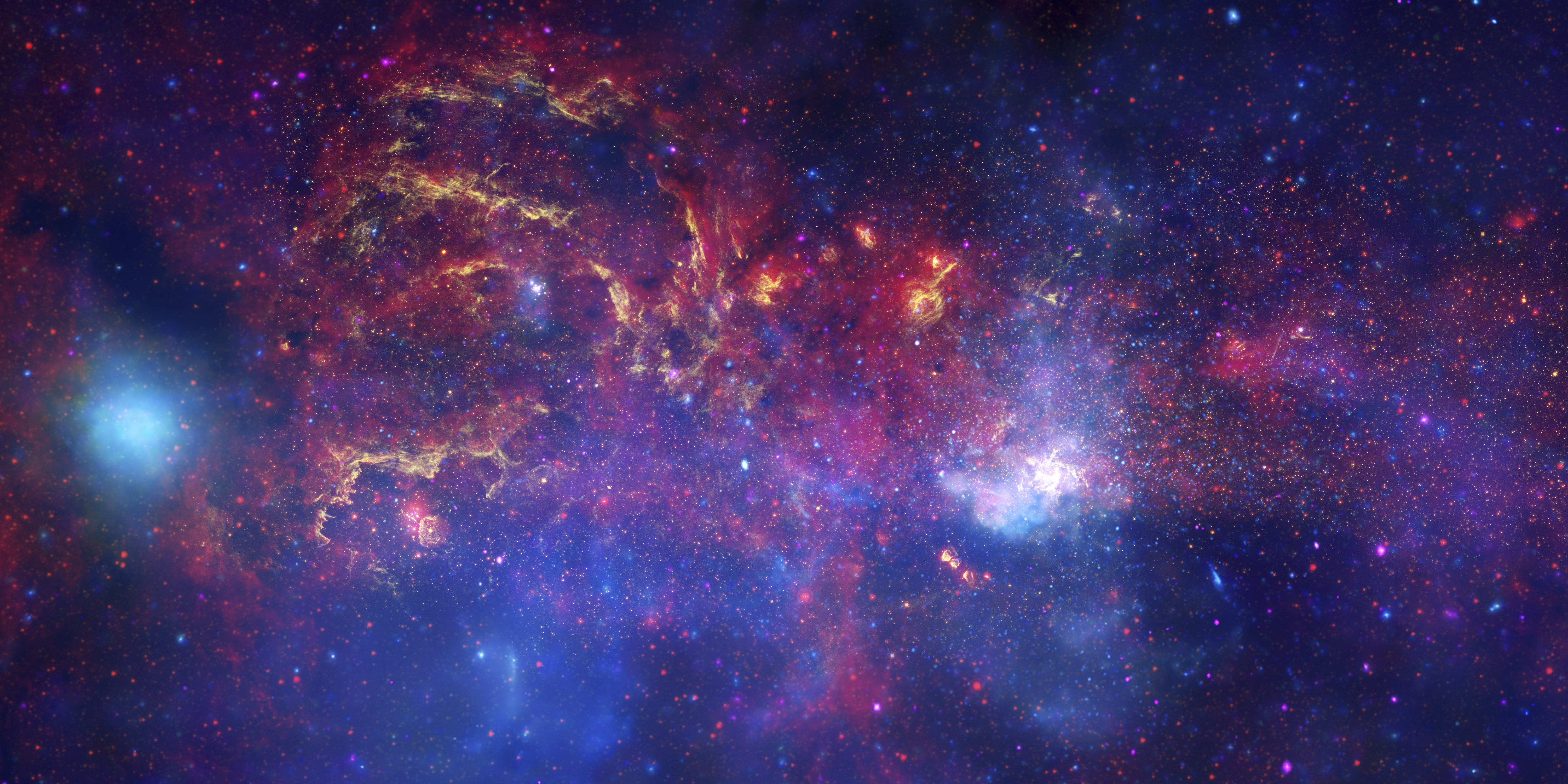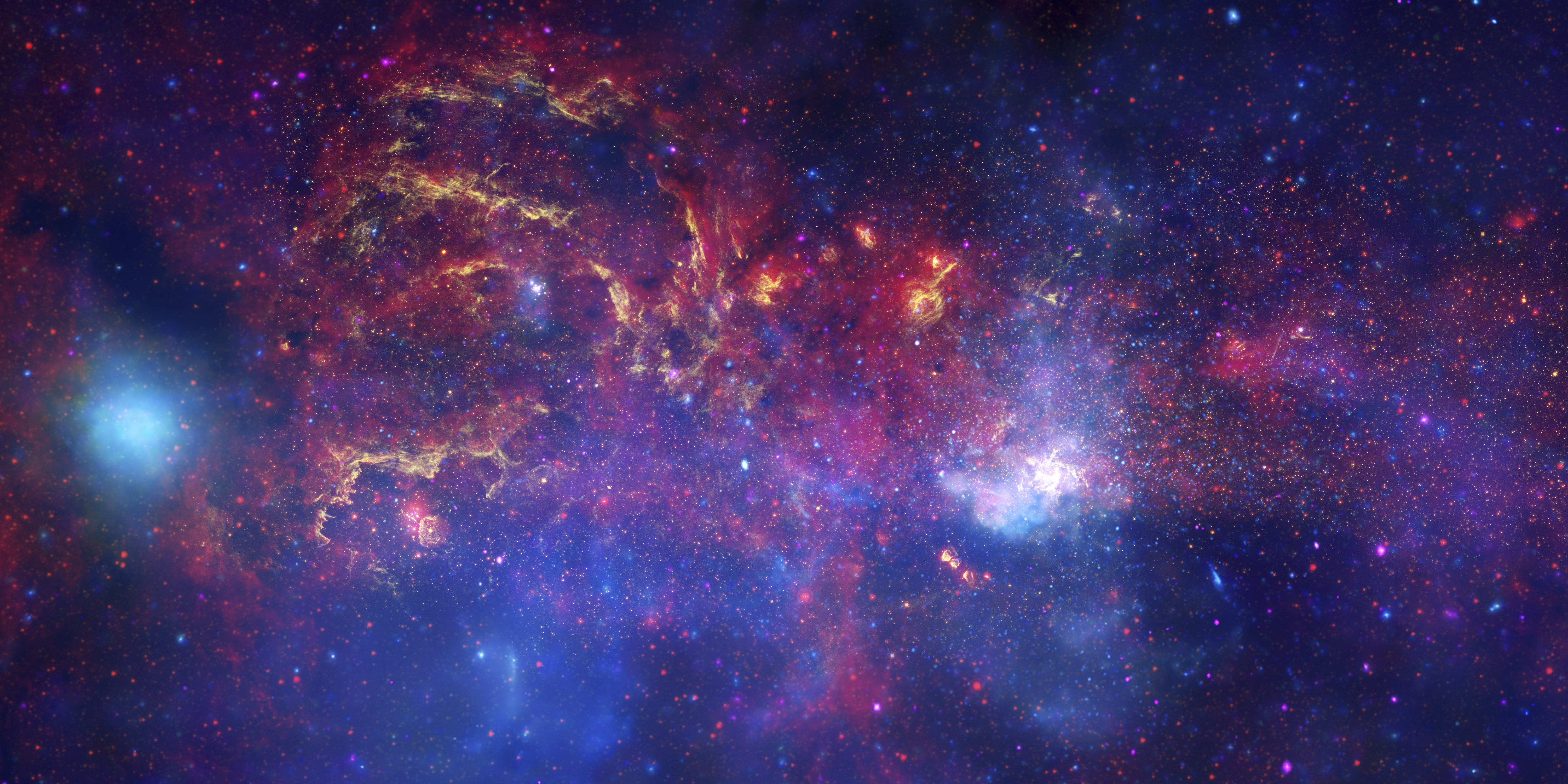
Where can a telescope take you? Four hundred years ago, a telescope took Galileo to the Moon to discover craters, to Saturn to discover rings, to Jupiter to discover moons, to Venus to discover phases, and to the Sun to discover spots. Today, in celebration of Galileo's telescopic achievements and as part of the International Year of Astronomy, NASA has used its entire fleet of Great Observatories, and the Internet, to bring the center of our Galaxy to you. Pictured above, in greater detail and in more colors than ever seen before, are the combined images of the Hubble Space Telescope in near-infrared light, the Spitzer Space Telescope in infrared light, and the Chandra X-ray Observatory in X-ray light. A menagerie of vast star fields is visible, along with dense star clusters, long filaments of gas and dust, expanding supernova remnants, and the energetic surroundings of what likely is our Galaxy's central black hole. Many of these features are labeled on a complementary annotated image. Of course, a telescope's magnification and light-gathering ability create only an image of what a human could see if visiting these places. To actually go requires rockets.
¿A dónde puede llevarte un telescopio? Hace cuatrocientos años, un telescopio llevó a Galileo a la Luna para descubrir cráteres, a Saturno para descubrir anillos, a Júpiter para descubrir lunas, a Venus para descubrir fases, y al Sol para descubrir manchas. Hoy, en celebración de los logros telescópicos de Galileo y como parte del Año Internacional de la Astronomía, NASA ha utilizado toda su flota de Grandes Observatorios, junto con Internet, para traer el centro de nuestra Galaxia hasta ti. En la imagen superior, con mayor detalle y en más colores de los nunca vistos antes, se muestran las imágenes combinadas del Telescopio Espacial Hubble en luz infrarroja cercana, del Telescopio Espacial Spitzer en luz infrarroja, y del Observatorio de Rayos X Chandra en luz de rayos X. Se ven campos estelares vastos, junto con densos cúmulos estelares, largos filamentos de gas y polvo, restos en expansión de supernovas, y los alrededores energéticos de lo que probablemente sea el agujero negro central de nuestra Galaxia. Muchas de estas características están etiquetadas en una imagen complementaria anotada. Por supuesto, la magnificación y la capacidad de recogida de luz de un telescopio crean solo una imagen de lo que un ser humano podría ver si visitara estos lugares. Para realmente ir allí se necesitan cohetes.