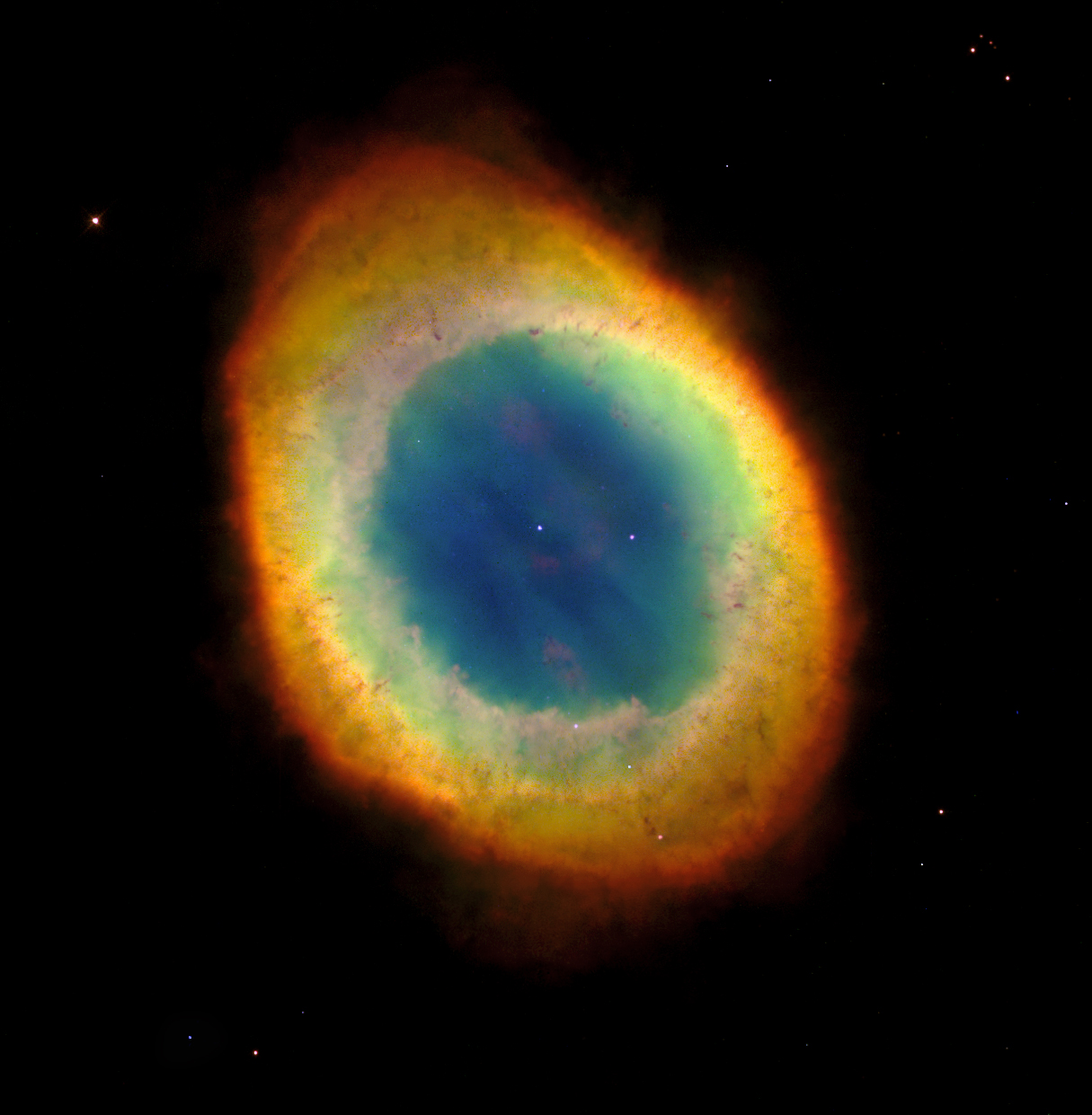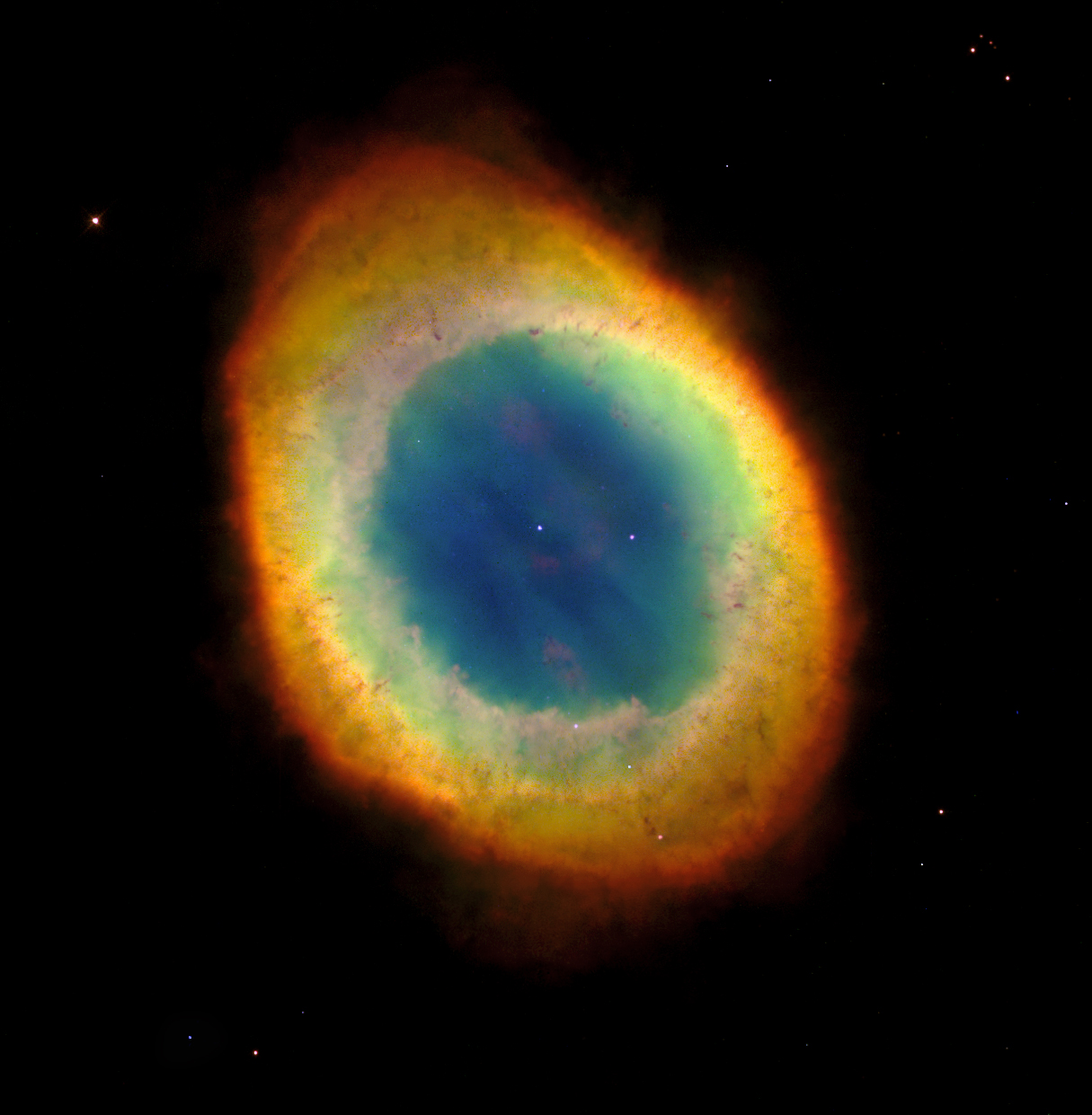
It looks like a ring on the sky. Hundreds of years ago astronomers noticed a nebula with a most unusual shape. Now known as M57 or NGC 6720, the gas cloud became popularly known as the Ring Nebula. It is now known to be a planetary nebula, a gas cloud emitted at the end of a Sun-like star's existence. As one of the brightest planetary nebula on the sky, the Ring Nebula can be seen with a small telescope in the constellation of Lyra. The Ring Nebula lies about 4,000 light years away, and is roughly 500 times the diameter of our Solar System. In this picture by the Hubble Space Telescope in 1998, dust filaments and globules are visible far from the central star. This helps indicate that the Ring Nebula is not spherical, but cylindrical.
Se parece a un anillo en el cielo. Hace cientos de años, los astrónomos notaron una nebulosa con una forma muy inusual. Ahora conocida como M57 o NGC 6720, la nube de gas se convirtió en popularmente conocida como la Nebulosa Anular. Se sabe ahora que es una nebulosa planetaria, una nube de gas expulsada al final de la existencia de una estrella similar al Sol. Como una de las nebulosas planetarias más brillantes del cielo, la Nebulosa Anular puede verse con un telescopio pequeño en la constelación de Lyra. La Nebulosa Anular se encuentra a unos 4000 años luz de distancia, y tiene aproximadamente 500 veces el diámetro de nuestro Sistema Solar. En esta imagen tomada por el Telescopio Espacial Hubble en 1998, se ven filamentos y globulos de polvo lejos de la estrella central. Esto ayuda a indicar que la Nebulosa Anular no es esférica, sino cilíndrica.