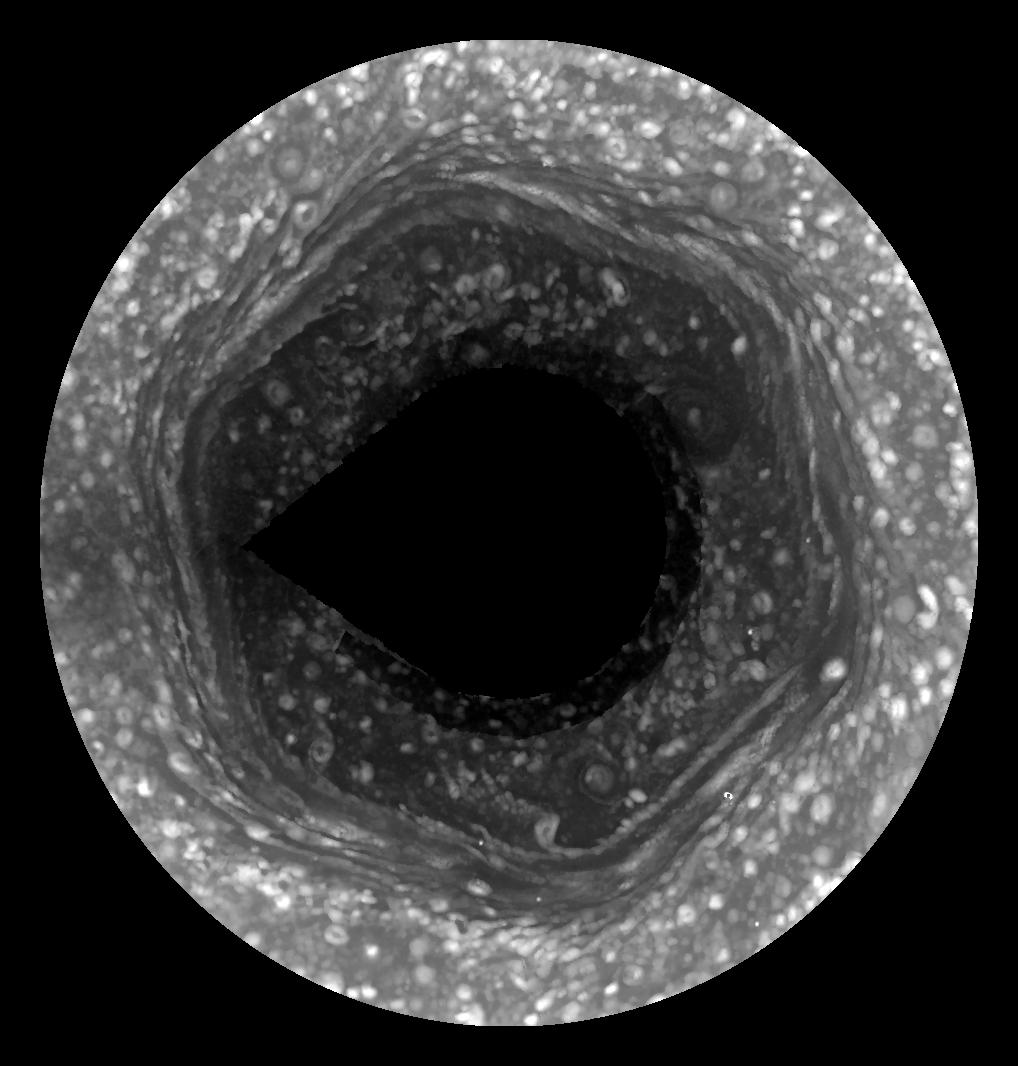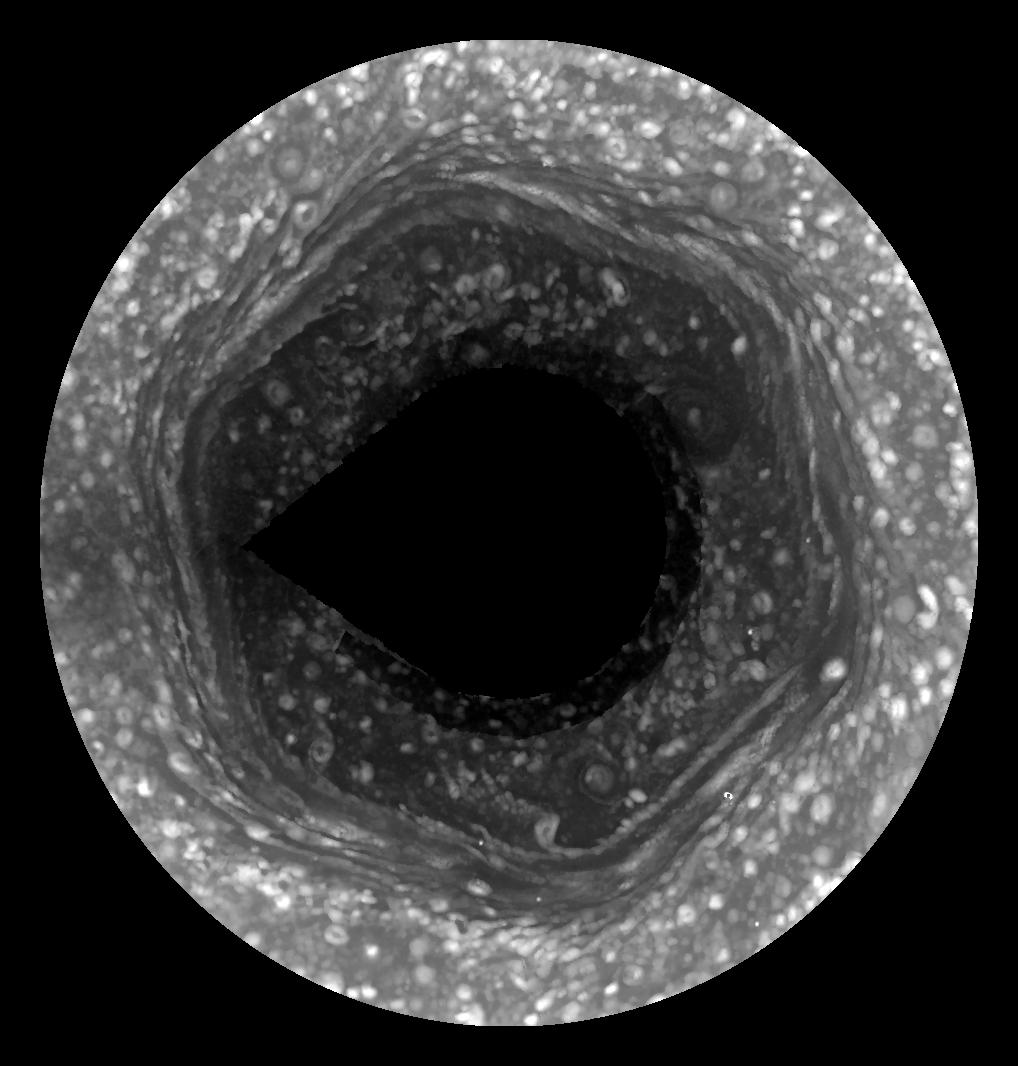
Believe it or not, this is the North Pole of Saturn. It is unclear how an unusual hexagonal cloud system that surrounds Saturn's north pole was created, keeps its shape, or how long it will last. Originally discovered during the Voyager flybys of Saturn in the 1980s, nobody has ever seen anything like it elsewhere in the Solar System. Although its infrared glow was visible previously to the Cassini spacecraft now orbiting Saturn, over the past year the mysterious hexagonal vortex became fully illuminated by sunlight for the first time during the Cassini's visit. Since then, Cassini has imaged the rotating hexagon in visible light enough times to create a time-lapse movie. The pole center was not well imaged and has been excluded. This movie shows many unexpected cloud motions, such as waves emanating from the corners of the hexagon. Planetary scientists are sure to continue to study this most unusual cloud formation for quite some time. New Mirror: APOD now available in Romanian from Romania
Crédito: NASA, ESA, JPL, y equipos de investigación de Cassini Aunque pueda parecer increíble, esta es la región polar norte de Saturno. Aún no se comprende cómo se formó un sistema inusual de nubes con forma hexagonal que rodea el polo norte de Saturno, cómo mantiene su forma ni cuánto tiempo durará. Originalmente descubierto durante los sobrevuelos de las sondas Voyager por Saturno en la década de 1980, nadie ha observado algo similar en otro lugar del Sistema Solar. Aunque su brillo en el infrarrojo ya era visible anteriormente por la nave Cassini, que ahora orbita Saturno, en los últimos doce meses el misterioso vórtice hexagonal fue iluminado completamente por primera vez por la luz solar durante la visita de Cassini. Desde entonces, Cassini ha capturado imágenes del hexágono rotante en luz visible con suficiente frecuencia como para crear una película de avance temporal. El centro del polo no fue bien capturado y ha sido excluido. Esta película muestra muchas movimientos inesperados de nubes, como ondas que emanan de las esquinas del hexágono. Los científicos planetarios seguramente continuarán estudiando esta formación de nubes tan inusual durante bastante tiempo.