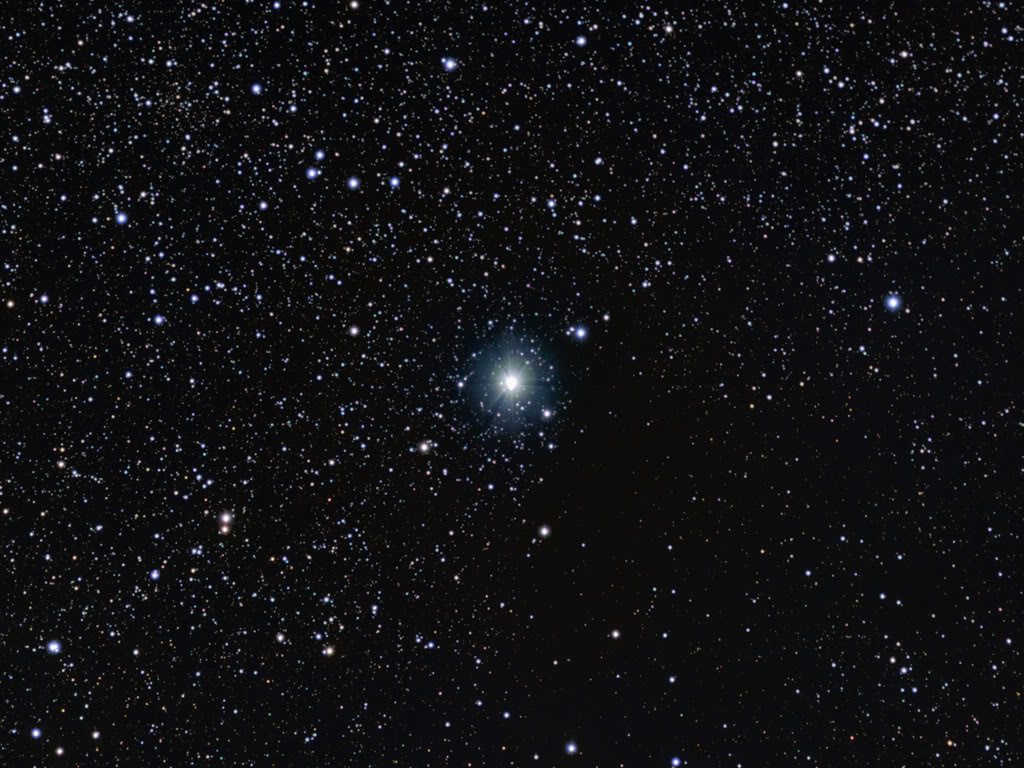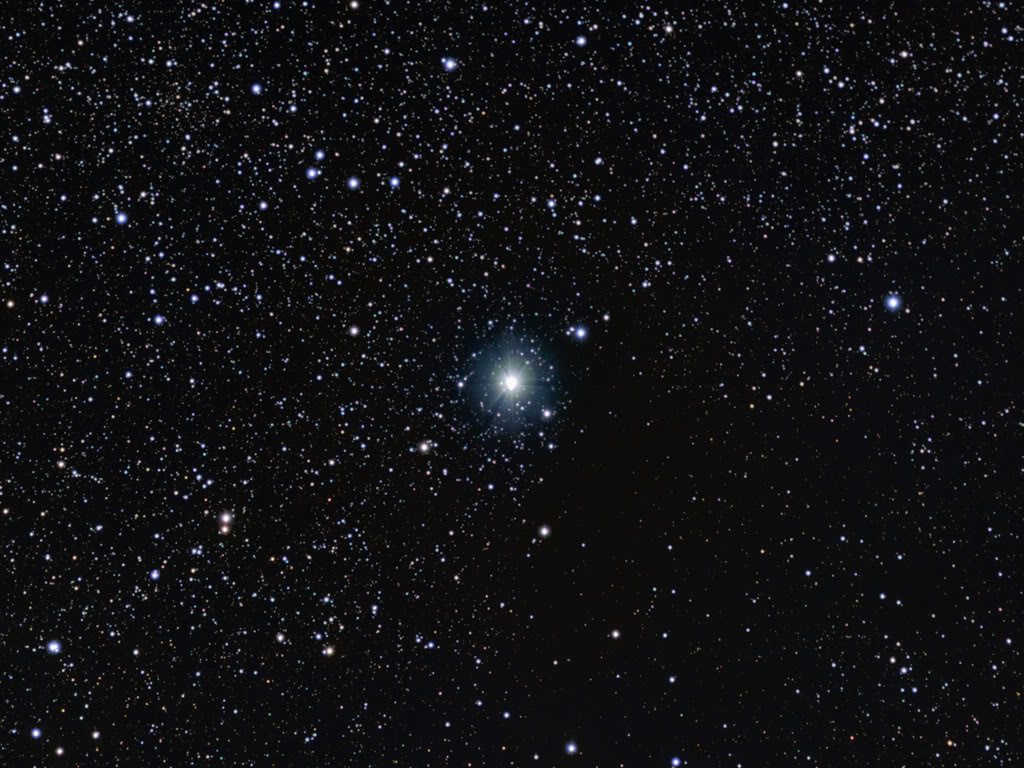
very 27 years Epsilon Aurigae fades, remaining dim for roughly two years before growing bright again. Since the 19th century, astronomers have studied the mystery star, eventually arguing that Epsilon Aur, centered in this telescopic skyview, was actually undergoing a long eclipse by a dark companion object. But the nature of the companion and even the state of bright star itself could not be pinned down by observations. Continuing to collect evidence, Citizen Sky, a team of professional and amateur astronomers, is studying the current eclipse of Epsilon Aur, reporting that it began in August 2009 and by late December had reached its deepest point. Epsilon Aur is now expected to remain dim for all of 2010, before rapidly regaining normal brightness in 2011. Meanwhile, recent infrared data from the Spitzer Space Telescope supports a model for the enigmatic system that identifies Epsilon Aur as a large but lower mass star near the end of its life, periodically eclipsed by a single star embedded in a dusty disk. The disk is estimated to have a radius of about 4 AU, or 4 times the Earth-Sun distance, and to be about 0.5 AU thick. Note: An APOD editor will review astronomy images of 2009, hosted by the Amateur Astronomers Association of New York tonight at the American Museum of Natural History, NYC.
Cada 27 años, Epsilon Aurigae se oscurece, permaneciendo tenue durante aproximadamente dos años antes de recuperar su brillo. Desde el siglo XIX, los astrónomos han estudiado el misterio de esta estrella, llegando finalmente a la conclusión de que Epsilon Aur, ubicada en el centro de esta imagen telescópica, estaba experimentando un eclipse prolongado por un objeto oscuro compañero. Sin embargo, la naturaleza del compañero y el estado mismo de la estrella brillante no podían ser determinados con las observaciones disponibles. Continuando la recolección de evidencia, Citizen Sky, un equipo de astrónomos profesionales y amateurs, está estudiando el actual eclipse de Epsilon Aur, reportando que comenzó en agosto de 2009 y, para finales de diciembre, había alcanzado su punto más profundo. Se espera que Epsilon Aur permanezca tenue durante todo el año 2010, recuperando rápidamente su brillo normal en 2011. Mientras tanto, los datos recientes en infrarrojos del Telescopio Espacial Spitzer respaldan un modelo para este sistema enigmático que identifica a Epsilon Aur como una estrella grande pero de menor masa, al final de su vida, eclipsada periódicamente por una única estrella incrustada en un disco polvoriento. Se estima que el disco tiene un radio de aproximadamente 4 UA, o cuatro veces la distancia Tierra-Sol, y que tiene un espesor de aproximadamente 0,5 UA.