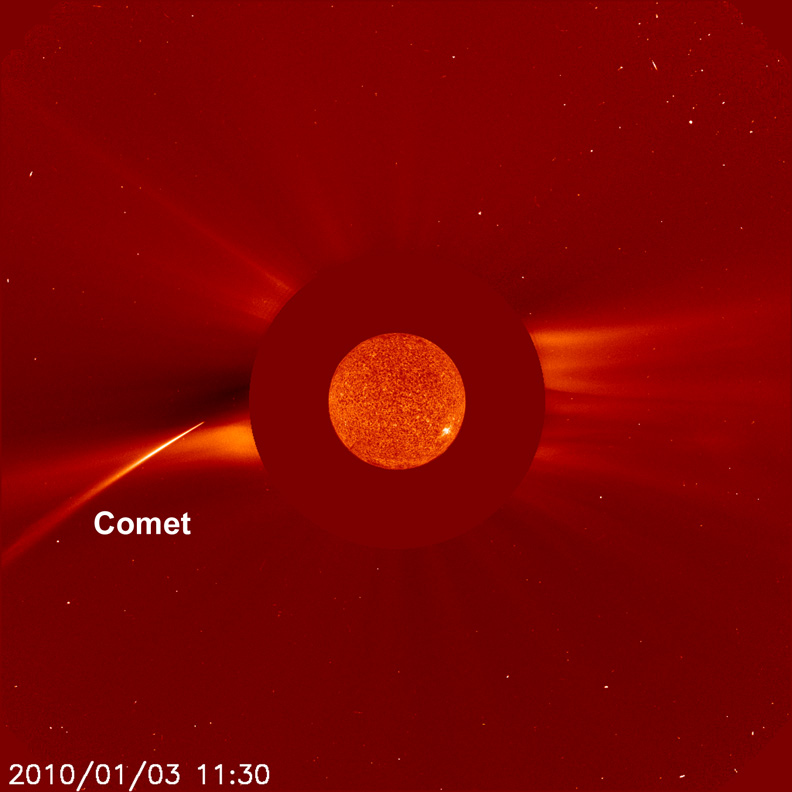
Intense and overwhelming, the direct glare of the Sun is blocked by the smooth occulting disk in this image from the sun-staring SOHO spacecraft. Taken on January 3rd, an extreme ultraviolet image of the Sun to scale, is superimposed at the center of the disk. Beyond the disk's outer boundary is a sungrazer comet, one of the brightest yet seen by SOHO. The comet was discovered (movie link) by Australian amateur astronomer Alan Watson, while examining earlier images from another sun-watching spacecraft, STEREO-A. Based on their orbits, sungrazers are believed to belong to the Kreutz family of comets, created by successive break ups from a single large parent comet that passed very near the Sun in the twelfth century. Subjected to strong tidal forces and intense solar heat, this sungrazer comet did not survive its close encounter.
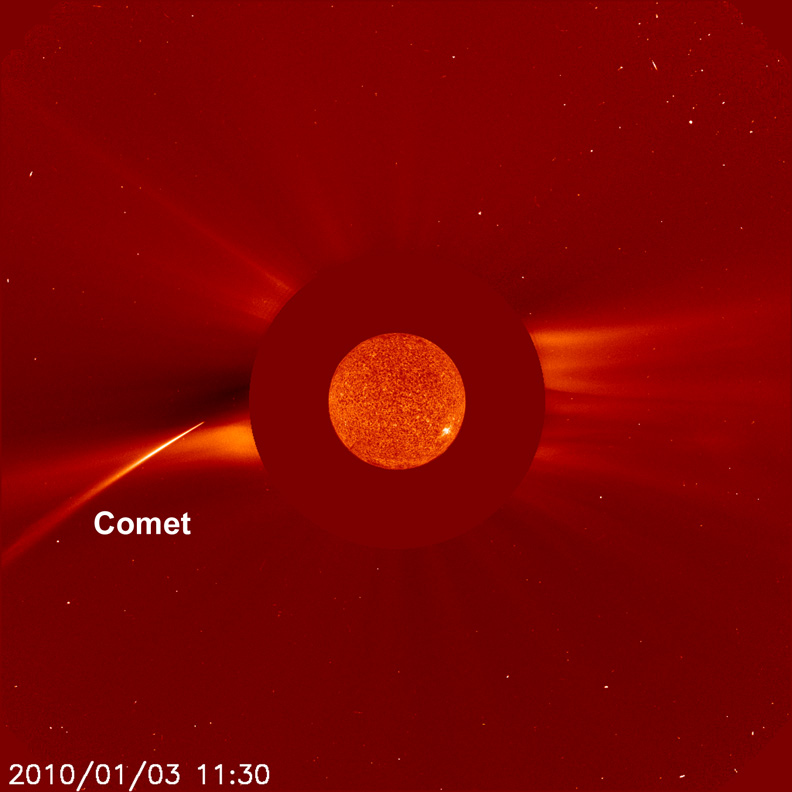
El resplandor intenso y abrumador del Sol está bloqueado por el disco de ocultación liso en esta imagen del satélite SOHO, que observa directamente al Sol. Tomada el 3 de enero, una imagen de ultravioleta extremo a escala del Sol está superpuesta en el centro del disco. Más allá del límite exterior del disco se encuentra un cometa sungrazer, uno de los más brillantes observados hasta ahora por SOHO. El cometa fue descubierto (enlace a video) por el astrónomo aficionado australiano Alan Watson, mientras examinaba imágenes anteriores de otro satélite que observa al Sol, STEREO-A. Según sus órbitas, los sungrazers se cree que pertenecen a la familia de cometas Kreutz, creada por sucesivas rupturas de un gran cometa progenitor que pasó muy cerca del Sol en el siglo XII. Sometido a fuertes fuerzas de marea y al calor intenso del Sol, este cometa sungrazer no sobrevivió a su cercana aproximación.