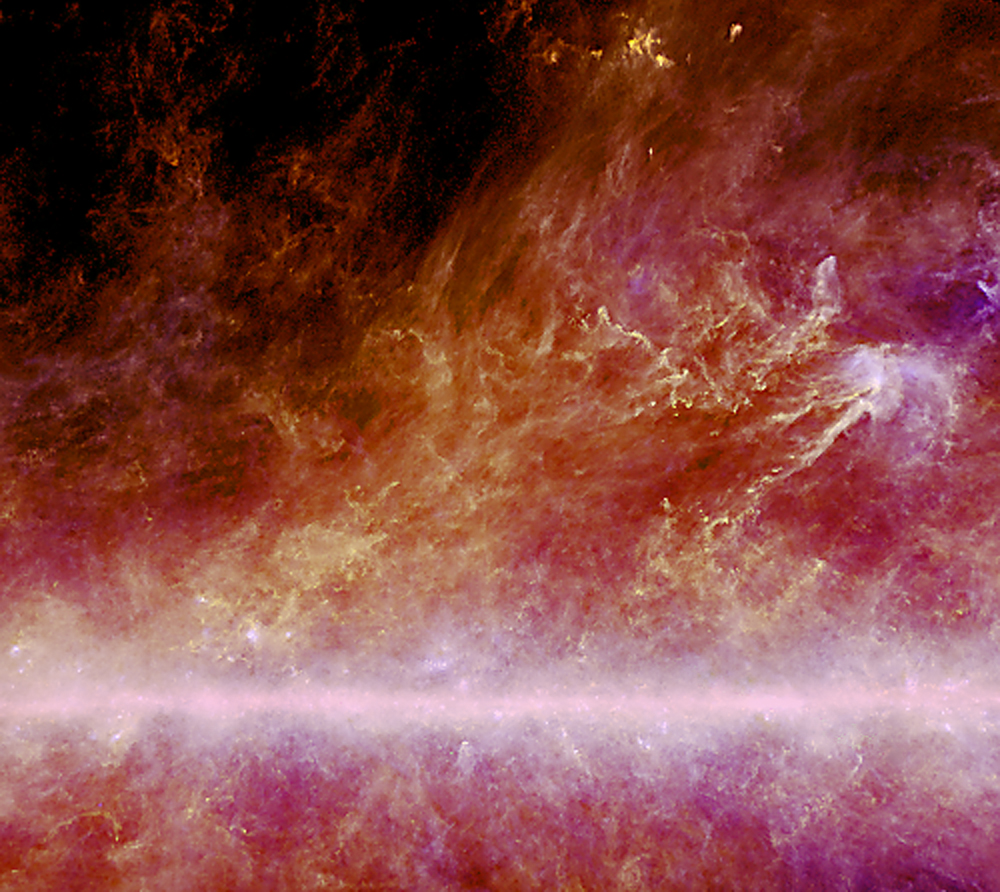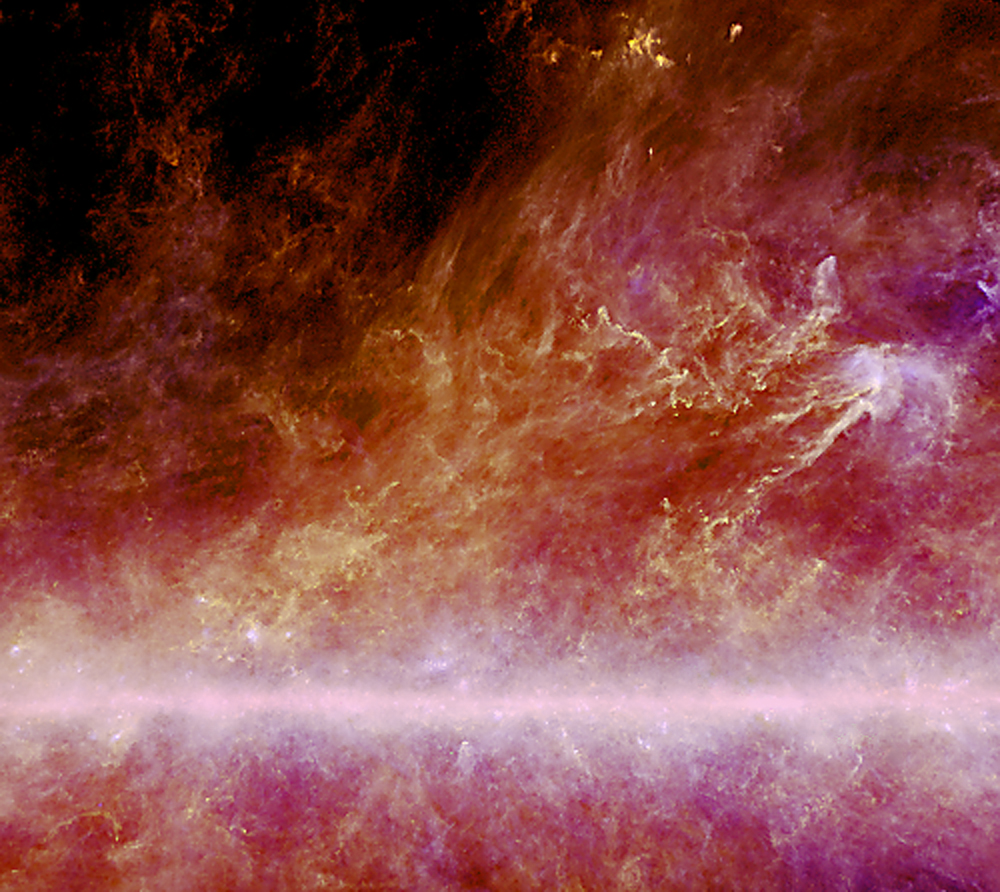
What shapes the remarkable dust tapestry of the nearby Milky Way Galaxy? No one knows for sure. The intricate structures, shown above, were resolved in new detail recently in a wide region of the sky imaged in far infrared light by the European Space Agency's Planck satellite. The above image is a digital fusion of three infrared colors: two taken at high resolution by Planck, while the other is an older image taken by the now defunct IRAS satellite. At these colors, the sky is dominated by the faint glow of very cold gas within only 500 light years of Earth. In the above image, red corresponds to temperatures as cold as 10 degrees Kelvin above absolute zero, while white corresponds to gas as warm at 40 Kelvins. The pink band across the lower part of the image is warm gas confined to the plane of our Galaxy. The bright regions typically hold dense molecular clouds that are slowly collapsing to form stars, whereas the dimmer regions are most usually diffuse interstellar gas and dust known as cirrus. Why these regions have intricate filamentary shapes shared on both large and small scales remains a topic of research. Future study of the origin and evolution of dust may help in the understanding the recent history of our Galaxy as well as how planetary systems such as our Solar System came to be born.
Crédito: Agencia Espacial Europea, Planck ¿Qué forma la sorprendente cenefa de polvo de la galaxia Vía Láctea cercana? Nadie lo sabe con certeza. Las estructuras intrincadas, mostradas arriba, se resolvieron en nuevos detalles recientemente en una amplia región del cielo fotografiada en luz infrarroja lejana por el satélite Planck de la Agencia Espacial Europea. La imagen superior es una fusión digital de tres colores infrarrojos: dos tomados a alta resolución por Planck, mientras que el otro es una imagen más antigua tomada por el satélite IRAS, ahora descontinuado. En estos colores, el cielo está dominado por el tenue brillo de gas muy frío dentro de solo 500 años luz de la Tierra. En la imagen superior, el rojo corresponde a temperaturas tan frías como 10 grados Kelvin por encima del cero absoluto, mientras que el blanco corresponde a gas tan cálido como 40 Kelvins. La banda rosa que cruza la parte inferior de la imagen es gas cálido confinado al plano de nuestra galaxia. Las regiones brillantes típicamente contienen nubes moleculares densas que se están colapsando lentamente para formar estrellas, mientras que las regiones más oscuras son generalmente gas y polvo interestelar difuso conocido como cirrus. ¿Por qué estas regiones tienen formas intrincadas y filamentosas que se comparten a escalas tanto grandes como pequeñas sigue siendo un tema de investigación. Estudios futuros sobre el origen y la evolución del polvo pueden ayudar a entender la historia reciente de nuestra galaxia, así como cómo sistemas planetarios como el nuestro Sistema Solar llegaron a nacer.