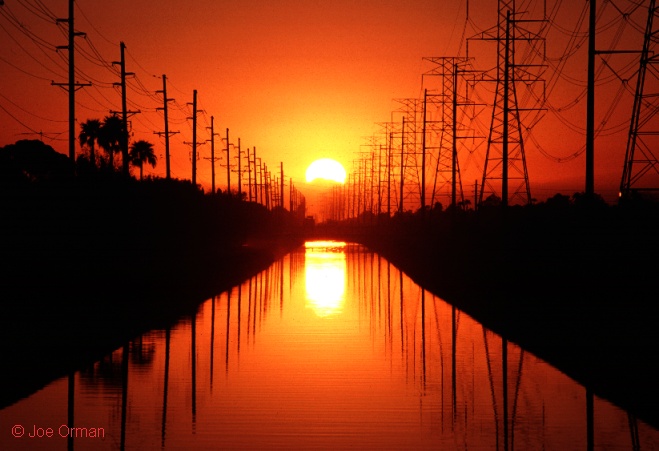
Twice a year, at the Spring and Fall equinox, the Sun rises due east. In an emphatic demonstration of this celestial alignment, photographer Joe Orman recorded this inspiring image of the Sun rising exactly along the east-west oriented Western Canal, in Tempe, Arizona, USA. But he waited until one day after the northern Spring equinox, in 2001, to photograph the striking view. Why was the rising Sun due east one day after the equinox? At Tempe's latitude the Sun rises at an angle, arcing southward as it climbs above the horizon. Because the distant mountains hide the true horizon, the Sun shifts slightly southward by the time it clears the mountain tops. Waiting 24 hours allowed the Sun to rise just north of east and arc back to an exactly eastern alignment for the photo. Today is another Equinox + 1 day, with the Sun crossing the celestial equator yesterday at about 17:32 Universal Time.
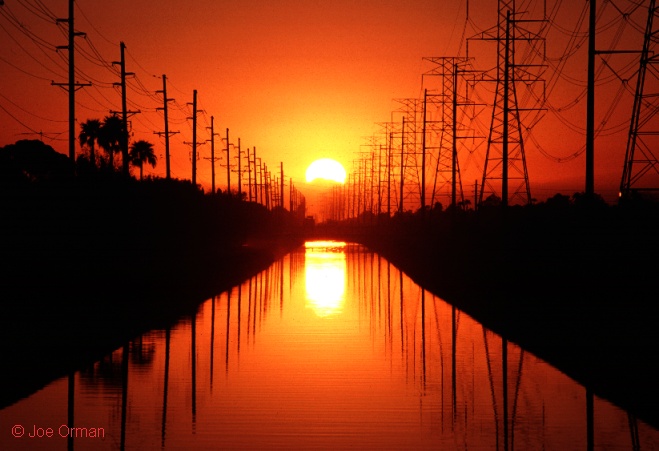
Crédito: Joe Orman Dos veces al año, en el equinoccio de primavera y otoño, el Sol sale exactamente hacia el este. En una demostración contundente de esta alineación celeste, el fotógrafo Joe Orman registró esta imagen inspiradora del Sol naciendo exactamente a lo largo del Canal Occidental, orientado este-oeste, en Tempe, Arizona, EE.UU. Pero esperó hasta un día después del equinoccio de primavera en el hemisferio norte, en 2001, para fotografiar esta impresionante vista. ¿Por qué el Sol naciente estaba exactamente hacia el este un día después del equinoccio? En la latitud de Tempe, el Sol sale con un ángulo, describiendo un arco hacia el sur a medida que se eleva sobre el horizonte. Debido a que las montañas distantes ocultan el verdadero horizonte, el Sol se desplaza ligeramente hacia el sur cuando supera las cimas de las montañas. Esperar 24 horas permitió que el Sol naciera justo al norte del este y describiera un arco de vuelta a una alineación exactamente oriental para la fotografía. Hoy es otro día Equinoccio + 1, con el Sol cruzando el ecuador celeste ayer a las aproximadamente 17:32 Tiempo Universal.