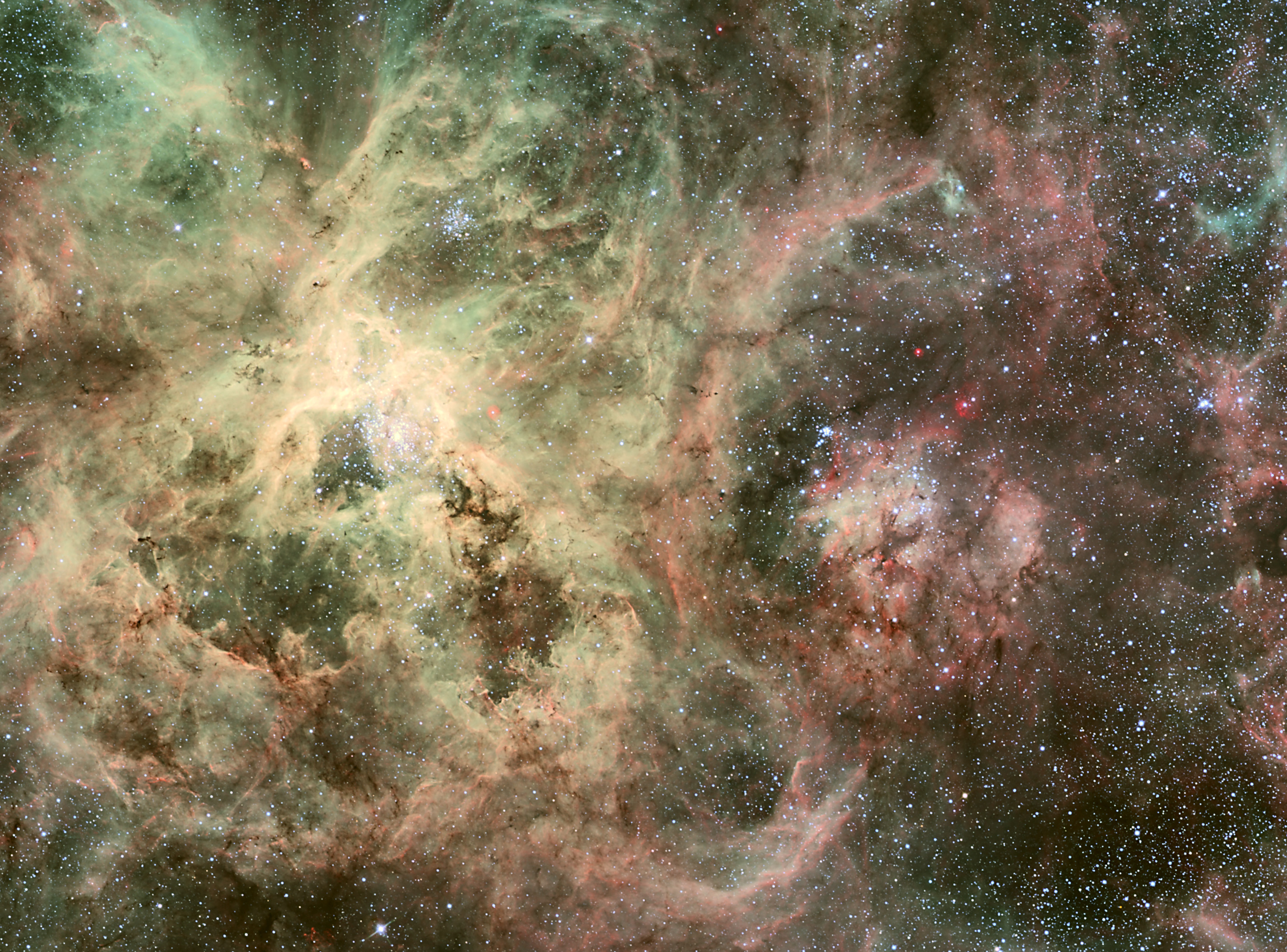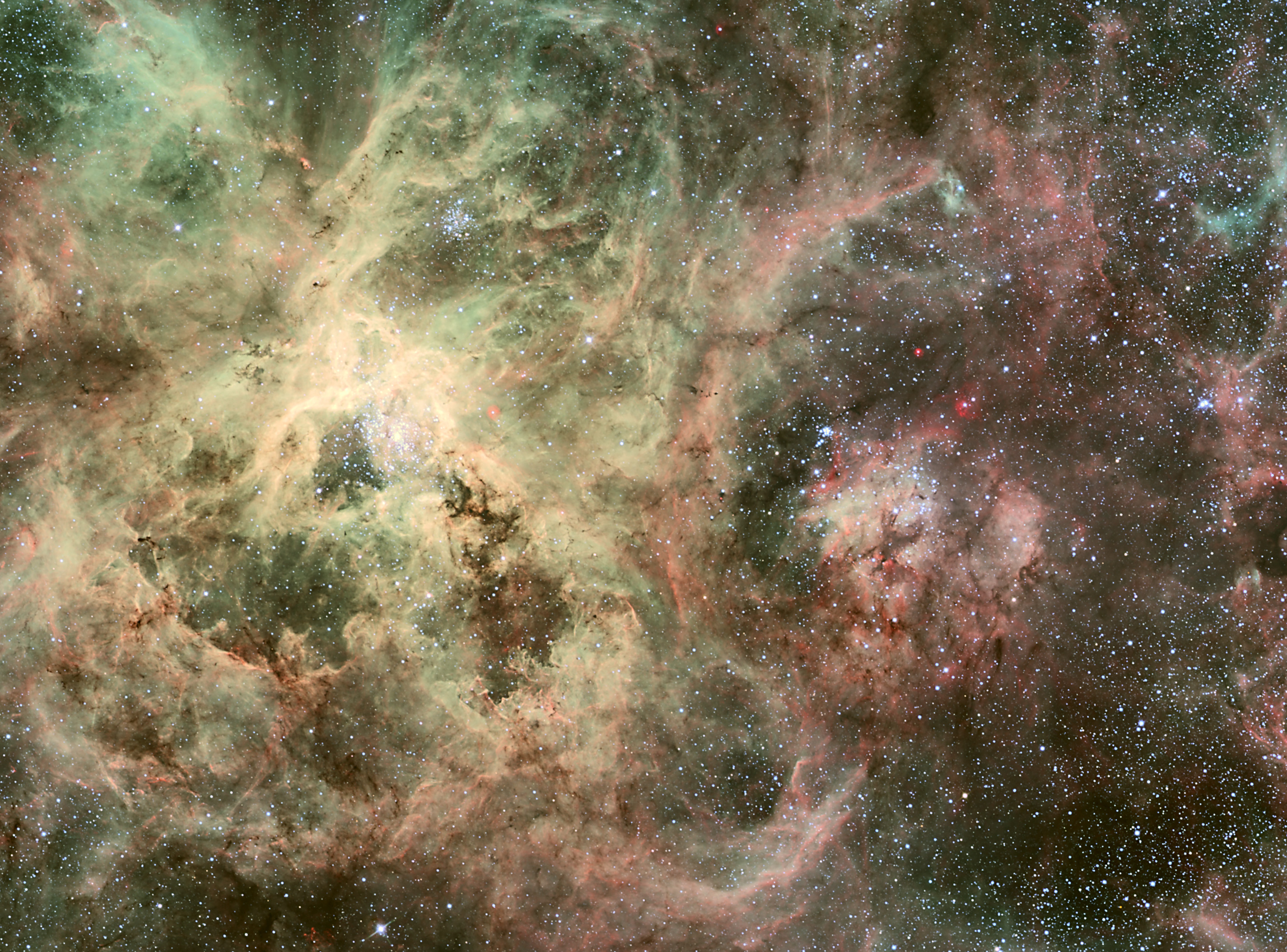
The largest, most violent star forming region known in the whole Local Group of galaxies lies in our neighboring galaxy the Large Magellanic Cloud (LMC). Were the Tarantula Nebula at the distance of the Orion Nebula -- a local star forming region -- it would take up fully half the sky. Also called 30 Doradus, the red and pink gas indicates a massive emission nebula, although supernova remnants and dark nebula also exist there. The bright knot of stars left of center is called R136 and contains many of the most massive, hottest, and brightest stars known. The above image taken with the European Southern Observatory's (ESO's) Wide Field Imager is one of the most detailed ever of this vast star forming region. A recent Hubble image of part of the nebula has uncovered a very massive star escaping from the region.
La región más grande y violenta de formación estelar conocida en toda la Grupo Local de galaxias se encuentra en nuestra galaxia vecina, la Gran Nube de Magallanes (LMC). Si la Nebulosa Tarántula estuviera a la distancia de la Nebulosa de Orión —una región local de formación estelar— ocuparía la mitad del cielo. También llamada 30 Doradus, el gas rojo y rosa indica una nebulosa de emisión masiva, aunque también existen allí restos de supernovas y nebulosas oscuras. El nudo brillante de estrellas a la izquierda del centro se llama R136 y contiene muchas de las estrellas más masivas, más calientes y más brillantes conocidas. La imagen superior tomada con el Wide Field Imager del Observatorio Europeo Austral (ESO) es una de las más detalladas jamás obtenidas de esta vasta región de formación estelar. Una imagen reciente del Hubble de una parte de la nebulosa ha revelado una estrella muy masiva escapando de la región.