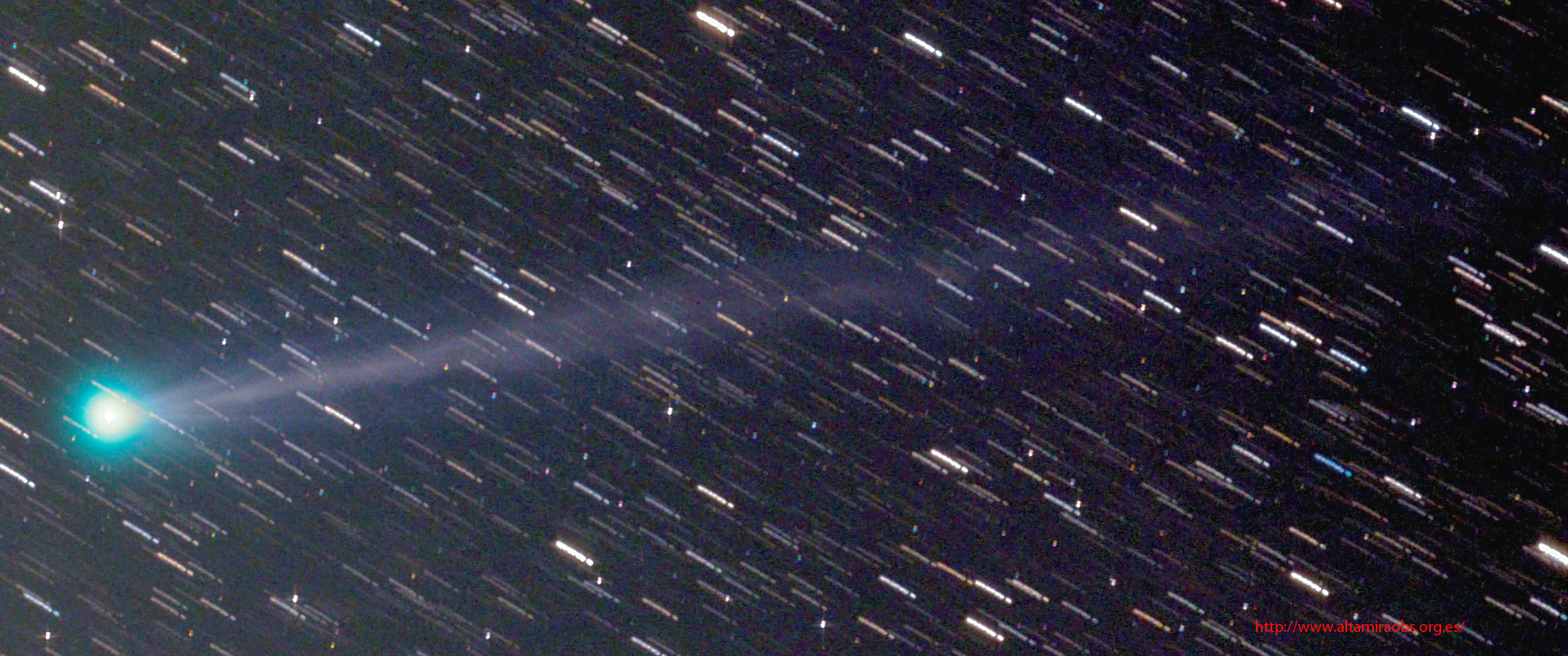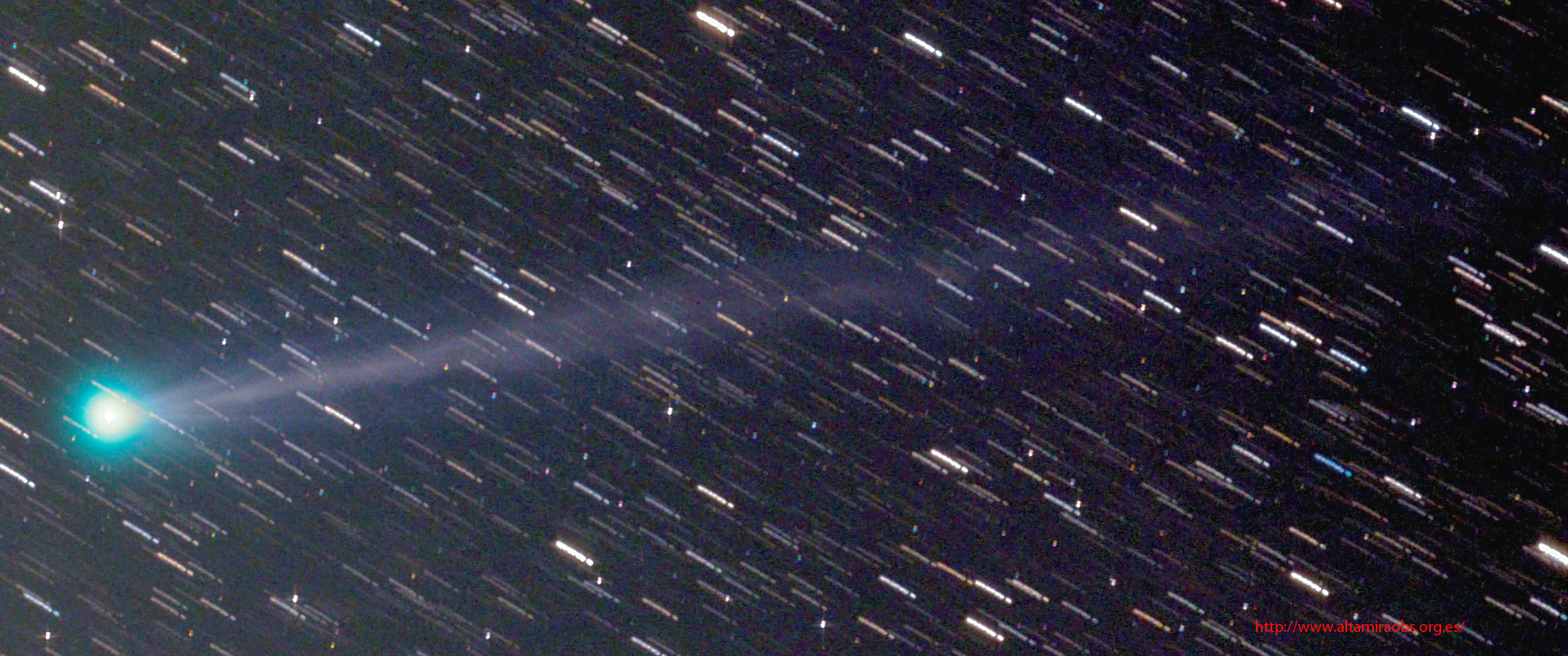
A new comet is brightening and is now expected to become visible to the unaided eye later this month. C/2009 R1 (McNaught) is already showing an impressive tail and is currently visible through binoculars. The above image, taken yesterday from the Altamira Observatory in the Canary Islands and spanning about five degrees, shows an impressive green coma and a long ion tail in front of distant star trails. Although predicting the brightness of comets is notoriously difficult, current estimates place Comet McNaught as becoming visible to unaided northern hemisphere observers in late June, before sunrise, and in early July, after sunset. Discovered by Robert McNaught last year, the sun-orbiting iceberg will pass the Earth next week and will continue to melt and shed debris as it closes in on the Sun until early July. After reaching about half of the Earth-Sun distance from the Sun, the comet should fade rapidly as it then heads out of the inner Solar System.
Un nuevo cometa está aumentando de brillo y ahora se espera que se vuelva visible a simple vista a finales de este mes. C/2009 R1 (McNaught) ya muestra una cola impresionante y actualmente es visible con binoculares. La imagen de arriba, tomada ayer desde el Observatorio Altamira en las Islas Canarias y que abarca aproximadamente cinco grados, muestra una coma verde impresionante y una larga cola iónica frente a las huellas de estrellas distantes. Aunque predecir el brillo de los cometas es notablemente difícil, las estimaciones actuales sitúan al cometa McNaught como visible a simple vista para observadores del hemisferio norte a finales de junio, antes del amanecer, y a principios de julio, después del atardecer. Descubierto por Robert McNaught el año pasado, el iceberg que orbita al Sol pasará por la Tierra la próxima semana y continuará derritiéndose y liberando escombros a medida que se acerque al Sol hasta principios de julio. Después de alcanzar aproximadamente la mitad de la distancia Tierra-Sol del Sol, el cometa debería desvanecerse rápidamente a medida que se aleje del sistema solar interior.