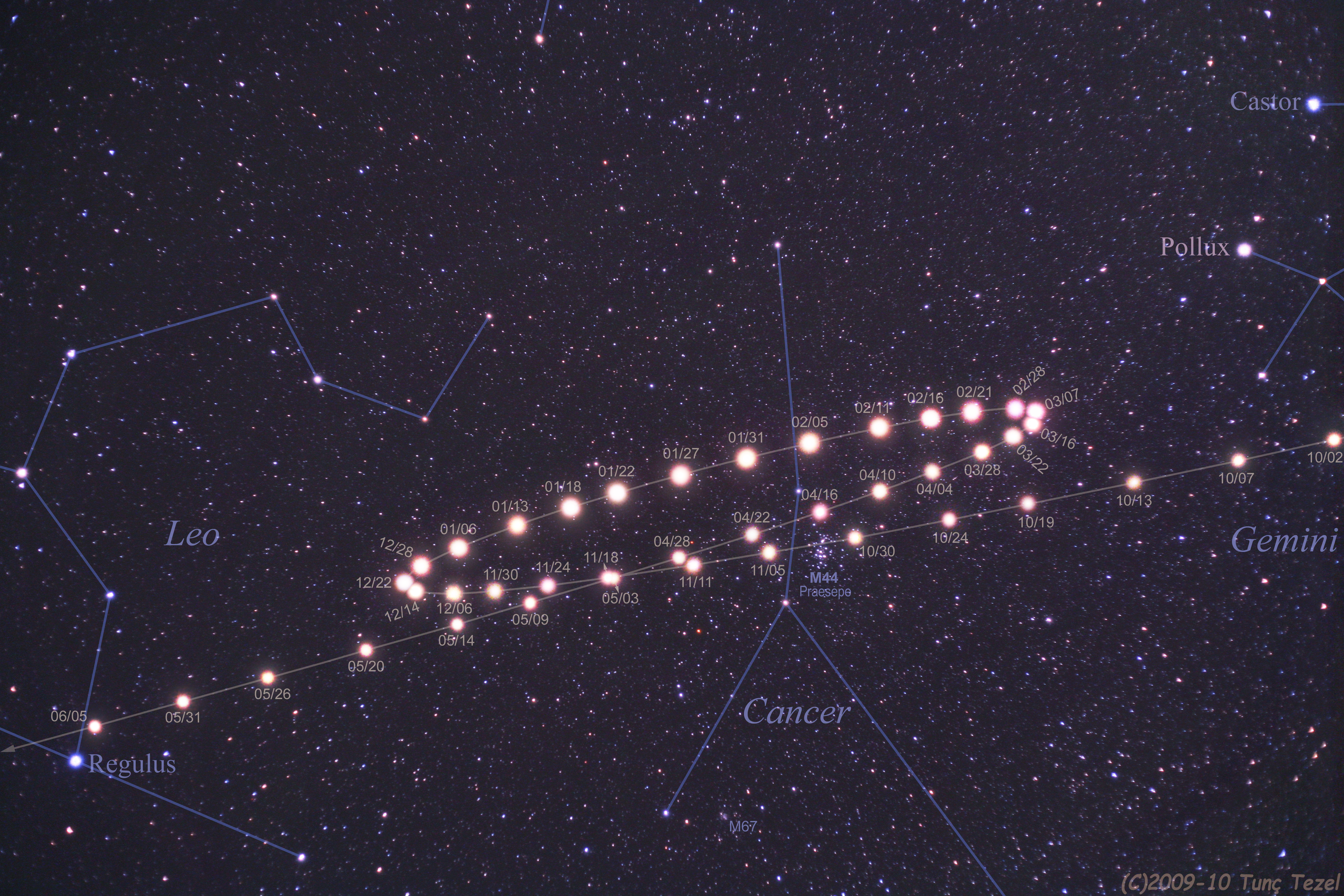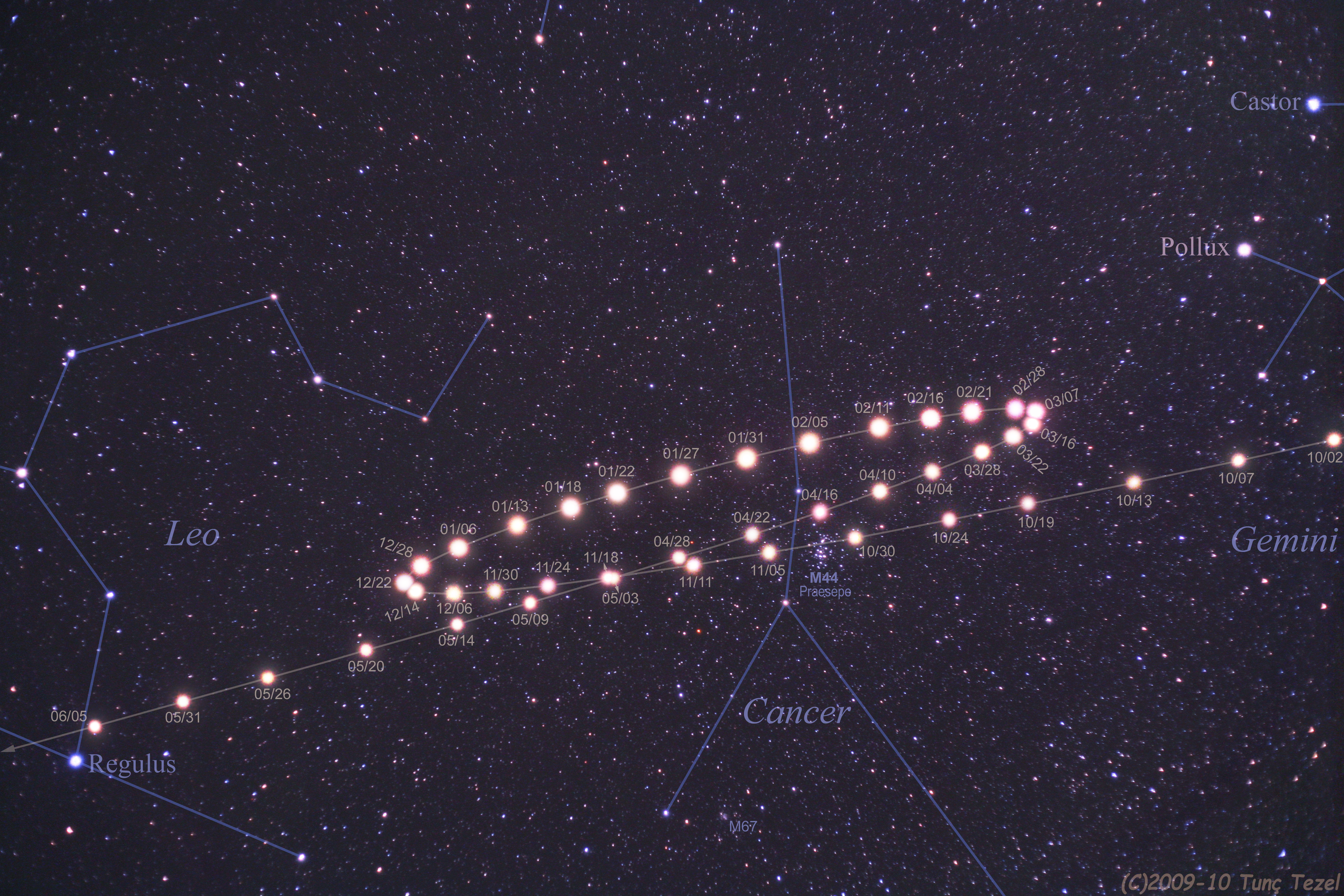
Why would Mars appear to move backwards? Most of the time, the apparent motion of Mars in Earth's sky is in one direction, slow but steady in front of the far distant stars. About every two years, however, the Earth passes Mars as they orbit around the Sun. During the most recent such pass late last year and early this year, Mars as usual, loomed large and bright. Also during this time, Mars appeared to move backwards in the sky, a phenomenon called retrograde motion. Pictured above is a series of images digitally stacked so that all of the stars images coincide. Here, Mars appears to trace out a loop in the sky. At the center of the loop, Earth passed Mars and the retrograde motion was the highest. Retrograde motion can also be seen for other Solar System planets.
¿Por qué Marte parece moverse hacia atrás? La mayor parte del tiempo, el movimiento aparente de Marte en el cielo terrestre ocurre en una sola dirección, lento pero constante frente a las estrellas distantes. Sin embargo, aproximadamente cada dos años, la Tierra pasa a Marte mientras ambos orbitan alrededor del Sol. Durante la última pasada de este tipo, que ocurrió a finales del año pasado y principios de este año, Marte, como es habitual, apareció grande y brillante. También durante este periodo, Marte pareció moverse hacia atrás en el cielo, un fenómeno llamado movimiento retrógrado. En la imagen de arriba se muestra una serie de imágenes apiladas digitalmente de manera que todas las imágenes de las estrellas coinciden. Aquí, Marte parece trazar una espiral en el cielo. En el centro de la espiral, la Tierra pasó a Marte y el movimiento retrógrado fue el más pronunciado. El movimiento retrógrado también puede observarse en otros planetas del Sistema Solar.