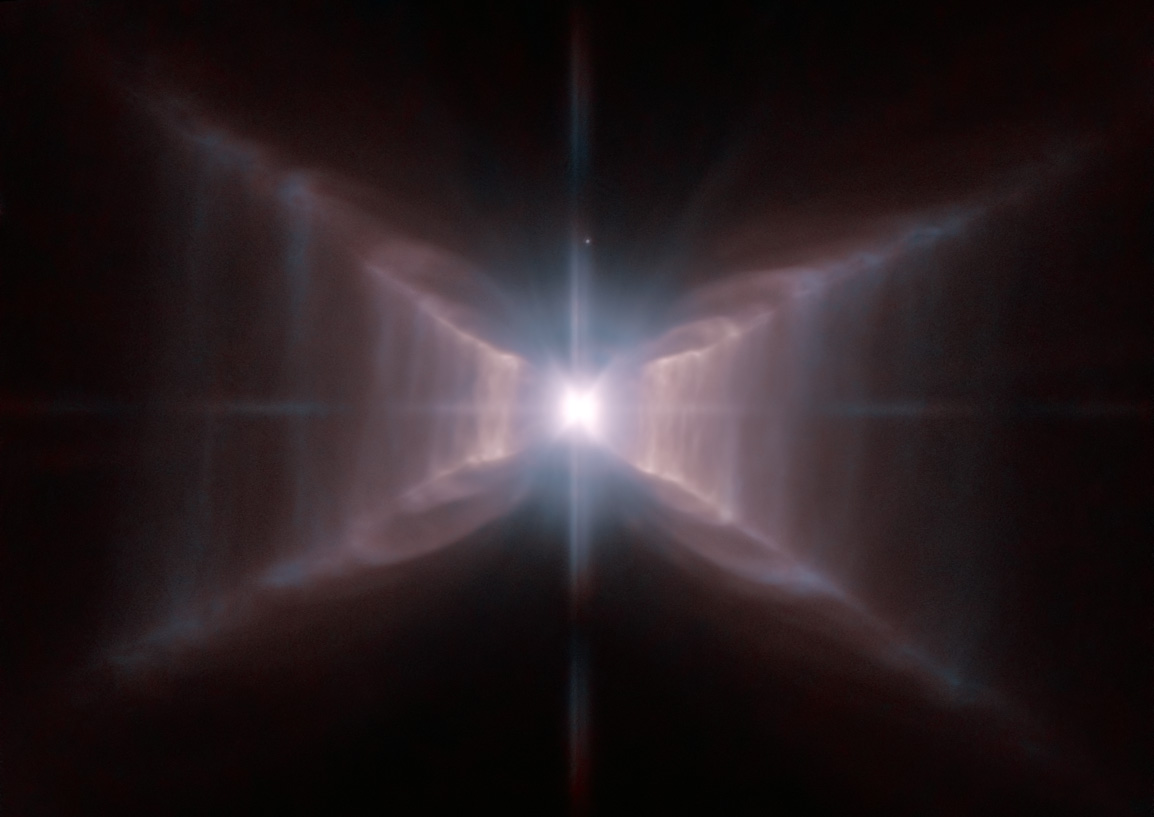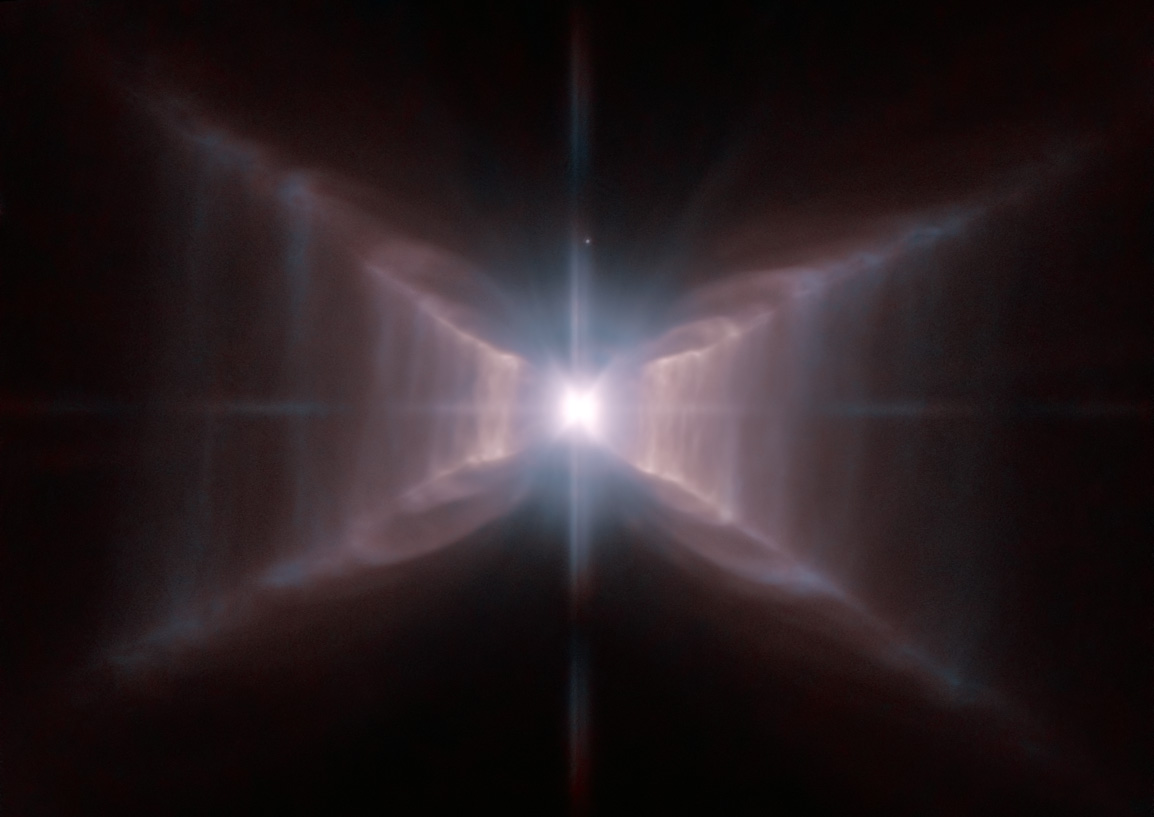
How was the unusual Red Rectangle nebula created? At the nebula's center is an aging binary star system that surely powers the nebula but does not, as yet, explain its colors. The unusual shape of the Red Rectangle is likely due to a thick dust torus which pinches the otherwise spherical outflow into tip-touching cone shapes. Because we view the torus edge-on, the boundary edges of the cone shapes seem to form an X. The distinct rungs suggest the outflow occurs in fits and starts. The unusual colors of the nebula are less well understood, however, and current speculation holds that they are partly provided by hydrocarbon molecules that may actually be building blocks for organic life. The Red Rectangle nebula lies about 2,300 light years away towards the constellation of the Unicorn (Monoceros). The nebula is shown above in unprecedented detail as captured recently by the Hubble Space Telescope. In a few million years, as one of the central stars becomes further depleted of nuclear fuel, the Red Rectangle nebula will likely bloom into a planetary nebula.
¿Cómo se creó la inusual nebulosa Red Rectangle? En el centro de la nebulosa se encuentra un sistema binario de estrellas envejecidas que sin duda impulsa la nebulosa, pero que aún no explica sus colores. La forma inusual de la Red Rectangle probablemente se deba a un toro de polvo denso que comprime el flujo esférico habitual en conos que se tocan en sus puntas. Dado que observamos el toro de perfil, los bordes de los conos parecen formar una X. Los escalones distintivos sugieren que el flujo ocurre en episodios intermitentes. Sin embargo, los colores inusuales de la nebulosa se comprenden menos bien, y la especulación actual sugiere que son en parte proporcionados por moléculas de hidrocarburos que podrían ser bloques de construcción para la vida orgánica. La nebulosa Red Rectangle se encuentra a unos 2300 años luz de distancia, en dirección a la constelación del Unicornio (Monoceros). La nebulosa se muestra arriba con un detalle sin precedentes, capturada recientemente por el Telescopio Espacial Hubble. En unos pocos millones de años, a medida que una de las estrellas centrales se agote aún más de combustible nuclear, la nebulosa Red Rectangle probablemente florezca en una nebulosa planetaria.