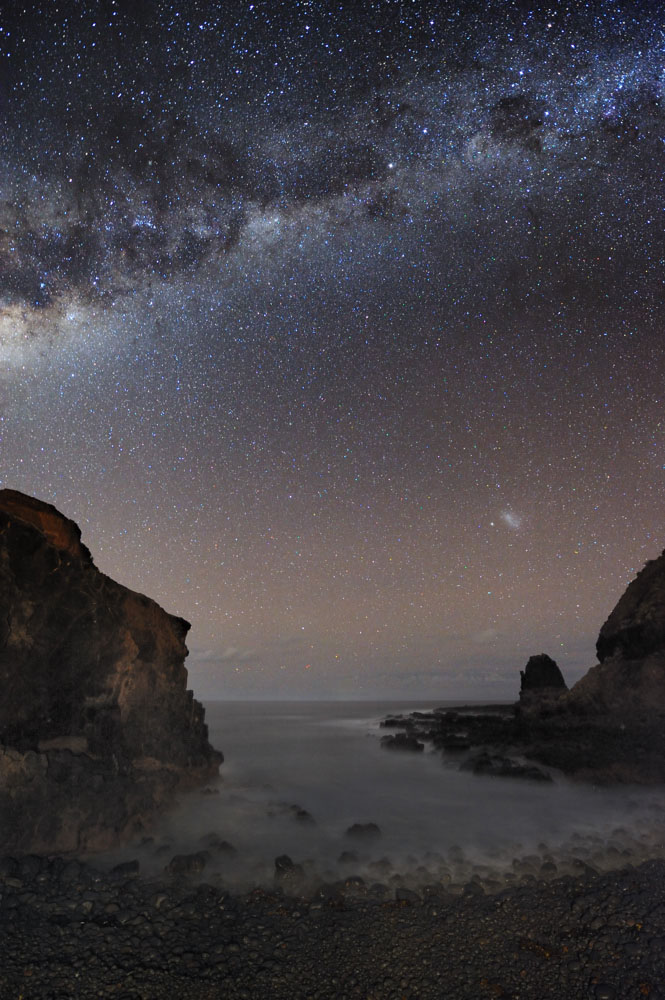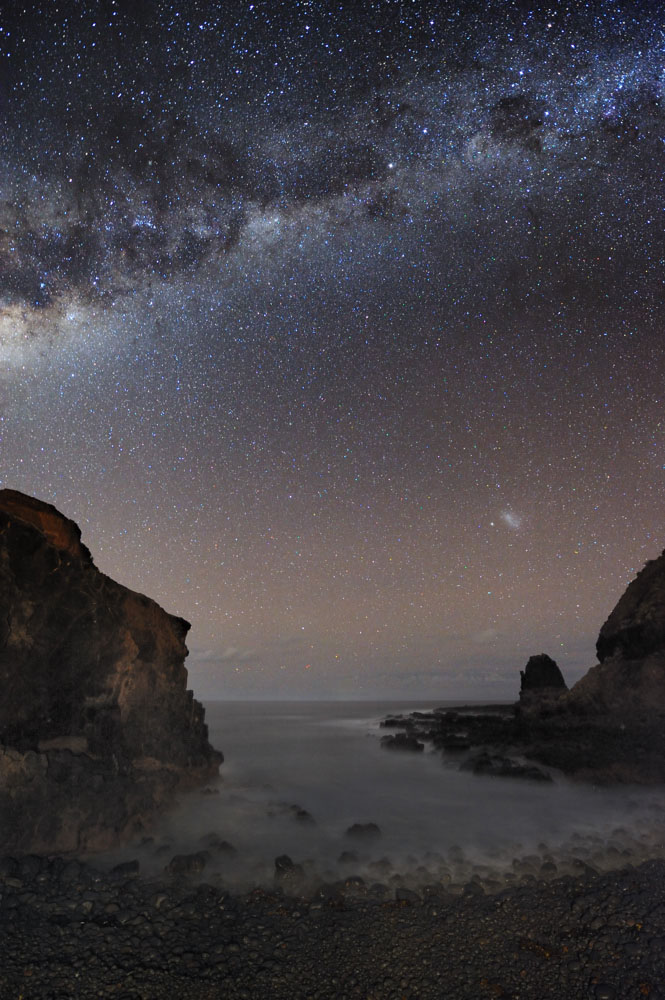
Can a picture of the sky be relaxing? A candidate for such a picture might be this image taken only last month from Cape Schank, Victoria, Australia. The frame is highlighted by a dreamlike lagoon, two galaxies, and tens of thousands of stars. The rock cropping on the left may appear from this angle like a human head, but the more famous rock structure is on the far right and known as Pulpit Rock. Across the top of the image runs a distant stream of bright stars and dark dust that is part of the disk of our spiral Milky Way Galaxy. On the right, just above Pulpit Rock, is the Milky Way's small neighboring galaxy the Small Magellanic Cloud (SMC). The bright white object just to the left of the SMC is a globular cluster of stars in the Milky Way known as 47 Tucana. Best Space Images: APOD Editor to Speak at AstroFest Penn State this Friday Night
¿Puede una imagen del cielo ser relajante? Un candidato para tal imagen podría ser esta tomada hace apenas un mes desde Cape Schank, Victoria, Australia. El marco es destacado por un lago soñador, dos galaxias y decenas de miles de estrellas. La roca que aparece a la izquierda podría parecer desde este ángulo la cabeza de un ser humano, pero la estructura rocosa más famosa está en el extremo derecho y se conoce como Risco del Púlpito. A lo largo de la parte superior de la imagen se extiende un río distante de estrellas brillantes y polvo oscuro que forma parte del disco de nuestra galaxia espiral, la Vía Láctea. A la derecha, justo encima del Risco del Púlpito, se encuentra la pequeña galaxia vecina de la Vía Láctea, la Nube Menor de Magallanes (SMC). El objeto brillante de color blanco que aparece justo a la izquierda de la SMC es un cúmulo globular de estrellas en la Vía Láctea conocido como 47 Tucanae.