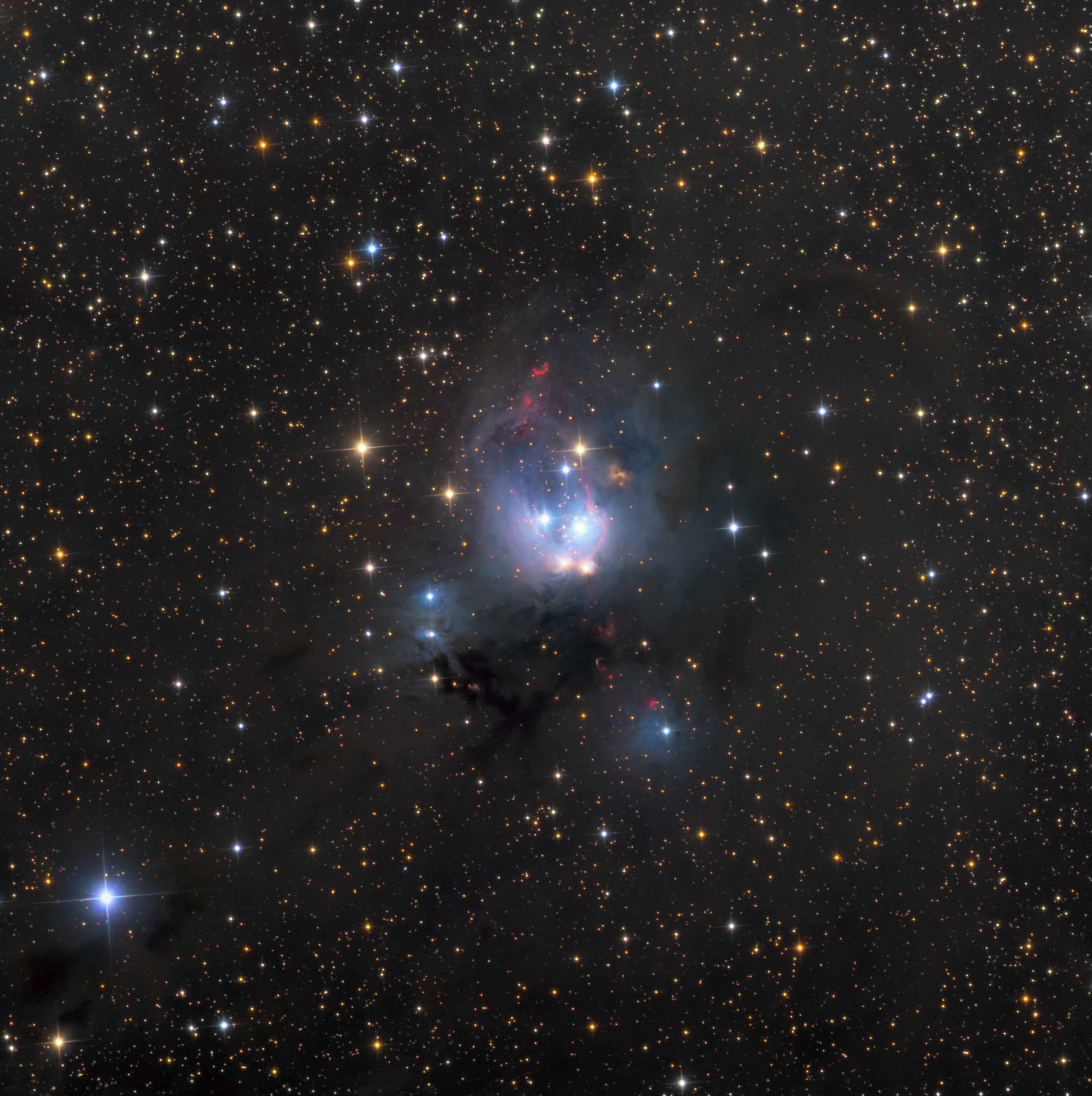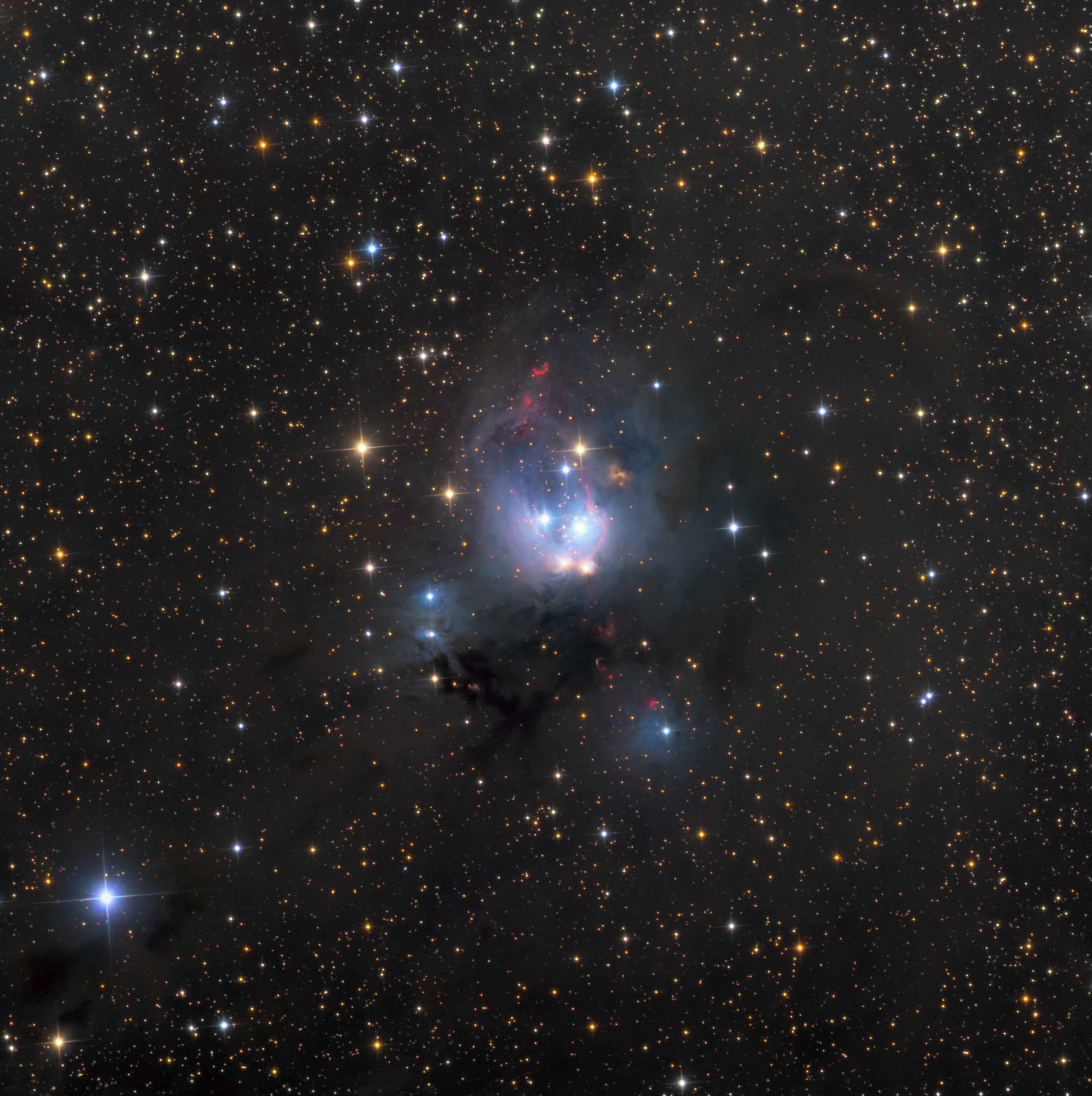
Young suns still lie within dusty NGC 7129, some 3,000 light-years away toward the royal constellation Cepheus. While these stars are at a relatively tender age, only a few million years old, it is likely that our own Sun formed in a similar stellar nursery some five billion years ago. Most noticeable in the sharp, (zoomable) image are the lovely bluish dust clouds that reflect the youthful starlight, but the smaller, deep red crescent shapes are also markers of energetic, young stellar objects. Known as Herbig-Haro objects, their shape and color is characteristic of glowing hydrogen gas shocked by jets streaming away from newborn stars. Ultimately the natal gas and dust in the region will be dispersed, the stars drifting apart as the loose cluster orbits the center of the Galaxy. At the estimated distance of NGC 7129, this telescopic view spans about 40 light-years. Take a short survey about viewing astronomy images on mobile devices.
Soles jóvenes aún se encuentran dentro del polvoriento NGC 7129, a unos 3000 años luz de distancia hacia la constelación real de Cefeo. Aunque estas estrellas tienen una edad relativamente tierna, de solo unos pocos millones de años, es probable que nuestro propio Sol se formara en una guardería estelar similar hace unos cinco mil millones de años. Lo más destacable en la imagen nítida (ampliable) son las nubes de polvo azuladas que reflejan la luz de las estrellas jóvenes, pero las formas pequeñas y de color rojo profundo también son indicadores de objetos estelares energéticos y jóvenes. Conocidos como objetos Herbig-Haro, su forma y color son característicos del gas de hidrógeno que brilla debido a choques producidos por chorros que salen de estrellas recién nacidas. Finalmente, el gas y el polvo de la región natal se dispersarán, y las estrellas se separarán a medida que el cúmulo suelto orbite alrededor del centro de la Galaxia. A la distancia estimada de NGC 7129, esta vista telescópica abarca aproximadamente 40 años luz.