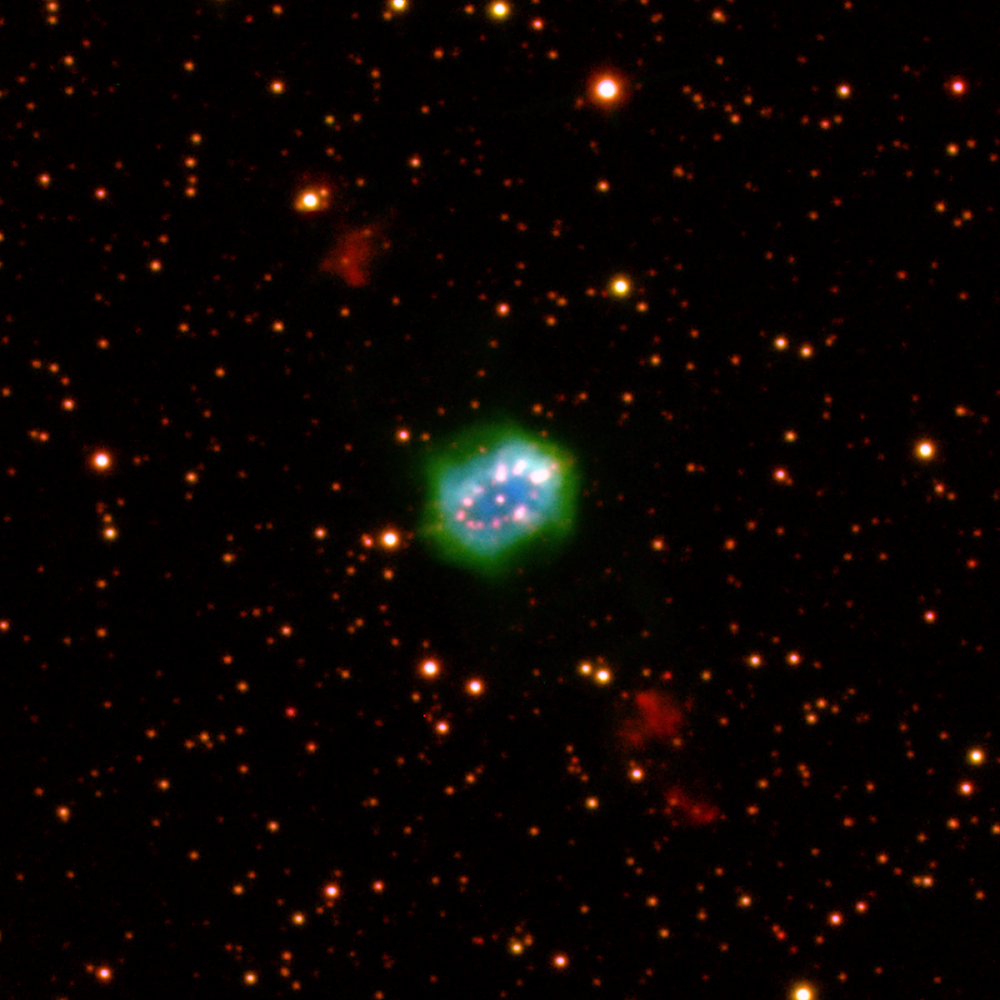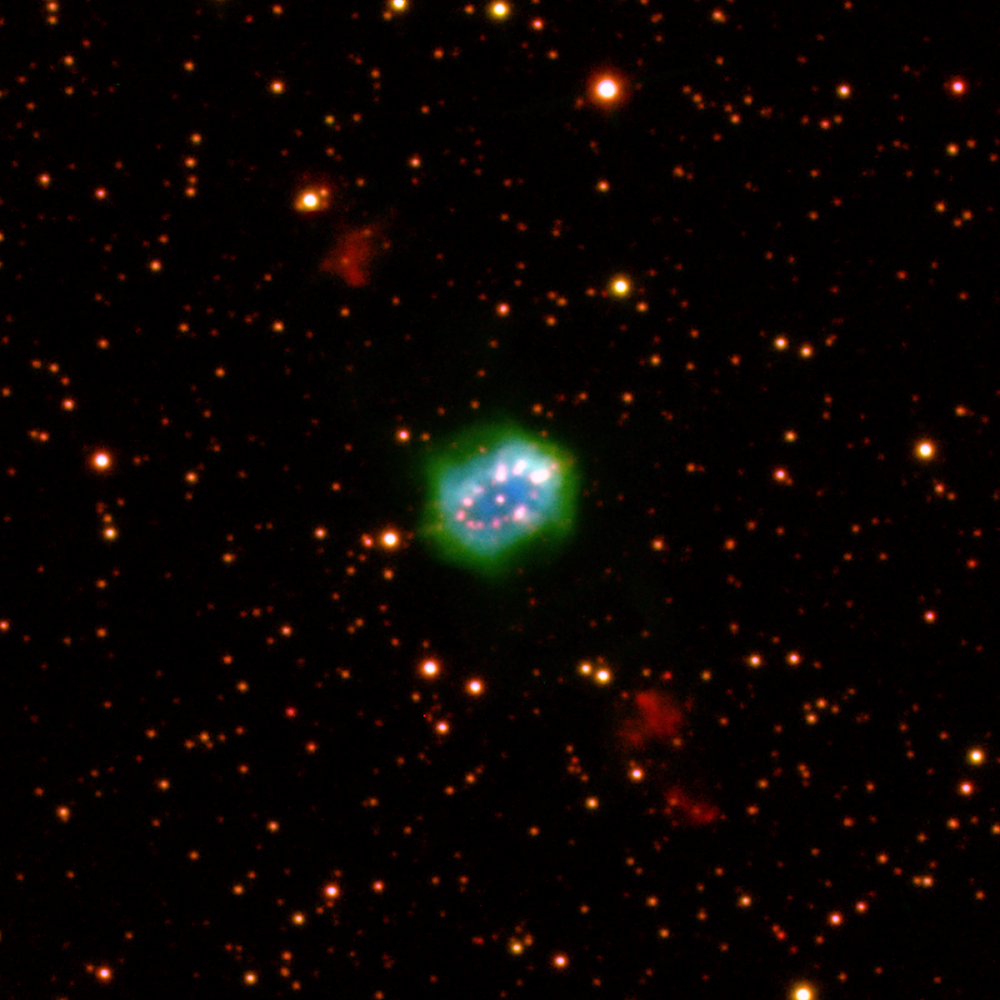
The small constellation Sagitta sports this large piece of cosmic jewelry, dubbed the Necklace Nebula. The newly discovered example of a ring-shaped planetary nebula is about 15,000 light-years distant. Its bright ring with pearls of glowing gas is half a light-year across. Planetary nebulae are created by sun-like stars in a final phase of stellar evolution. But the Necklace Nebula's central star, near the center of a ring strongly tilted to our line of sight, has also been shown to be binary, a close system of two stars with an orbital period of just over a day. Astronomers estimating the apparent age of the ring to be around 5,000 years, also find more distant gas clouds perpendicular to the ring plane, seen here at the upper left and lower right. Those clouds were likely ejected about 5,000 years before the clouds forming the necklace. This false color image combines emission from ionized hydrogen in blue, oxygen in green, and nitrogen in red.
La pequeña constelación de Sagitta alberga esta destacada pieza de joyería cósmica, conocida como el Cuello de Perlas. Este reciente ejemplo de nebulosa planetaria de forma anular se encuentra a unos 15 000 años luz de distancia. Su anillo brillante con perlas de gas luminoso tiene medio año luz de diámetro. Las nebulosas planetarias son creadas por estrellas similares al Sol en una fase final de la evolución estelar. Sin embargo, la estrella central de la Nebulosa del Cuello de Perlas, ubicada cerca del centro de un anillo fuertemente inclinado respecto a nuestra línea de visión, también ha demostrado ser binaria, un sistema estrecho de dos estrellas con un período orbital de apenas más de un día. Los astrónomos, que estiman la edad aparente del anillo en unos 5 000 años, también han encontrado nubes de gas más distantes perpendiculares al plano del anillo, visibles aquí en la parte superior izquierda e inferior derecha. Esas nubes probablemente fueron eyectadas unos 5 000 años antes de las nubes que forman el cuello. Esta imagen en falso color combina emisiones de hidrógeno ionizado en azul, oxígeno en verde y nitrógeno en rojo.