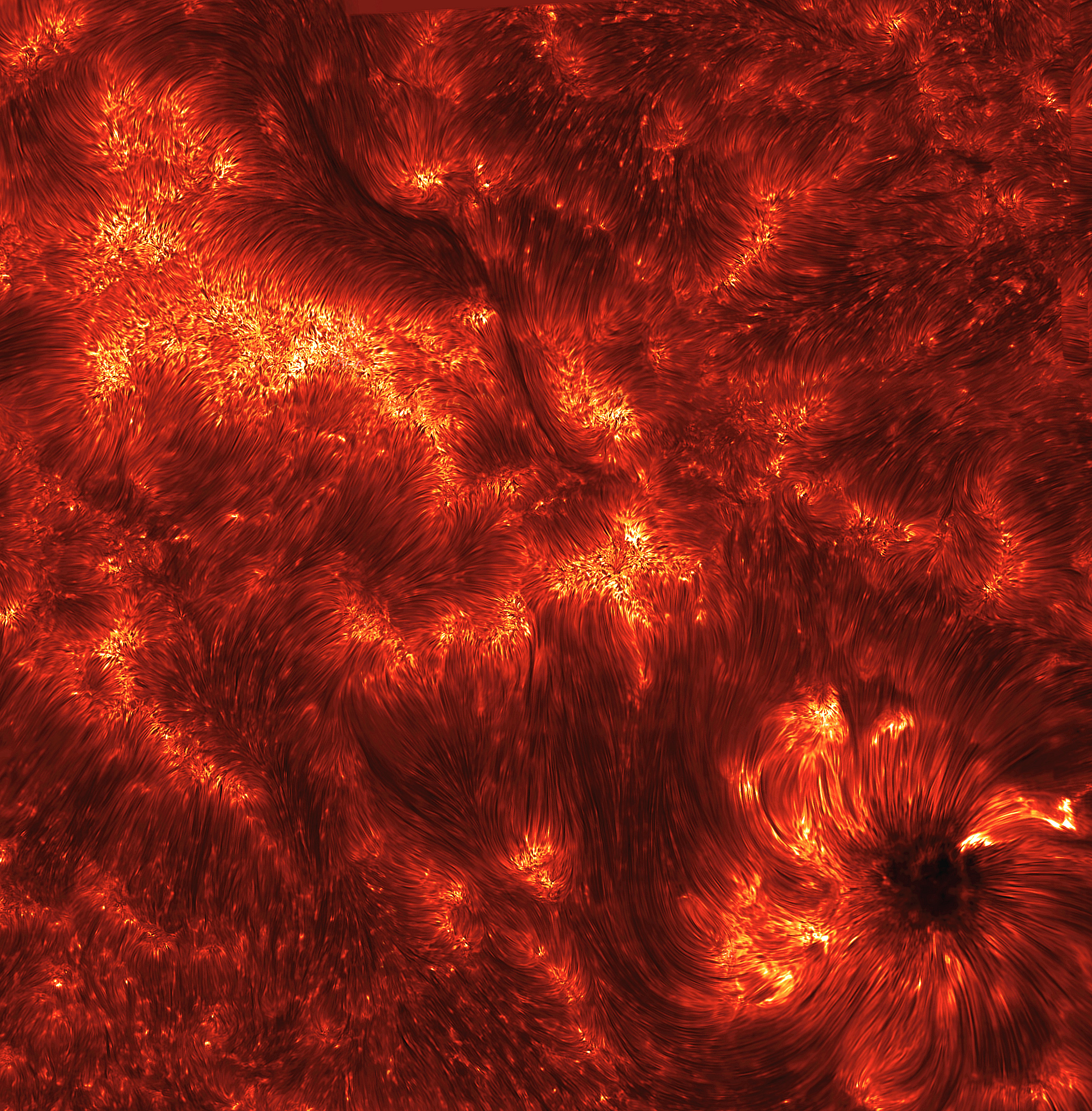
Imagine a pipe as wide as a state and as long as the Earth. Now imagine that this pipe is filled with hot gas moving 50,000 kilometers per hour. Further imagine that this pipe is not made of metal but a transparent magnetic field. You are envisioning just one of thousands of young spicules on the active Sun. Pictured above is one of the highest resolution image yet of these enigmatic solar flux tubes. Spicules line the above frame of solar active region 11092 that crossed the Sun last month, but are particularly evident converging on the sunspot on the lower left. Time-sequenced images have recently shown that spicules last about five minutes, starting out as tall tubes of rapidly rising gas but eventually fading as the gas peaks and falls back down to the Sun. What determines the creation and dynamics of spicules remains a topic of active research.
Imagina un tubo tan ancho como un estado y tan largo como la Tierra. Ahora imagina que este tubo está lleno de gas caliente que se mueve a 50 000 kilómetros por hora. Además, imagina que este tubo no está hecho de metal, sino de un campo magnético transparente. Estás visualizando una de las miles de espículas jóvenes en el Sol activo. La imagen de arriba es una de las imágenes de mayor resolución hasta ahora de estos misteriosos tubos de flujo solar. Las espículas bordean el marco de la región activa solar 11092 que cruzó el Sol el mes pasado, pero son particularmente evidentes convergiendo en la mancha solar de la esquina inferior izquierda. Imágenes secuenciales en el tiempo han mostrado recientemente que las espículas duran aproximadamente cinco minutos, comenzando como tubos altos de gas que sube rápidamente, pero finalmente desaparecen cuando el gas alcanza su punto máximo y vuelve a caer hacia el Sol. Lo que determina la creación y dinámica de las espículas sigue siendo un tema de investigación activa.