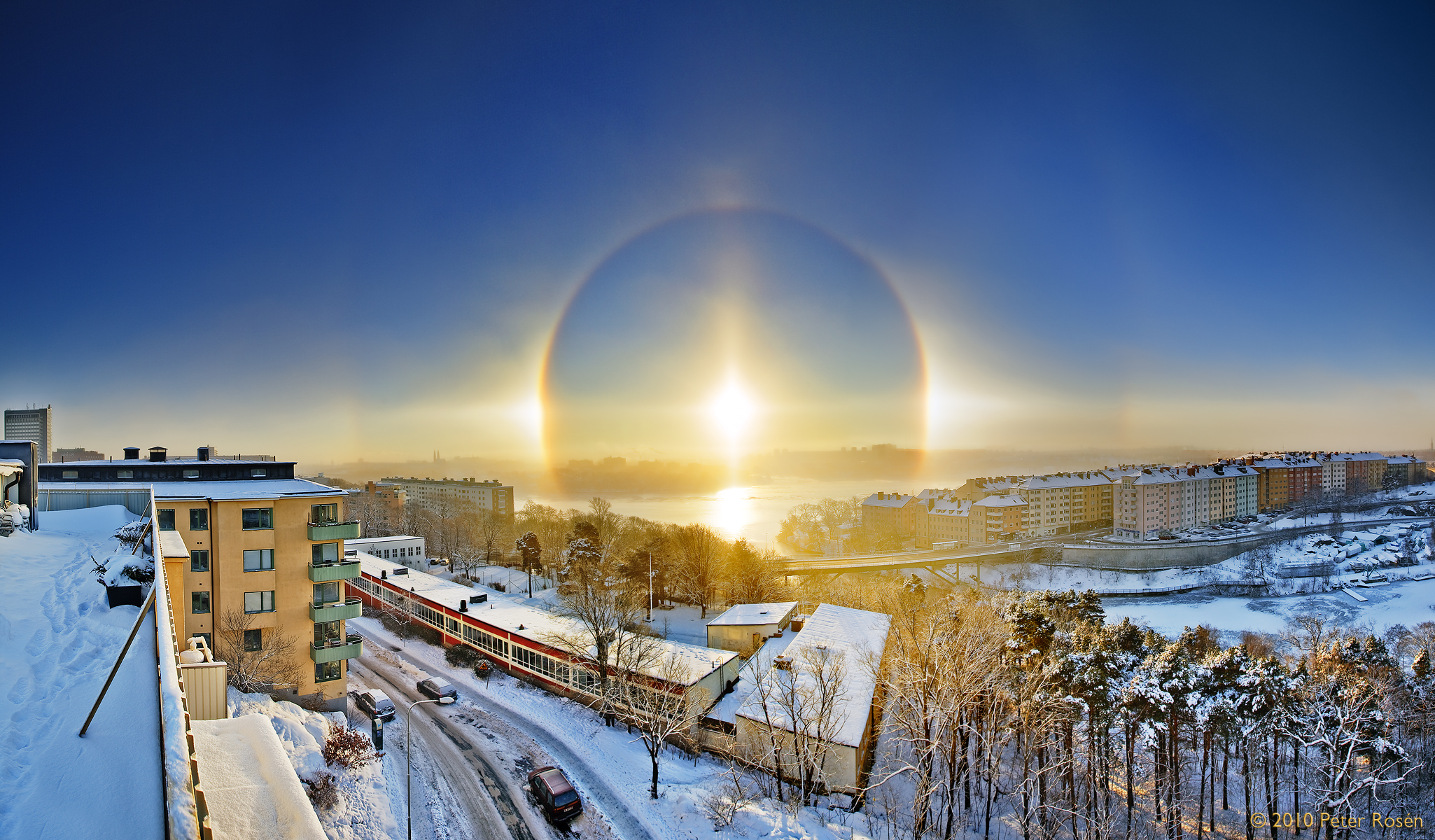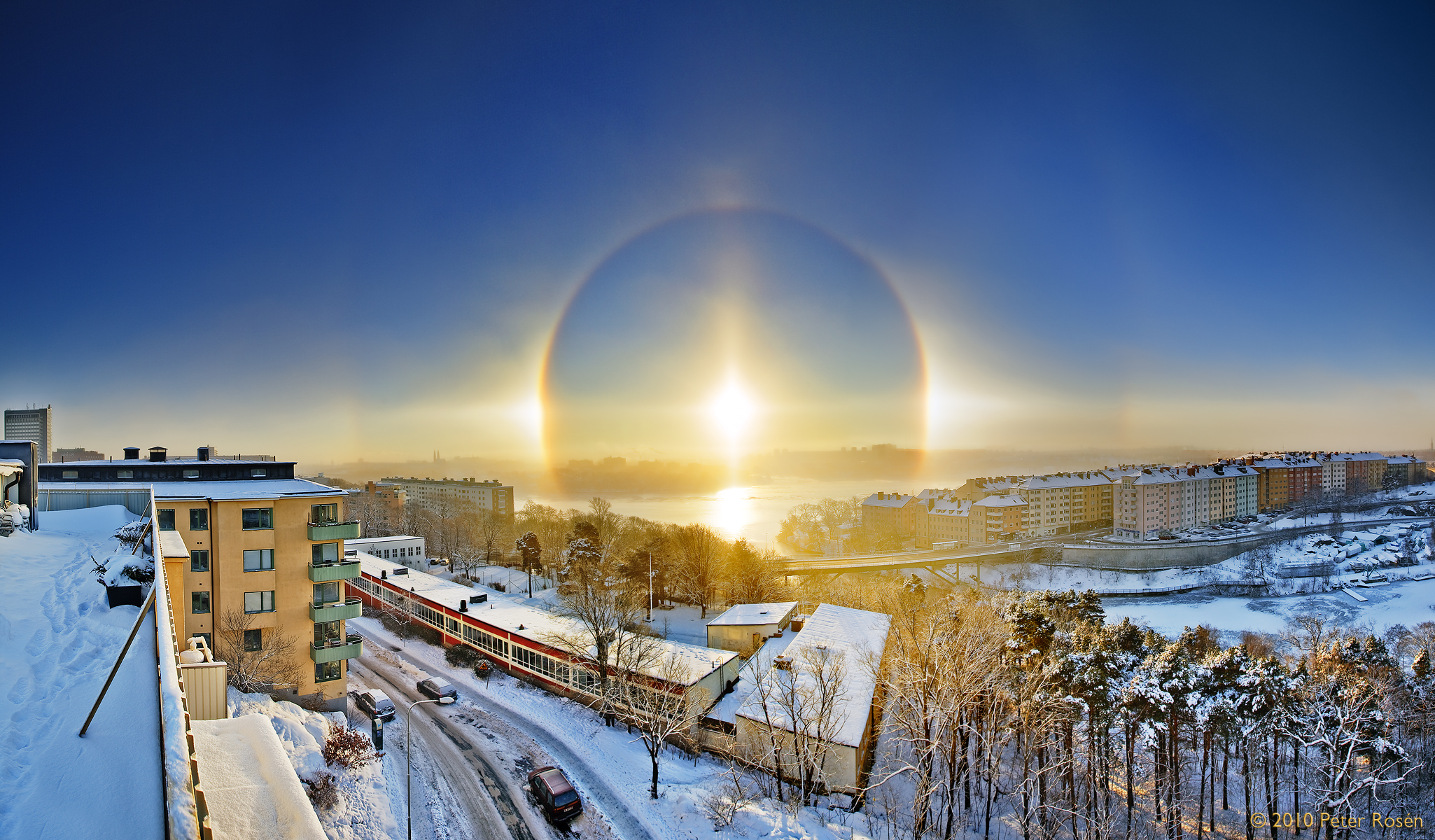
What's happened to the Sun? Sometimes it looks like the Sun is being viewed through a large lens. In the above case, however, there are actually millions of lenses: ice crystals. As water freezes in the upper atmosphere, small, flat, six-sided, ice crystals might be formed. As these crystals flutter to the ground, much time is spent with their faces flat, parallel to the ground. An observer may pass through the same plane as many of the falling ice crystals near sunrise or sunset. During this alignment, each crystal can act like a miniature lens, refracting sunlight into our view and creating phenomena like parhelia, the technical term for sundogs. The above image was taken last year in Stockholm, Sweden. Visible in the image center is the Sun, while two bright sundogs glow prominently from both the left and the right. Also visible is the bright 22 degree halo -- as well as the rarer and much fainter 46 degree halo -- also created by sunlight reflecting off of atmospheric ice crystals.
¿Qué le ha ocurrido al Sol? A veces parece como si el Sol fuera observado a través de una gran lente. Sin embargo, en este caso, en realidad existen millones de lentes: cristales de hielo. Cuando el agua se congela en la atmósfera superior, pueden formarse pequeños cristales de hielo planos, con seis lados. A medida que estos cristales caen hacia el suelo, pasan gran parte del tiempo con sus caras planas y paralelas al suelo. Un observador puede atravesar el mismo plano en el que se encuentran muchos de estos cristales en caída libre cerca del amanecer o el atardecer. Durante esta alineación, cada cristal puede actuar como una lente en miniatura, refractando la luz solar hacia nuestra vista y creando fenómenos como los parhelios, el término técnico para los «sundogs». La imagen fue tomada el año pasado en Estocolmo, Suecia. En el centro de la imagen se puede ver el Sol, mientras que dos brillantes parhelios resplandecen destacadamente tanto a la izquierda como a la derecha. También es visible el brillante halo de 22 grados, así como el más raro y mucho más tenue halo de 46 grados, ambos creados por la luz solar que se refleja en los cristales de hielo atmosféricos.