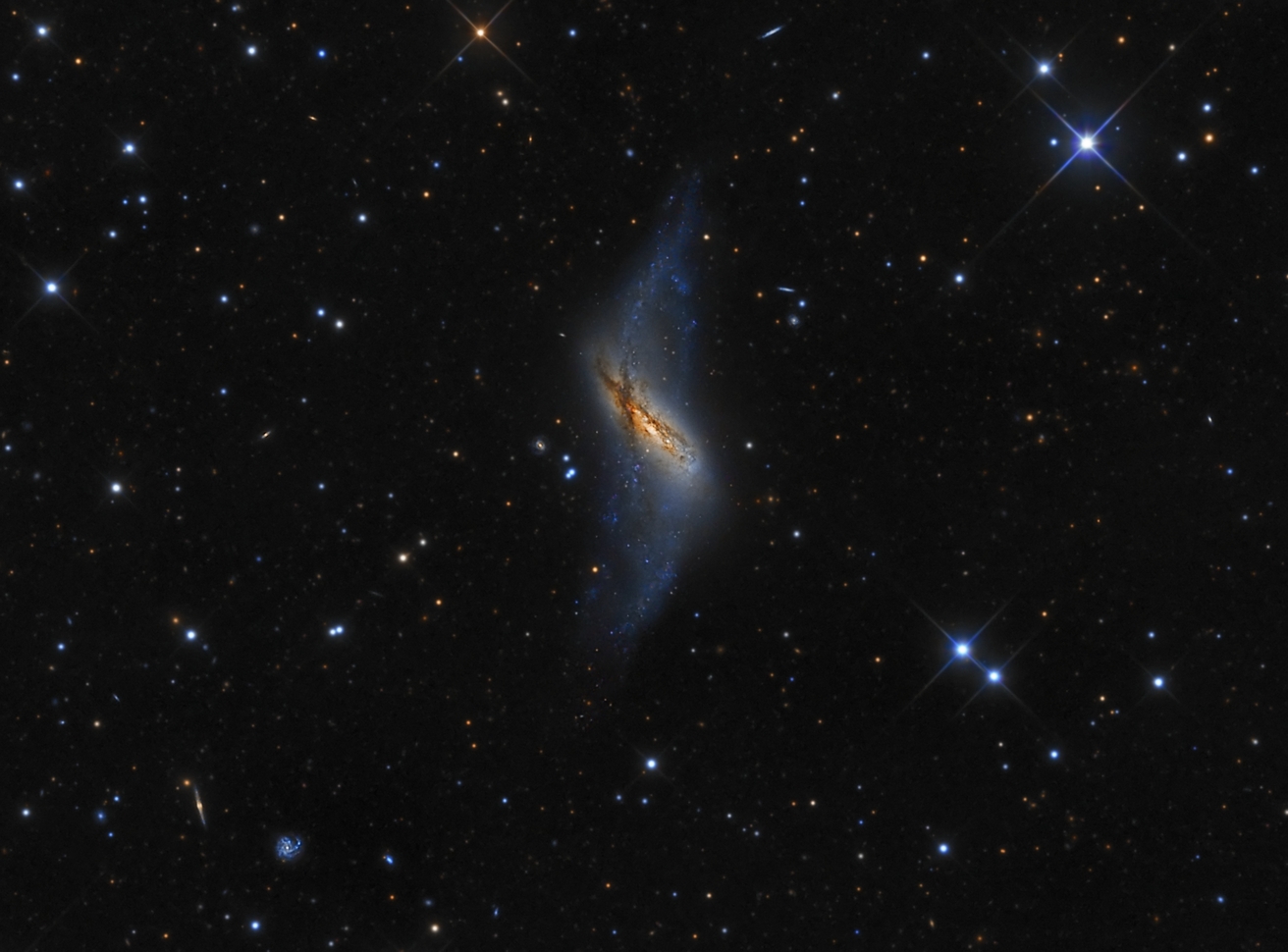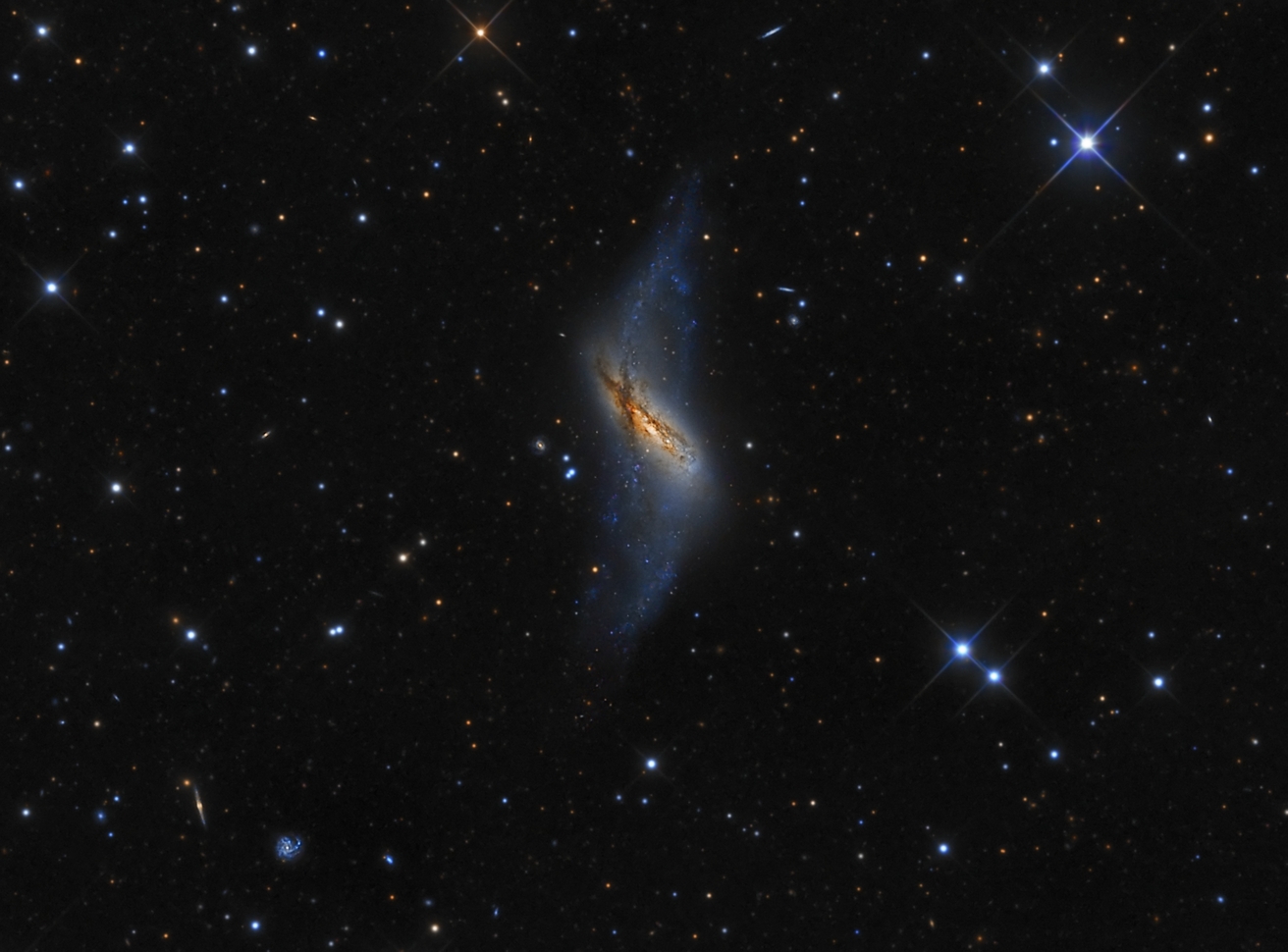
NGC 660 lies near the center of this intriguing skyscape, swimming in the boundaries of the constellation Pisces. Over 20 million light-years away, its peculiar appearance marks it as a polar ring galaxy. A rare galaxy type, polar ring galaxies have a substantial population of stars, gas, and dust orbiting in rings nearly perpendicular to the plane of the galactic disk. The bizarre configuration could have been caused by the chance capture of material from a passing galaxy by the disk galaxy, with the captured debris strung out in a rotating ring. The polar ring component can be used to explore the shape of the galaxy's otherwise unseen dark matter halo by calculating the dark matter's gravitational influence on the rotation of the ring and disk. Broader than the disk, NGC 660's ring spans about 40,000 light-years.
NGC 660 se encuentra cerca del centro de este intrigante paisaje celeste, en los límites de la constelación de Piscis. A más de 20 millones de años luz de distancia, su peculiar apariencia la identifica como una galaxia de anillo polar. Las galaxias de anillo polar son un tipo galáctico poco común, en el que una considerable población de estrellas, gas y polvo orbita en anillos casi perpendiculares al plano del disco galáctico. Esta bizarra configuración podría haberse originado por la captura fortuita de material proveniente de una galaxia cercana que pasó cerca del disco galáctico, quedando los restos capturados distribuidos en un anillo en rotación. El componente del anillo polar puede utilizarse para explorar la forma del halo de materia oscura, de otro modo invisible, calculando la influencia gravitacional de dicha materia oscura sobre la rotación tanto del anillo como del disco. Más amplio que el propio disco, el anillo de NGC 660 se extiende aproximadamente 40.000 años luz.