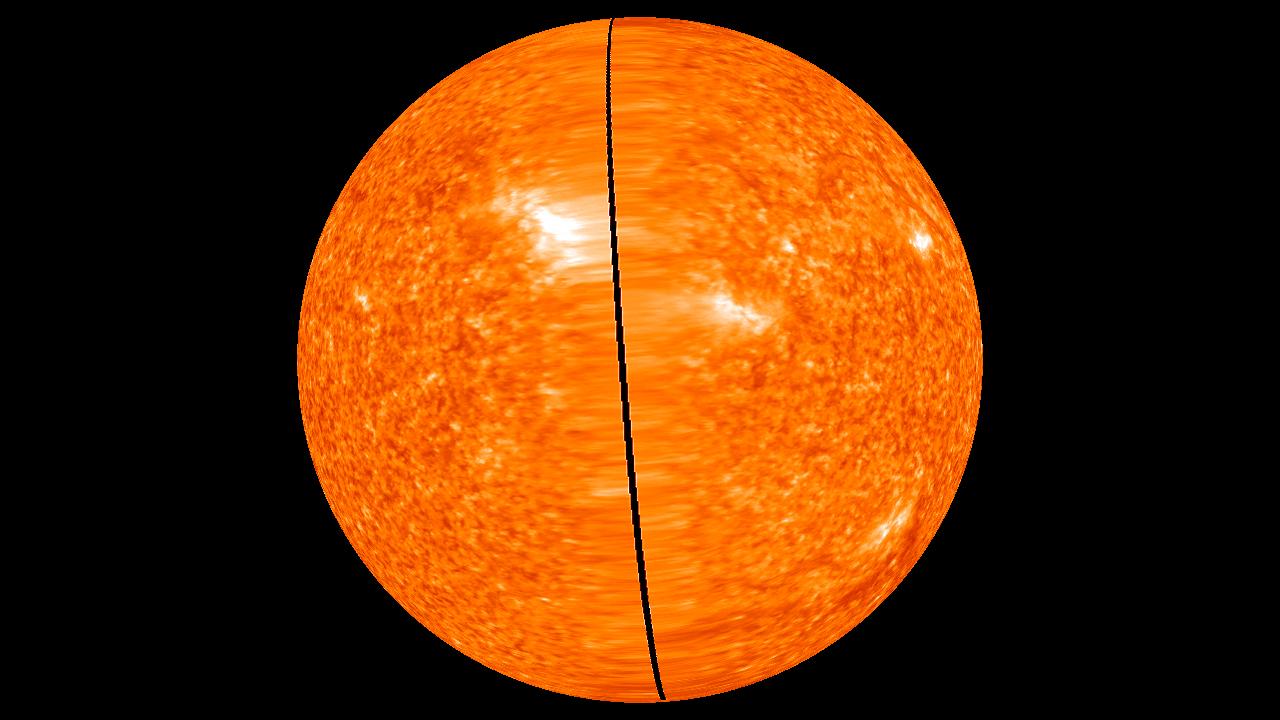
For the first time, the entire Sun is being imaged all at once. This has become possible because the two STEREO satellites orbiting and monitoring the Sun are now on opposite sides of the Sun. The two satellites have been drifting apart, as expected, since their launch in 2006, since one satellite orbits slightly closer to the Sun than the other. The above image shows nearly the entire Sun as it appeared one day last week, a few days before maximum exposure. Yesterday, the dark gap in the center closed completely, and STEREO was able to beam back to Earth full 360 degree images of the closest star. Full solar images are useful scientifically for a number of reasons, including catching rapidly evolving flares, coronal mass ejections, tsunamis, and filaments, no matter where they occur on the Sun, as well as monitoring days-long sunspots and active regions without losing them as they rotate out of view. Even though the STEREO satellites will continue to drift apart at about 44 degrees per year, Sun-staring instruments on or near the Earth will augment them to provide a full view of the Sun for the next several years. Students (young and old): See free lectures on astronomy
Por primera vez, el Sol completo está siendo observado en su totalidad de manera simultánea. Esto ha sido posible gracias a que los dos satélites STEREO que orbitan y monitorean el Sol se encuentran ahora en lados opuestos de nuestra estrella. Ambos satélites han ido separándose progresivamente, tal como se esperaba, desde su lanzamiento en 2006, ya que uno de ellos orbita ligeramente más cerca del Sol que el otro. La imagen presentada muestra casi la totalidad del Sol tal como se veía un día de la semana pasada, pocos días antes de la exposición máxima. Ayer, la brecha oscura en el centro se cerró por completo, y STEREO pudo transmitir a la Tierra imágenes completas de 360 grados de la estrella más cercana. Las imágenes solares completas son científicamente útiles por diversas razones, entre ellas la posibilidad de registrar llamaradas de rápida evolución, eyecciones de masa coronal, tsunamis y filamentos, independientemente del lugar del Sol donde ocurran, así como el seguimiento de manchas solares y regiones activas de varios días de duración sin perderlos de vista cuando rotan fuera del campo de observación. Aunque los satélites STEREO continuarán separándose a una velocidad aproximada de 44 grados por año, los instrumentos de observación solar ubicados en la Tierra o en sus proximidades los complementarán para proporcionar una vista completa del Sol durante los próximos años.