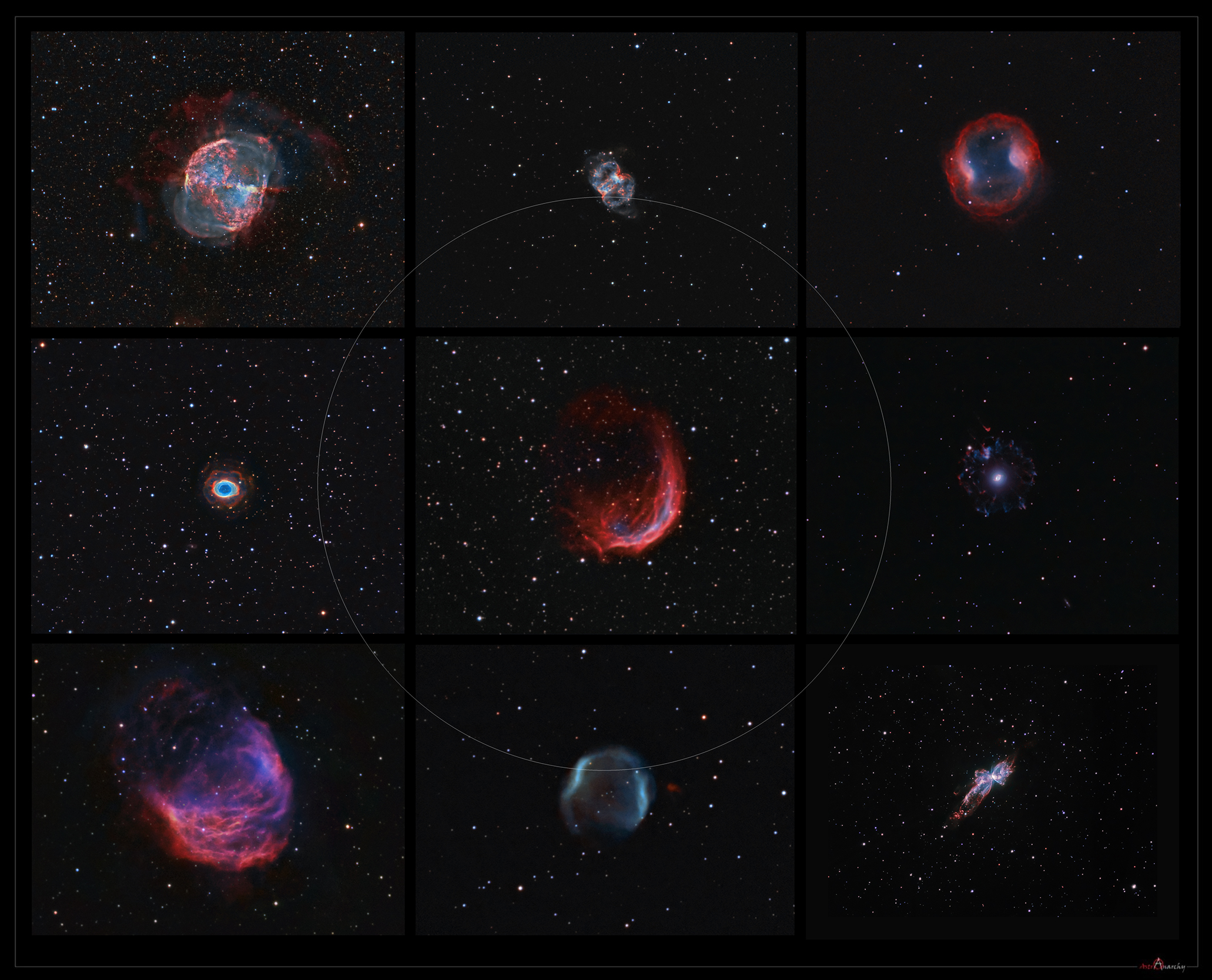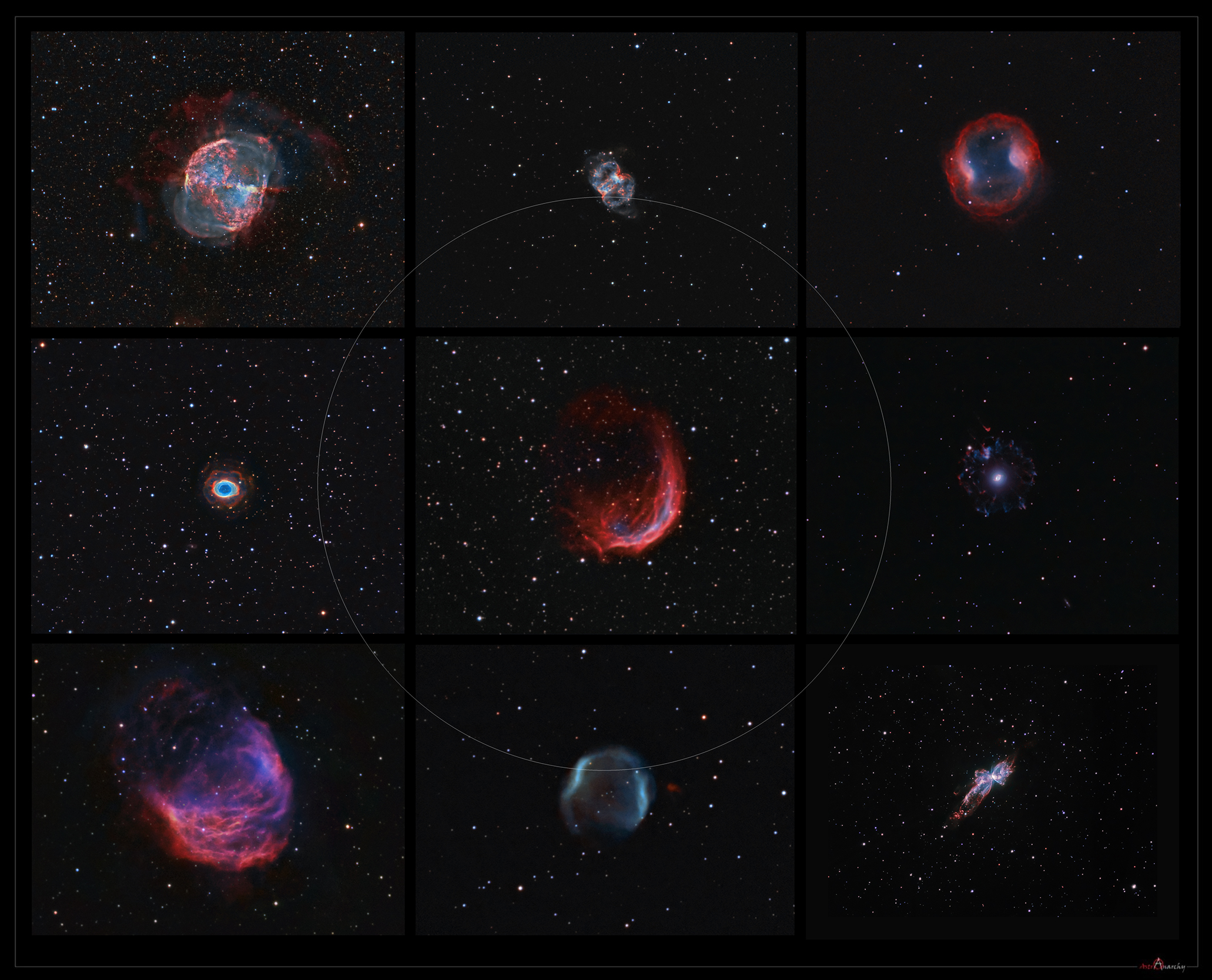
Cast off by dying sunlike stars, planetary nebulae are a brief but glorious final phase of stellar evolution. The gaseous shrouds are ionized by an extremely hot central source, the shrinking core of a star running out of fuel for nuclear fusion. Shining in the cosmic night, their simple symmetries are fascinating and have inspired this planetary nebula poster project. In it, nine planetaries are displayed for comparison in a 3x3 grid. Of course, planetary nebula fans should be able to pick out the bright Messier objects M27 - the Dumbbell Nebula, M76 - the Little Dumbbell, and M57 - the Ring Nebula, as well as NGC 6543, aka the Cat's Eye Nebula. Lesser known nebulae include the Medusa and the Bug. All the images were made with detailed narrow band data and are shown at the same angular scale, spanning 20 arc minutes (1/3 degree). At that scale, the grey circle represents the apparent size of the Full Moon. These planetary nebulae hint at the fate of our own Sun as its core runs out of nuclear fuel in another 5 billion years.
Expulsadas por estrellas moribundas similares al Sol, las nebulosas planetarias constituyen una fase final breve pero gloriosa de la evolución estelar. Los mantos gaseosos son ionizados por una fuente central extremadamente caliente: el núcleo en contracción de una estrella que se queda sin combustible para la fusión nuclear. Brillando en la noche cósmica, sus sencillas simetrías resultan fascinantes y han inspirado este proyecto de póster de nebulosas planetarias. En él, nueve nebulosas planetarias se exhiben para su comparación en una cuadrícula de 3×3. Por supuesto, los aficionados a las nebulosas planetarias podrán reconocer los brillantes objetos Messier M27 —la Nebulosa Dumbbell—, M76 —la Pequeña Dumbbell— y M57 —la Nebulosa del Anillo—, así como NGC 6543, también conocida como la Nebulosa del Ojo de Gato. Entre las nebulosas menos conocidas se encuentran la Medusa y el Insecto. Todas las imágenes fueron obtenidas con detallados datos de banda estrecha y se muestran a la misma escala angular, abarcando 20 minutos de arco (1/3 de grado). A esa escala, el círculo gris representa el tamaño aparente de la Luna llena. Estas nebulosas planetarias nos dan una pista sobre el destino de nuestro propio Sol, cuando su núcleo se quede sin combustible nuclear dentro de otros 5000 millones de años.