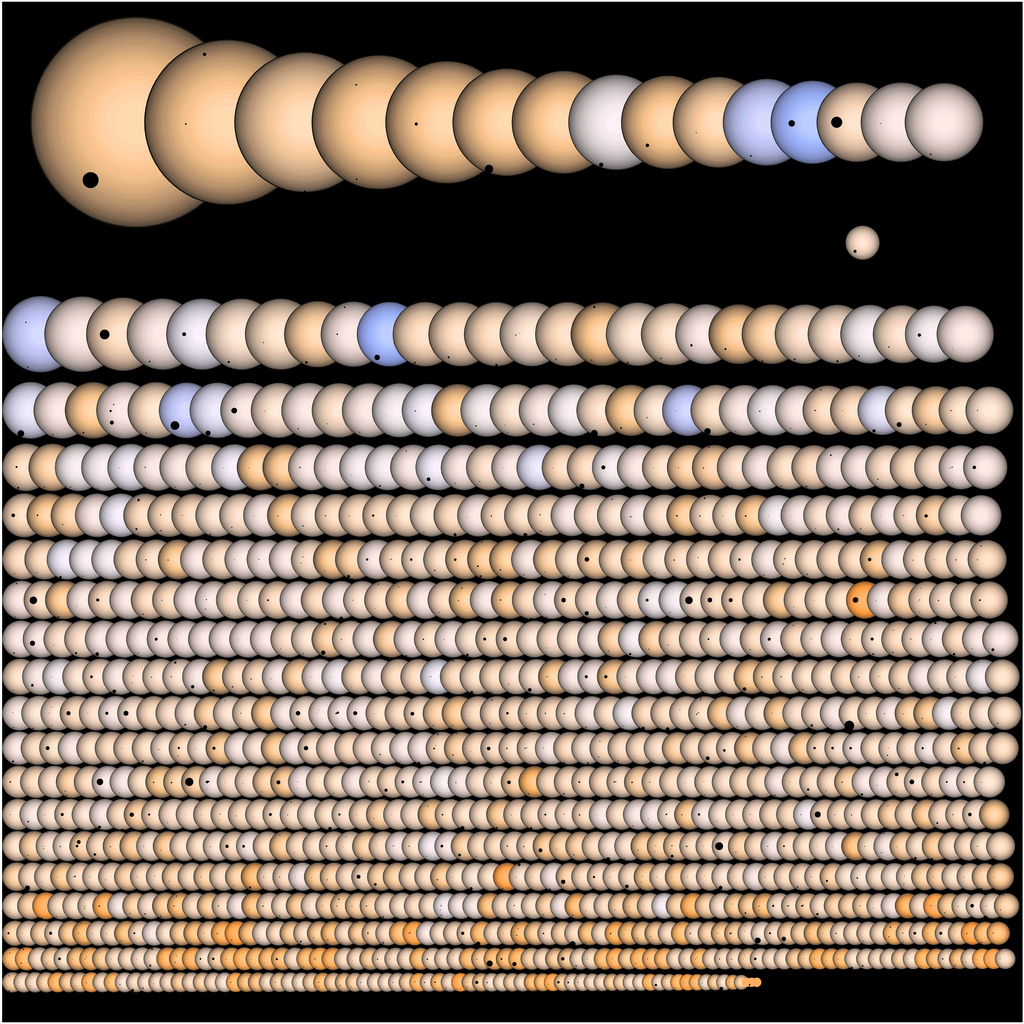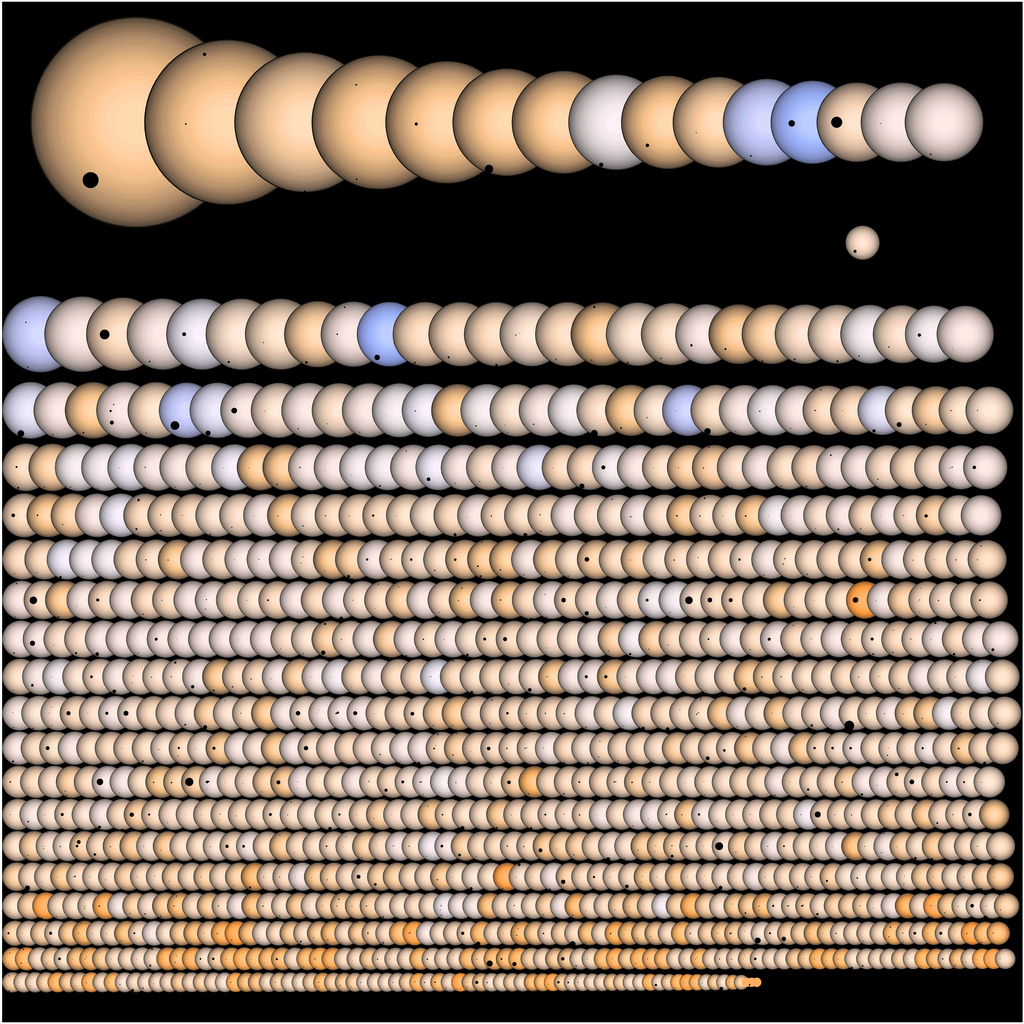
Using the prolific planet hunting Kepler spacecraft, astronomers have discovered 1,235 candidate planets orbiting other suns since the Kepler mission's search for Earth-like worlds began in 2009. To find them, Kepler monitors a rich star field to identify planetary transits by the slight dimming of starlight caused by a planet crossing the face of its parent star. In this remarkable illustration, all of Kepler's planet candidates are shown in transit with their parent stars ordered by size from top left to bottom right. Simulated stellar disks and the silhouettes of transiting planets are all shown at the same relative scale, with saturated star colors. Of course, some stars show more than one planet in transit, but you may have to examine the picture at high resolution to spot them all. For reference, the Sun is shown at the same scale, by itself below the top row on the right. In silhouette against the Sun's disk, both Jupiter and Earth are in transit.
Utilizando la prolífica nave espacial cazadora de planetas Kepler, los astrónomos han descubierto 1.235 planetas candidatos que orbitan otros soles desde que la misión Kepler inició su búsqueda de mundos similares a la Tierra en 2009. Para encontrarlos, Kepler monitorea un rico campo estelar con el fin de identificar tránsitos planetarios mediante la leve disminución del brillo estelar causada por un planeta al cruzar frente a su estrella progenitora. En esta notable ilustración, todos los planetas candidatos de Kepler se muestran en tránsito junto a sus estrellas progenitoras, ordenadas por tamaño de izquierda a derecha y de arriba hacia abajo. Los discos estelares simulados y las siluetas de los planetas en tránsito se presentan todos a la misma escala relativa, con colores estelares saturados. Por supuesto, algunas estrellas muestran más de un planeta en tránsito, aunque quizás sea necesario examinar la imagen en alta resolución para identificarlos todos. Como referencia, el Sol se muestra a la misma escala, por sí solo debajo de la fila superior a la derecha. En silueta contra el disco solar, tanto Júpiter como la Tierra se encuentran en tránsito.