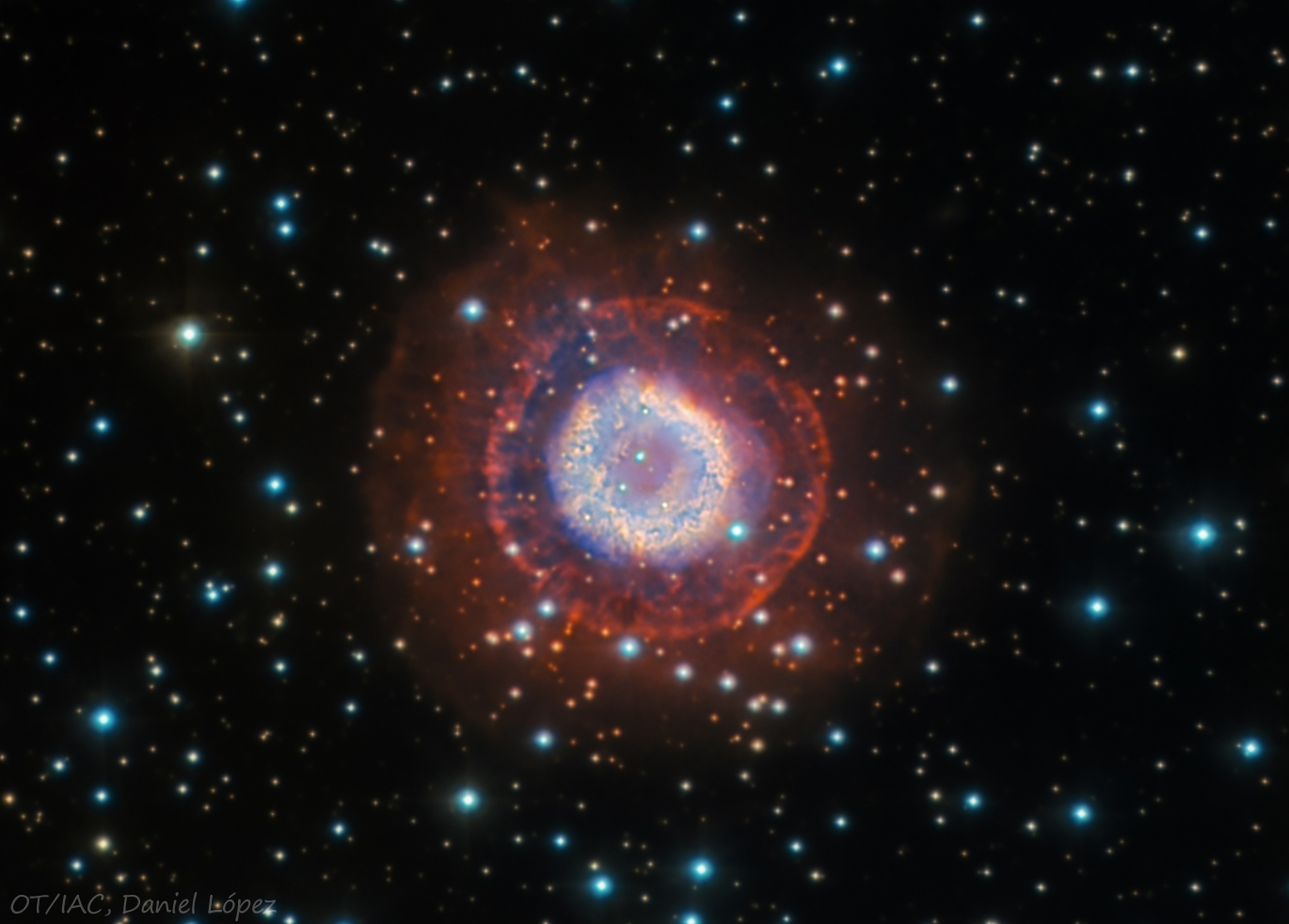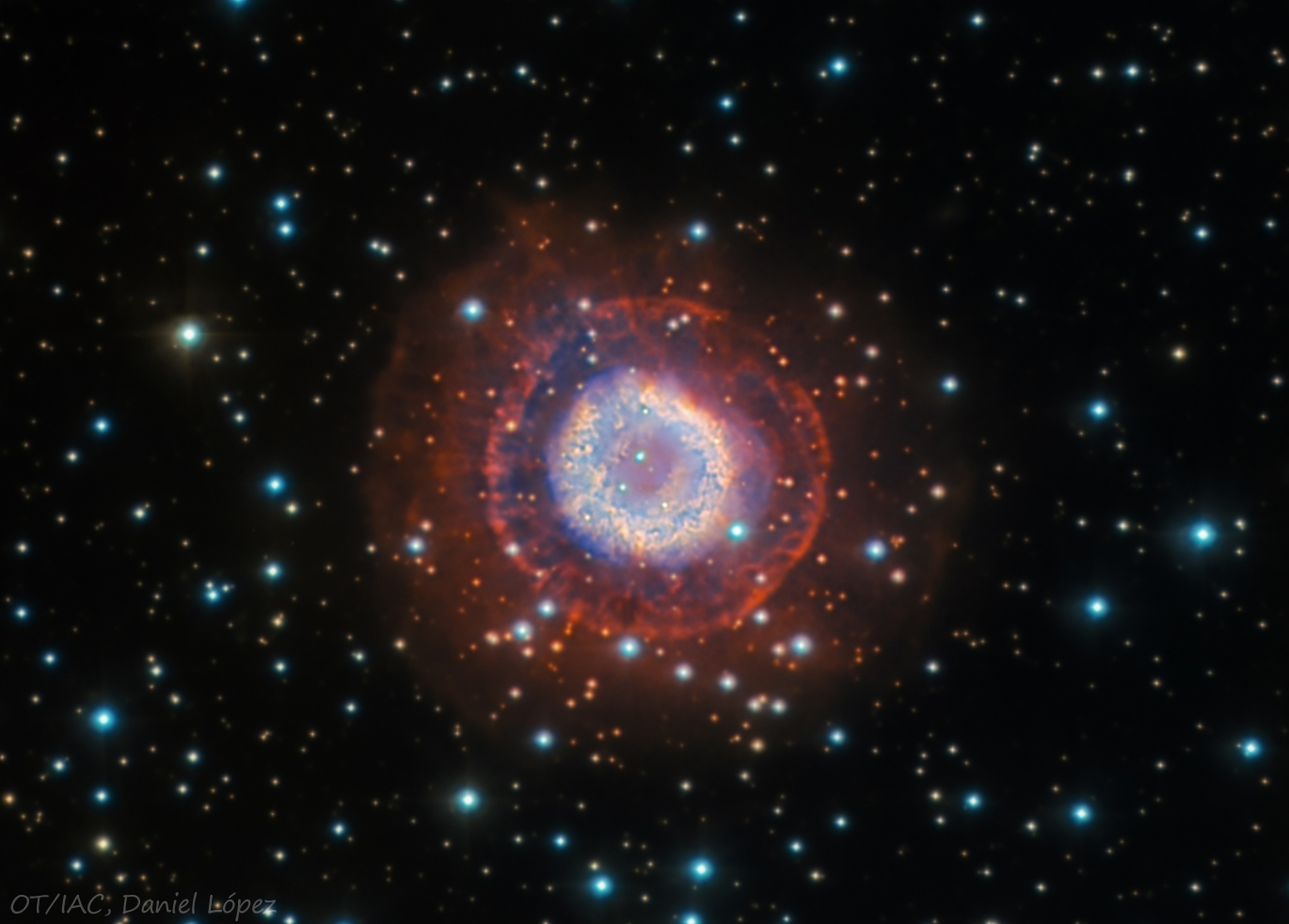
NGC 2438 is a planetary nebula, the gaseous shroud cast off by a dying sunlike star billions of years old whose central reservoir of hydrogen fuel has been exhausted. About 3,000 light-years distant it lies within the boundaries of the nautical constellation Puppis. Remarkably, NGC 2438 also seems to lie on the outskirts of bright, relatively young open star cluster M46. But this planetary nebula's central star is not only much older than the stars of M46, it moves through space at a different speed than the cluster stars. Distance estimates also place NGC 2438 closer than M46 and so the nebula appears in the foreground, only by chance along the line-of-sight to the young star cluster. This deep image of NGC 2438 highlights a halo of glowing atomic gas over 4.5 light-years across, extending beyond the nebula's brighter inner ring. Similar haloes have been found in deep images of other planetary nebulae, produced during the earlier active phases of their aging central stars.
NGC 2438 es una nebulosa planetaria, el sudario gaseoso expulsado por una estrella moribunda similar al Sol, de miles de millones de años de antigüedad, cuya reserva central de hidrógeno se ha agotado. Situada a unos 3.000 años-luz de distancia, se encuentra dentro de los límites de la constelación náutica de Puppis. Notablemente, NGC 2438 también parece ubicarse en las afueras del brillante y relativamente joven cúmulo estelar abierto M46. Sin embargo, la estrella central de esta nebulosa planetaria no solo es mucho más antigua que las estrellas de M46, sino que también se desplaza por el espacio a una velocidad diferente a la de las estrellas del cúmulo. Las estimaciones de distancia también sitúan a NGC 2438 más cerca que M46, por lo que la nebulosa aparece en primer plano, coincidiendo únicamente por azar con la línea de visión hacia el joven cúmulo estelar. Esta profunda imagen de NGC 2438 destaca un halo de gas atómico luminoso de más de 4,5 años-luz de extensión, que se prolonga más allá del anillo interior más brillante de la nebulosa. Halos similares han sido encontrados en imágenes profundas de otras nebulosas planetarias, producidos durante las fases activas anteriores de sus envejecidas estrellas centrales.