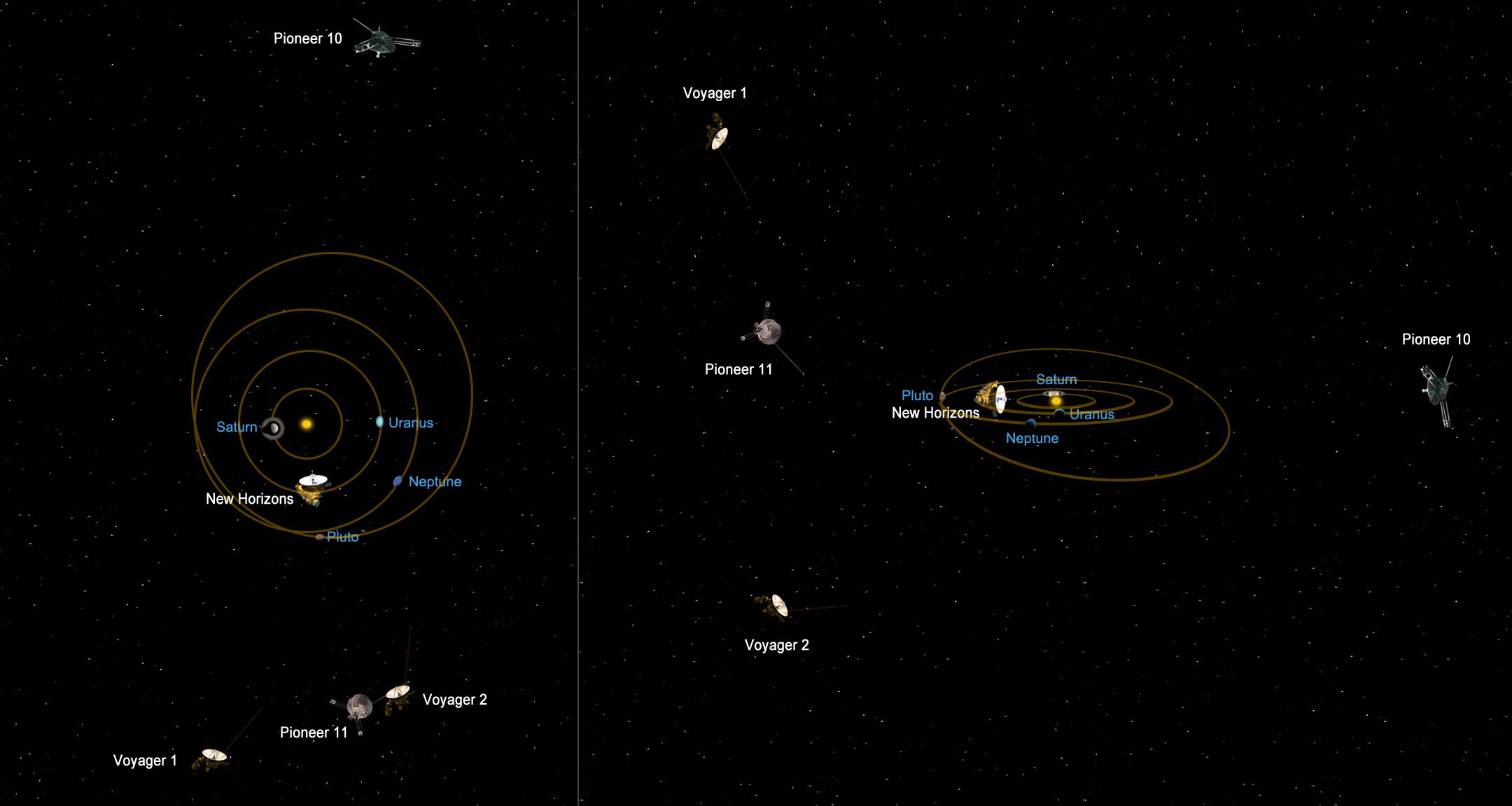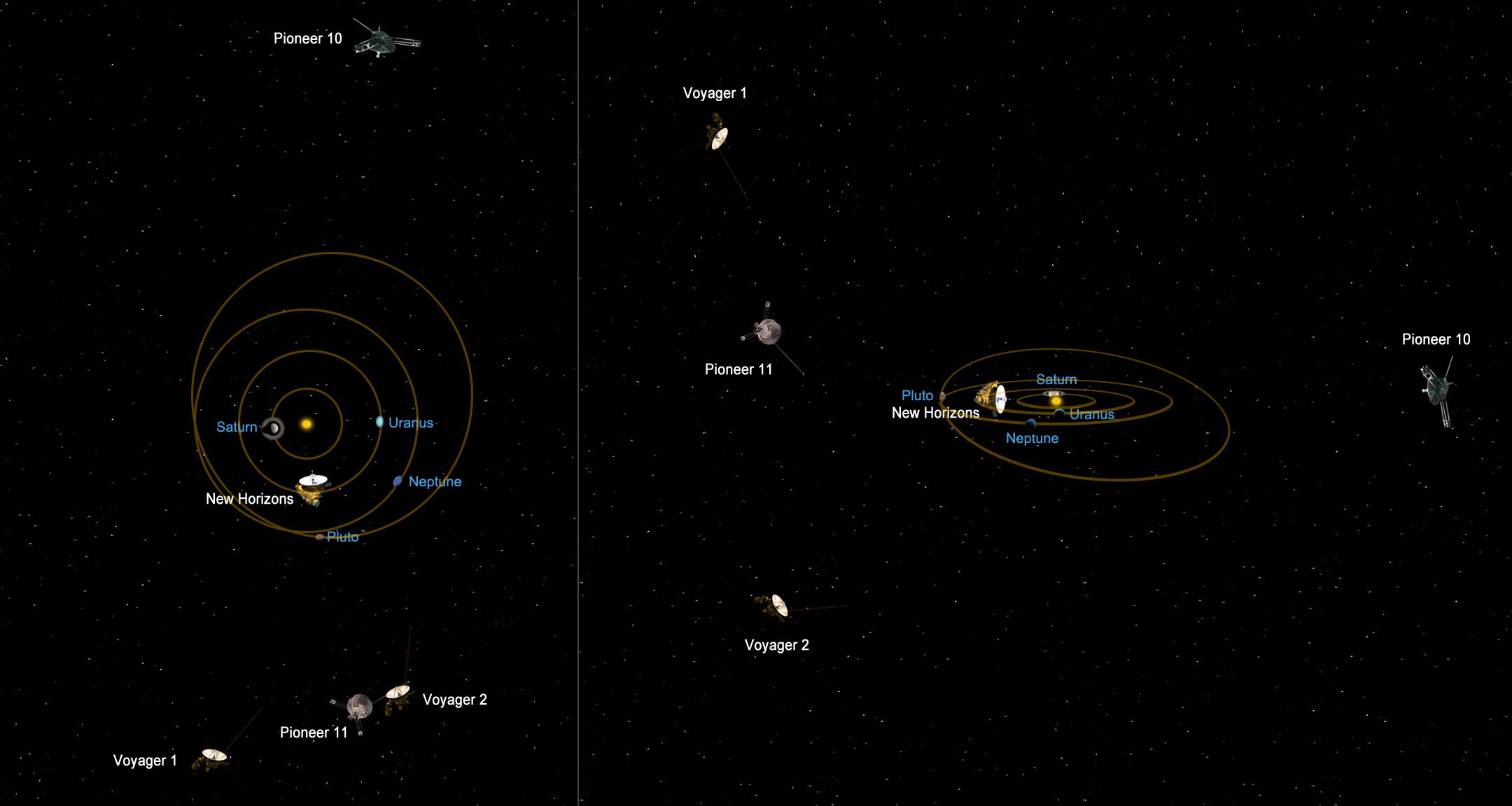
What is humanity's most distant spacecraft? Launched in 1977, Voyager 1 now holds that distinction at 17.5 billion kilometers from the Sun. That corresponds to 16 light-hours or 117 Astronomical Units (AU). This graphic shows the position of Voyager 1 relative to the outer solar system (top and side views) along with other distant spacecraft contenders. Next most distant, Pioneer 10 is about 15.4 billion kilometers from the Sun, though on the opposite side of the solar system from Voyager 1. Voyager 2 and Pioneer 11, both also well beyond the orbit of Pluto, are 14.2 billion and 12.4 billion kilometers from the Sun respectively. Still outbound for Pluto, the New Horizons spacecraft is presently 3 billion kilometers from the Sun and will encounter the Pluto system in July of 2015. All these spacecraft have used sling-shot style gravity assist maneuvers to increase their speeds through the outer solar system. Voyager 1 is moving the fastest, escaping the solar system at about 17 kilometers per second. Still operational, both Voyagers are headed towards the outer boundary of the solar system, in search of the heliopause and the beginning of interstellar space.
¿Cuál es la nave espacial más distante de la humanidad? Lanzada en 1977, la Voyager 1 ostenta actualmente ese récord, encontrándose a 17.500 millones de kilómetros del Sol. Eso equivale a 16 horas-luz o 117 Unidades Astronómicas (UA). Este gráfico muestra la posición de la Voyager 1 en relación con el sistema solar exterior (vistas superior y lateral), junto con otras naves espaciales candidatas a ese título. La siguiente más distante, la Pioneer 10, se encuentra a aproximadamente 15.400 millones de kilómetros del Sol, aunque en el lado opuesto del sistema solar respecto a la Voyager 1. La Voyager 2 y la Pioneer 11, ambas también muy por más allá de la órbita de Plutón, se encuentran a 14.200 millones y 12.400 millones de kilómetros del Sol, respectivamente. La nave espacial New Horizons, que aún se dirige hacia Plutón, se encuentra actualmente a 3.000 millones de kilómetros del Sol y llegará al sistema de Plutón en julio de 2015. Todas estas naves han utilizado maniobras de asistencia gravitacional —conocidas como 'efecto honda'— para incrementar su velocidad a través del sistema solar exterior. La Voyager 1 es la que se desplaza más rápido, escapando del sistema solar a unos 17 kilómetros por segundo. Todavía en funcionamiento, ambas Voyager se dirigen hacia el límite exterior del sistema solar, en busca de la heliopausa y el inicio del espacio interestelar.