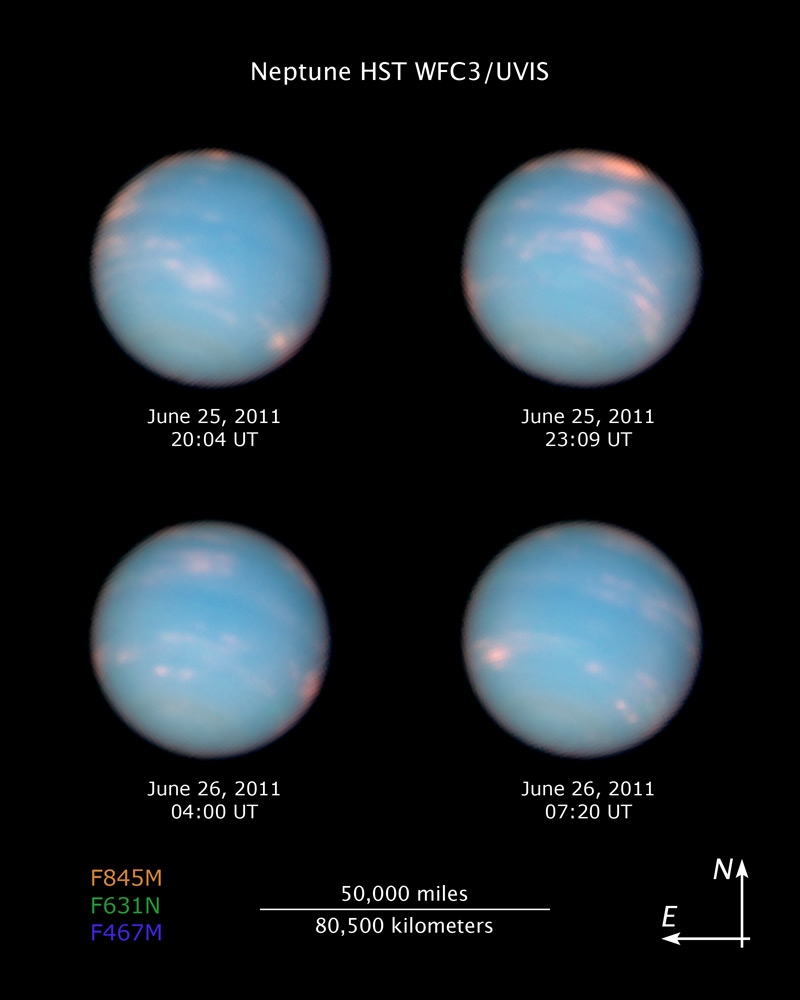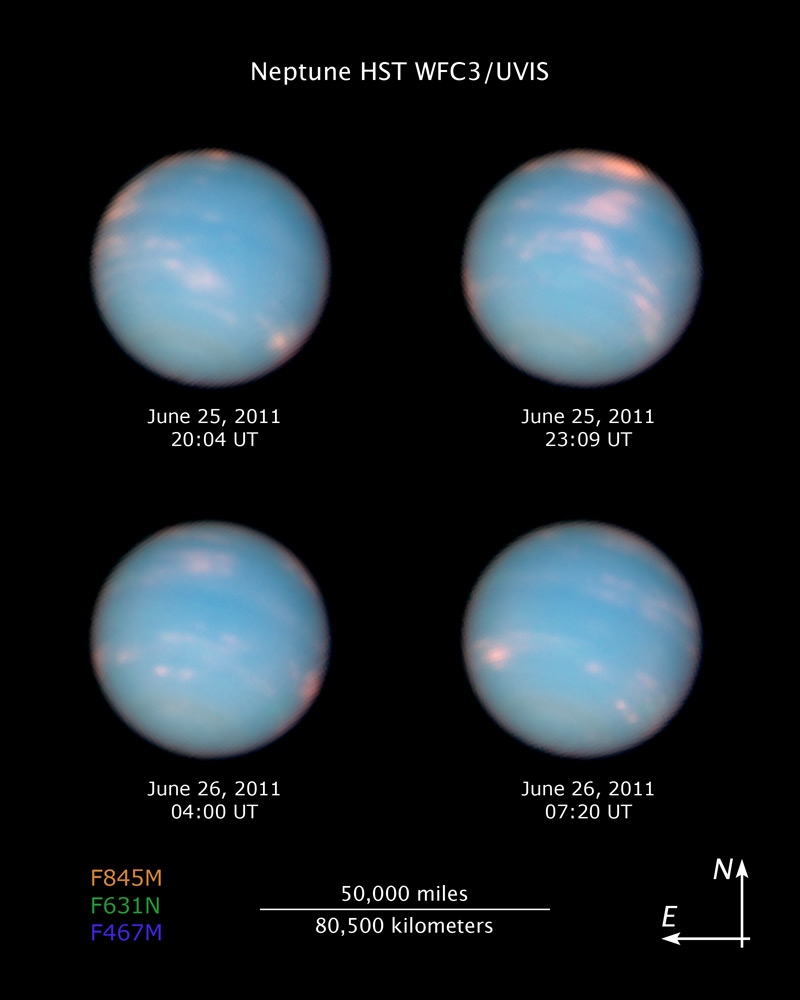
Neptune rotates once on its axis in about 16 hours. So, spaced about 4 hours apart these 4 images of the solar system's most distant gas giant cover one Neptune day. Recorded by the Hubble Space Telescope in late June they combine exposures made with visible and near-infrared filters to show high-altitude clouds composed of methane ice crystals against the planet's normally blue cloud tops. Because Neptune's axis of rotation is tilted to its orbital plane by 29 degrees, compared to Earth's 23.5 degrees, Neptune experiences seasons analogous to Earth's. As early summer comes to Neptune's southern hemisphere and winter to the north, Hubble observations have shown cloud activity shifting to the northern hemisphere. In fact the progression of Neptune's seasons has come around once since its position was predicted by French mathematician Urbain Le Verrier and British mathematician John Couch Adams, and the planet was subsequently discovered by German astronomer Johann Galle on September 23, 1846. With an orbital period of approximately 165 years, this week on July 12, Neptune has been once around the Sun since its discovery date.
Neptuno completa una rotación sobre su propio eje en aproximadamente 16 horas. Así, estas 4 imágenes del gigante gaseoso más distante del sistema solar, separadas entre sí por unos 4 horas, abarcan un día completo en Neptuno. Registradas por el Telescopio Espacial Hubble a finales de junio, combinan exposiciones obtenidas con filtros en el visible y el infrarrojo cercano para mostrar nubes de gran altitud compuestas por cristales de metano helado sobre las capas de nubes normalmente azules del planeta. Dado que el eje de rotación de Neptuno está inclinado 29 grados respecto a su plano orbital —frente a los 23,5 grados de la Tierra—, Neptuno experimenta estaciones análogas a las terrestres. A medida que el verano temprano llega al hemisferio sur de Neptuno y el invierno al norte, las observaciones del Hubble han mostrado que la actividad nubosa se desplaza hacia el hemisferio norte. De hecho, el ciclo completo de las estaciones de Neptuno ha transcurrido una vez desde que su posición fue predicha por el matemático francés Urbain Le Verrier y el matemático británico John Couch Adams, y el planeta fue descubierto posteriormente por el astrónomo alemán Johann Galle el 23 de septiembre de 1846. Con un período orbital de aproximadamente 165 años, esta semana, el 12 de julio, Neptuno ha completado una vuelta alrededor del Sol desde su fecha de descubrimiento.