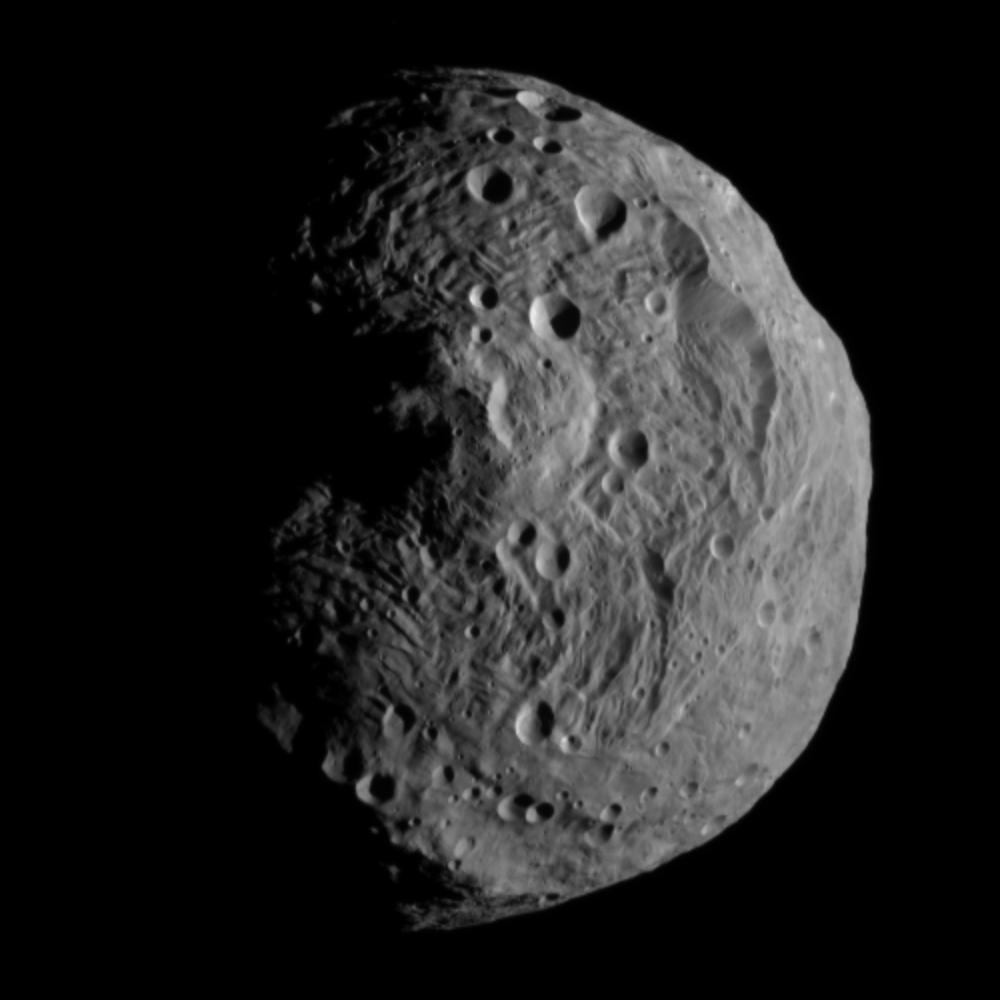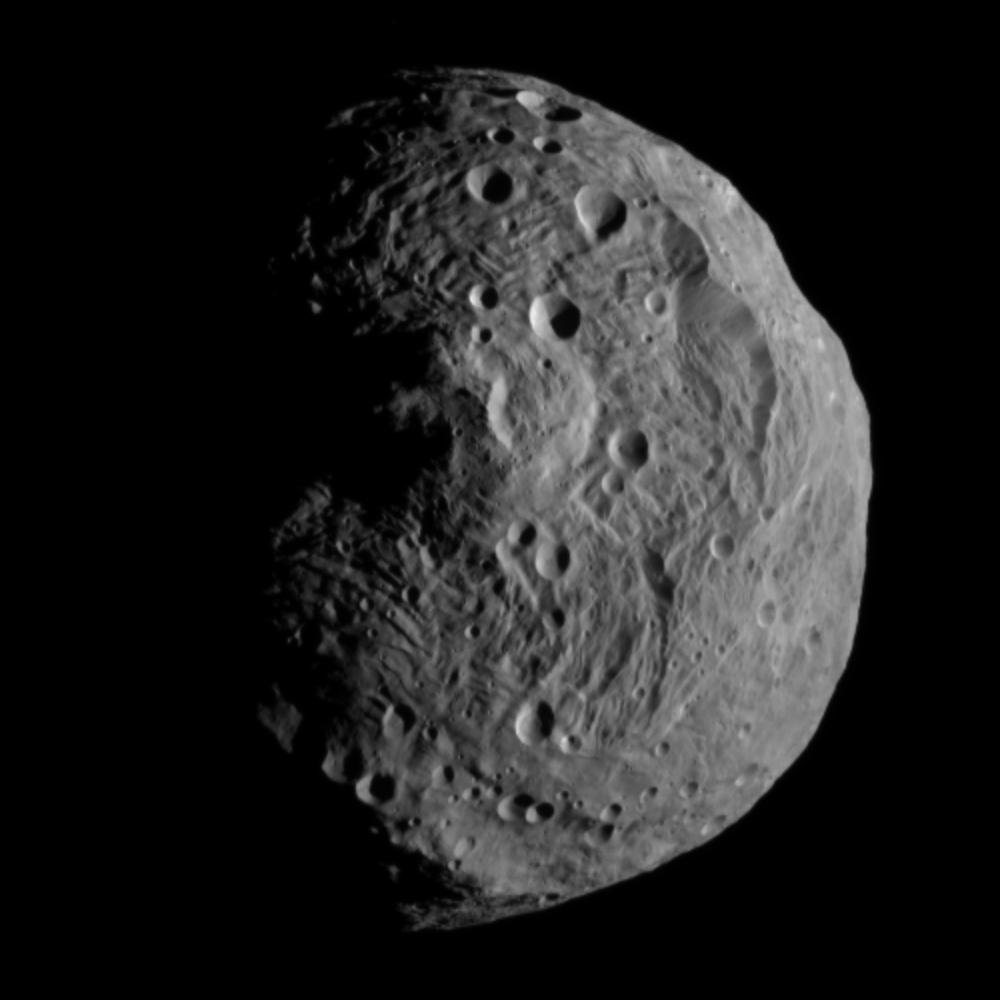
What does the surface of asteroid Vesta look like? The brightest asteroid in the Solar System and the object which takes up about 10 percent of the entire mass of the main asteroid belt had never been seen up close before. Over the past few weeks, however, the robotic Dawn spacecraft became the first spacecraft ever to approach Vesta. A few days ago, just after attaining orbit, Dawn took the above image. Early images show Vesta to be an old and battered world, covered with craters, bulges, grooves, and cliffs. Studying Vesta may give clues to the formative years of our early Solar System, as the unusual world may be one of the largest remaining protoplanets. After a year of studying Vesta, Dawn is scheduled to leave orbit and, in 2015, approach the only asteroid-belt object that is larger: Ceres. Poll: Which of these recently submitted images would make good future APODs?
¿Cómo es la superficie del asteroide Vesta? El asteroide más brillante del Sistema Solar, que representa aproximadamente el 10 por ciento de la masa total del cinturón de asteroides principal, nunca había sido observado de cerca. Sin embargo, durante las últimas semanas, la sonda robótica Dawn se convirtió en la primera nave espacial en aproximarse a Vesta. Hace unos días, justo después de alcanzar la órbita, Dawn capturó la imagen que se muestra arriba. Las primeras imágenes revelan que Vesta es un mundo antiguo y muy deteriorado, cubierto de cráteres, protuberancias, surcos y acantilados. El estudio de Vesta podría ofrecer pistas sobre los primeros años de formación de nuestro Sistema Solar, ya que este singular mundo podría ser uno de los protoplanetas más grandes que aún se conservan. Tras un año de estudio de Vesta, la sonda Dawn tiene previsto abandonar su órbita y, en 2015, aproximarse al único objeto del cinturón de asteroides que es más grande: Ceres.