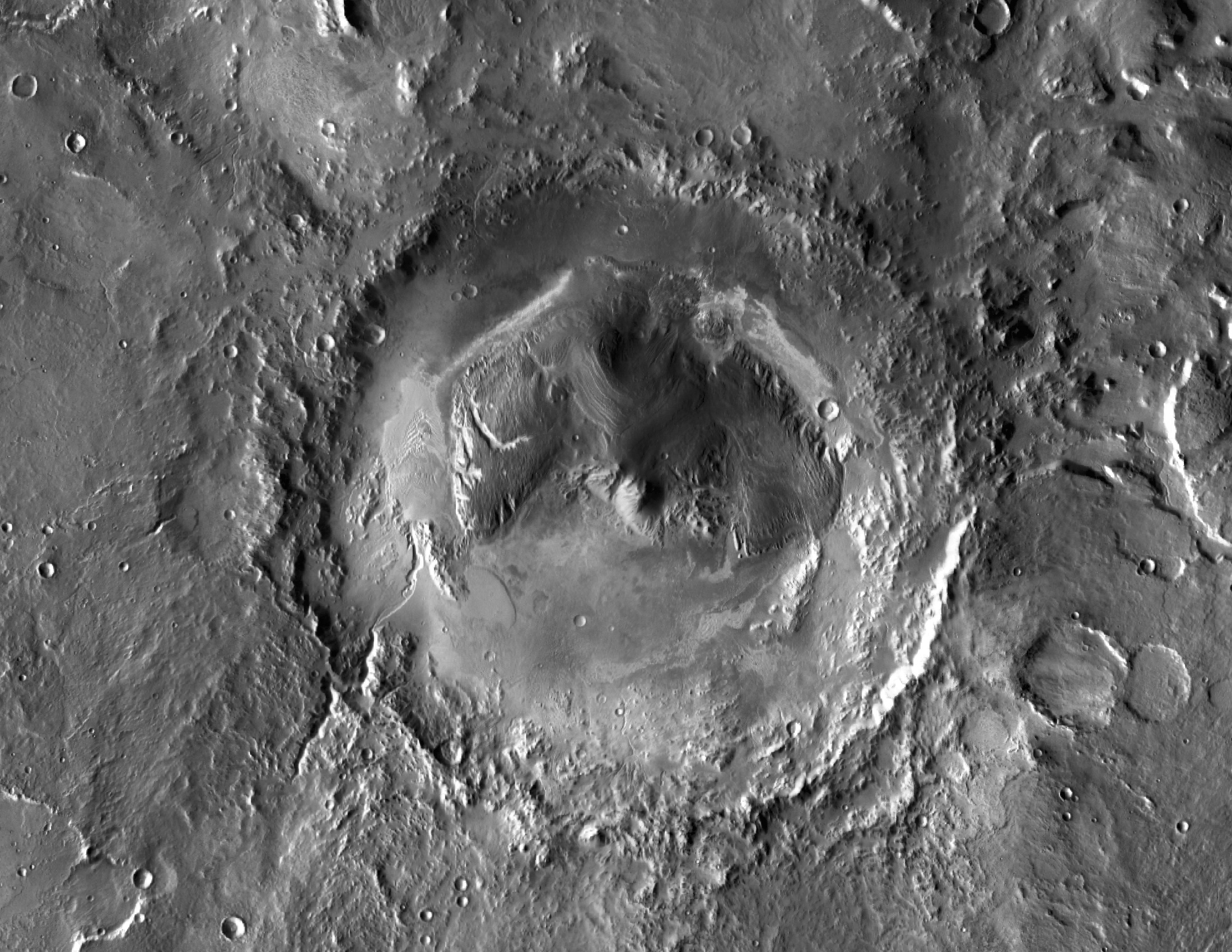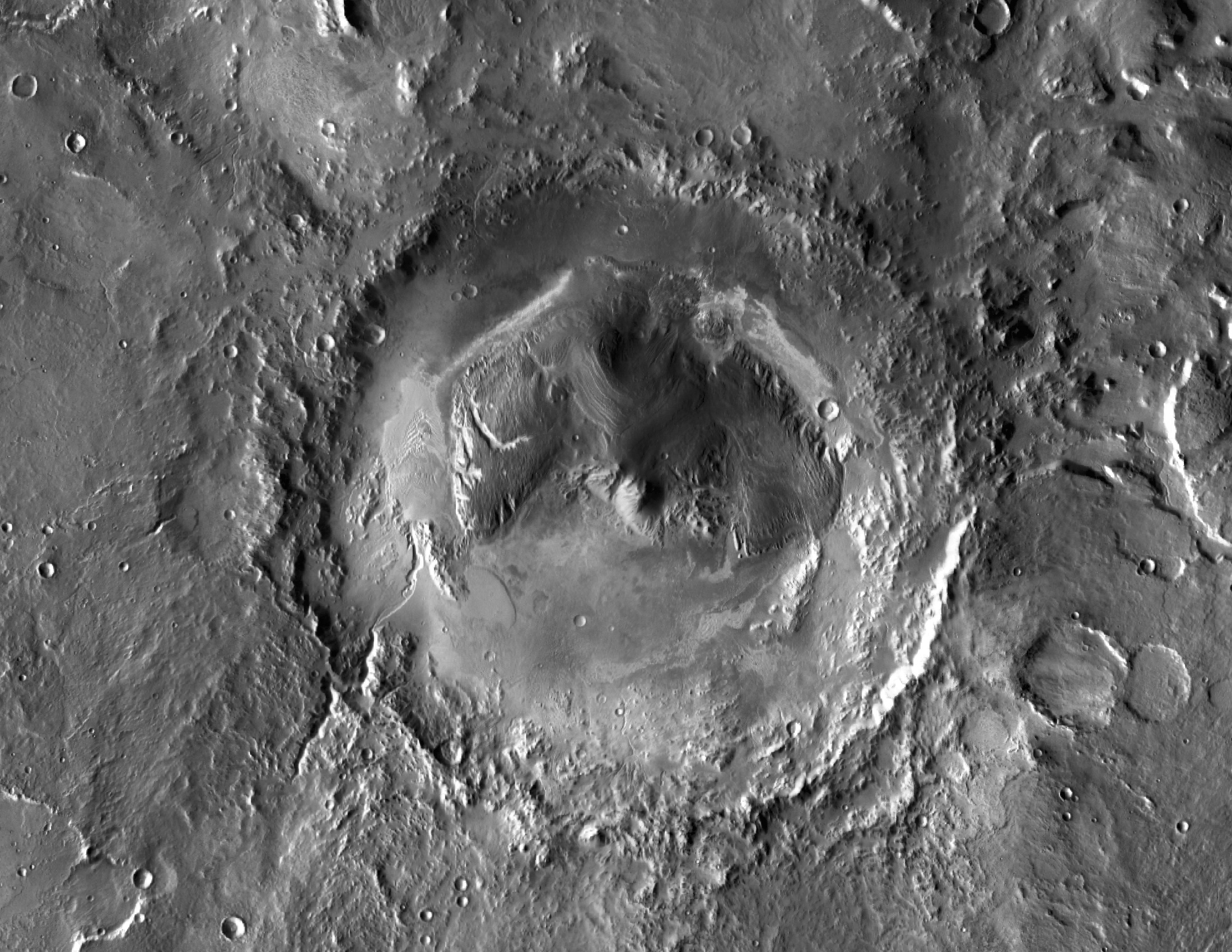
This sharp view from the Thermal Emission Imaging System camera on NASA's Mars Odyssey orbiter is centered on 154 kilometer (96 mile) wide Gale crater, near the martian equator. Within Gale, an impressive layered mountain rises about 5 kilometers (3 miles) above the crater floor. Layers and structures near its base are thought to have been formed in ancient times by water-carried sediments. In fact, a spot near the crater's northern side at the foot of the mountain has now been chosen as the target for the Mars Science Laboratory mission. Scheduled for launch late this year, the mission will land Mars' next visitor from planet Earth in August of 2012, lowering the car-sized Curiosity rover to the martian surface with a hovering, rocket-powered skycrane. Curiosity's science instruments are intended to discover if Gale once had favorable environmental conditions for supporting microbial life and for preserving clues about whether life ever existed on the Red Planet.
Esta nítida imagen obtenida por la cámara del Sistema de Imágenes por Emisión Térmica (THEMIS) a bordo del orbitador Mars Odyssey de la NASA está centrada en el cráter Gale, de 154 kilómetros (96 millas) de diámetro, ubicado cerca del ecuador marciano. En el interior de Gale, una imponente montaña de estratos se eleva aproximadamente 5 kilómetros (3 millas) sobre el suelo del cráter. Se cree que las capas y estructuras presentes en su base se formaron en épocas antiguas a partir de sedimentos transportados por el agua. De hecho, un punto cercano al lado norte del cráter, a los pies de la montaña, ha sido seleccionado como destino de la misión Mars Science Laboratory. Prevista para su lanzamiento a finales de este año, la misión depositará al próximo visitante terrestre en Marte en agosto de 2012, haciendo descender el róver Curiosity —del tamaño de un automóvil— sobre la superficie marciana mediante una grúa aérea propulsada por cohetes. Los instrumentos científicos de Curiosity tienen como objetivo determinar si Gale reunió alguna vez las condiciones ambientales favorables para albergar vida microbiana y para preservar indicios sobre si alguna vez existió vida en el Planeta Rojo.