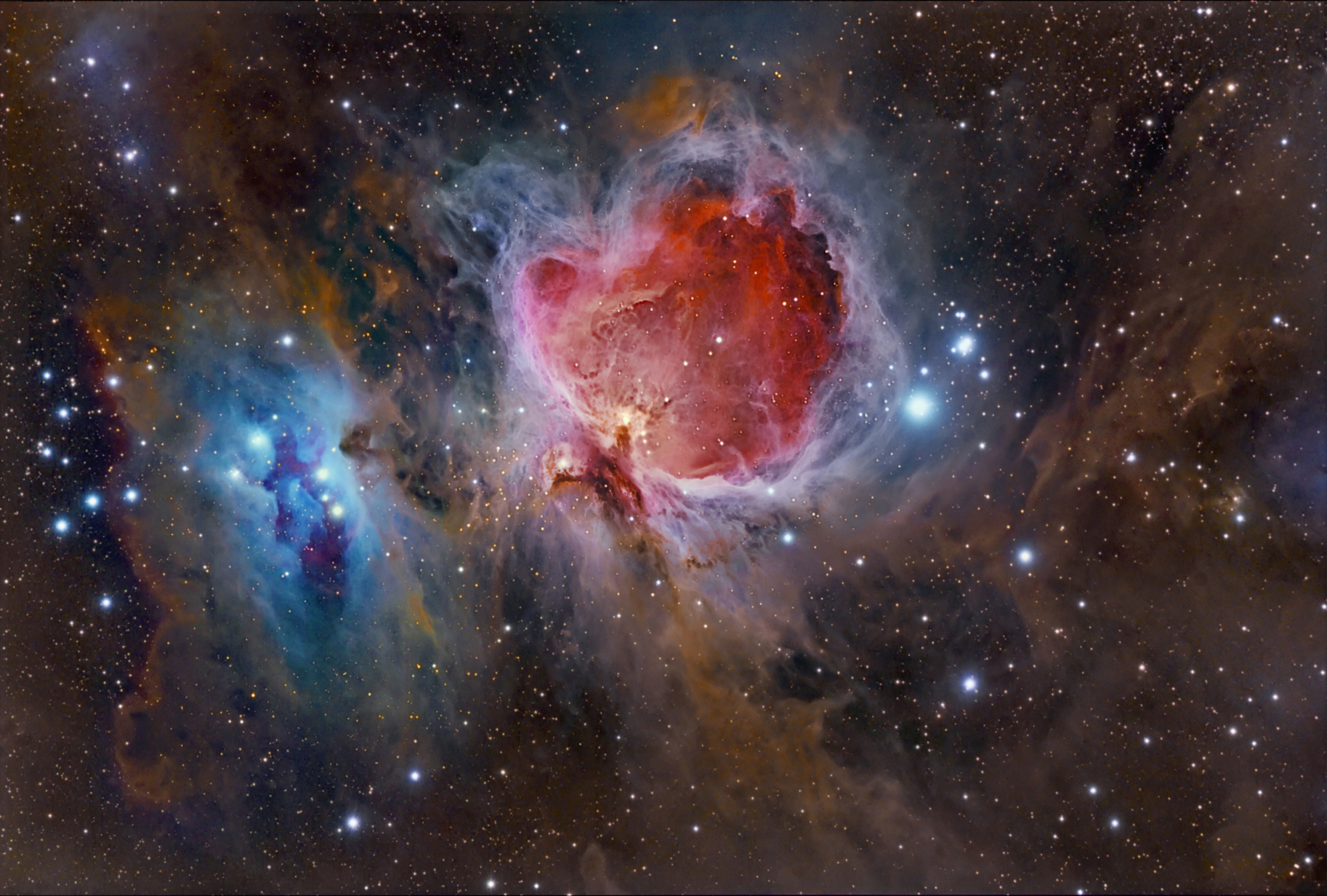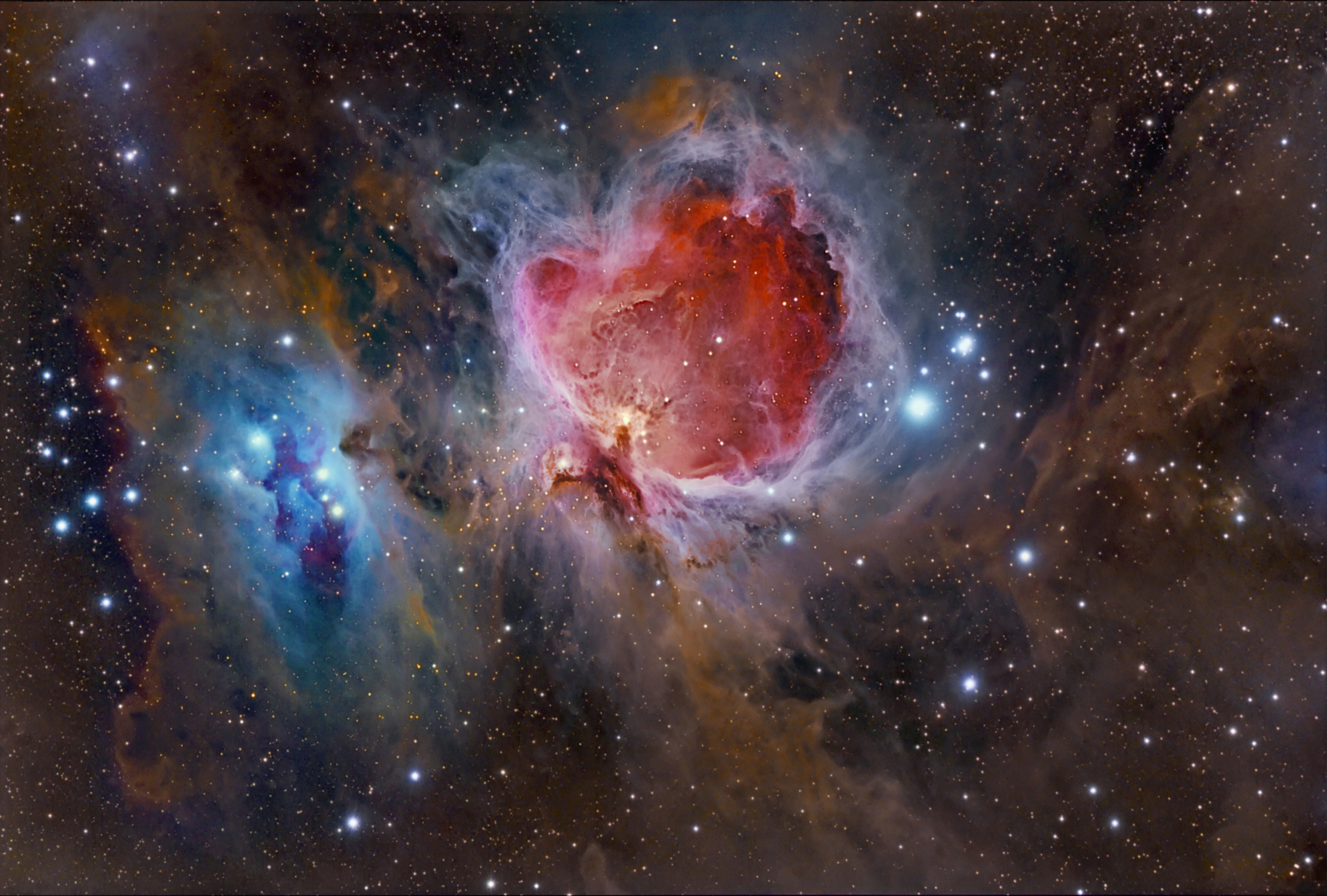
The Great Nebula in Orion, also known as M42, is one of the most famous nebulas in the sky. The star forming region's glowing gas clouds and hot young stars are on the right in this sharp and colorful image that includes the smaller nebula M43 near center and dusty, bluish reflection nebulae NGC 1977 and friends on the left. Located at the edge of an otherwise invisible giant molecular cloud complex, these eye-catching nebulae represent only a small fraction of this galactic neighborhood's wealth of interstellar material. Within the well-studied stellar nursery, astronomers have also identified what appear to be numerous infant planetary systems. The gorgeous skyscape spans nearly two degrees or about 45 light-years at the Orion Nebula's estimated distance of 1,500 light-years.
La Gran Nebulosa de Orión, también conocida como M42, es una de las nebulosas más célebres del cielo. Las luminosas nubes de gas de esta región de formación estelar y sus jóvenes y calientes estrellas se encuentran a la derecha en esta nítida y colorida imagen, que incluye la nebulosa menor M43 en el centro, y las nebulosas de reflexión NGC 1977 y sus vecinas, de aspecto polvoriento y tonalidad azulada, a la izquierda. Situadas en el borde de un enorme complejo de nubes moleculares por lo demás invisible, estas llamativas nebulosas representan tan solo una pequeña fracción de la riqueza de material interestelar que alberga este vecindario galáctico. Dentro de este extensamente estudiado vivero estelar, los astrónomos han identificado también lo que parecen ser numerosos sistemas planetarios en sus primeras etapas de formación. Este magnífico paisaje celeste abarca casi dos grados, o aproximadamente 45 años-luz, a la distancia estimada de 1.500 años-luz a la que se encuentra la Nebulosa de Orión.