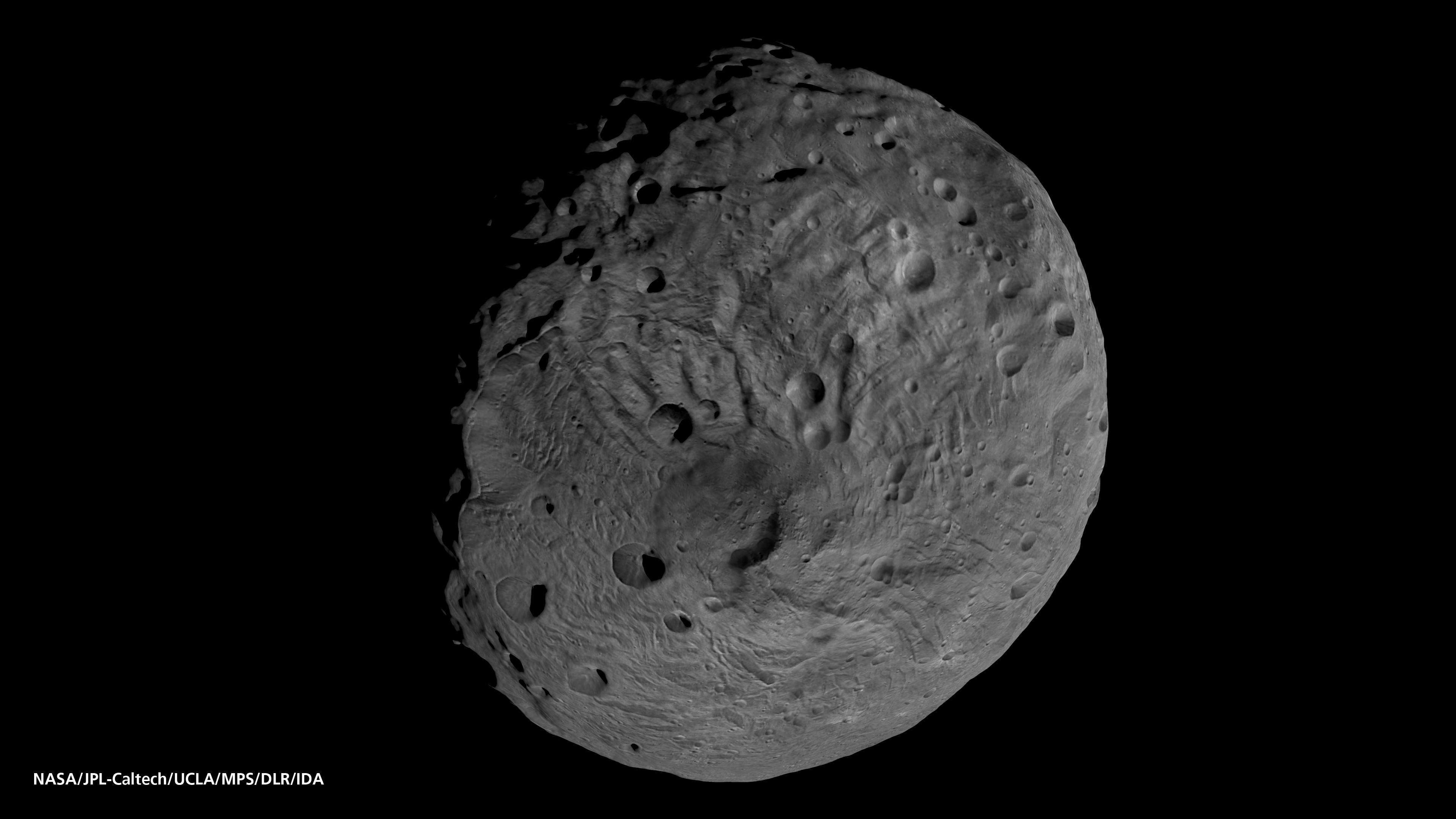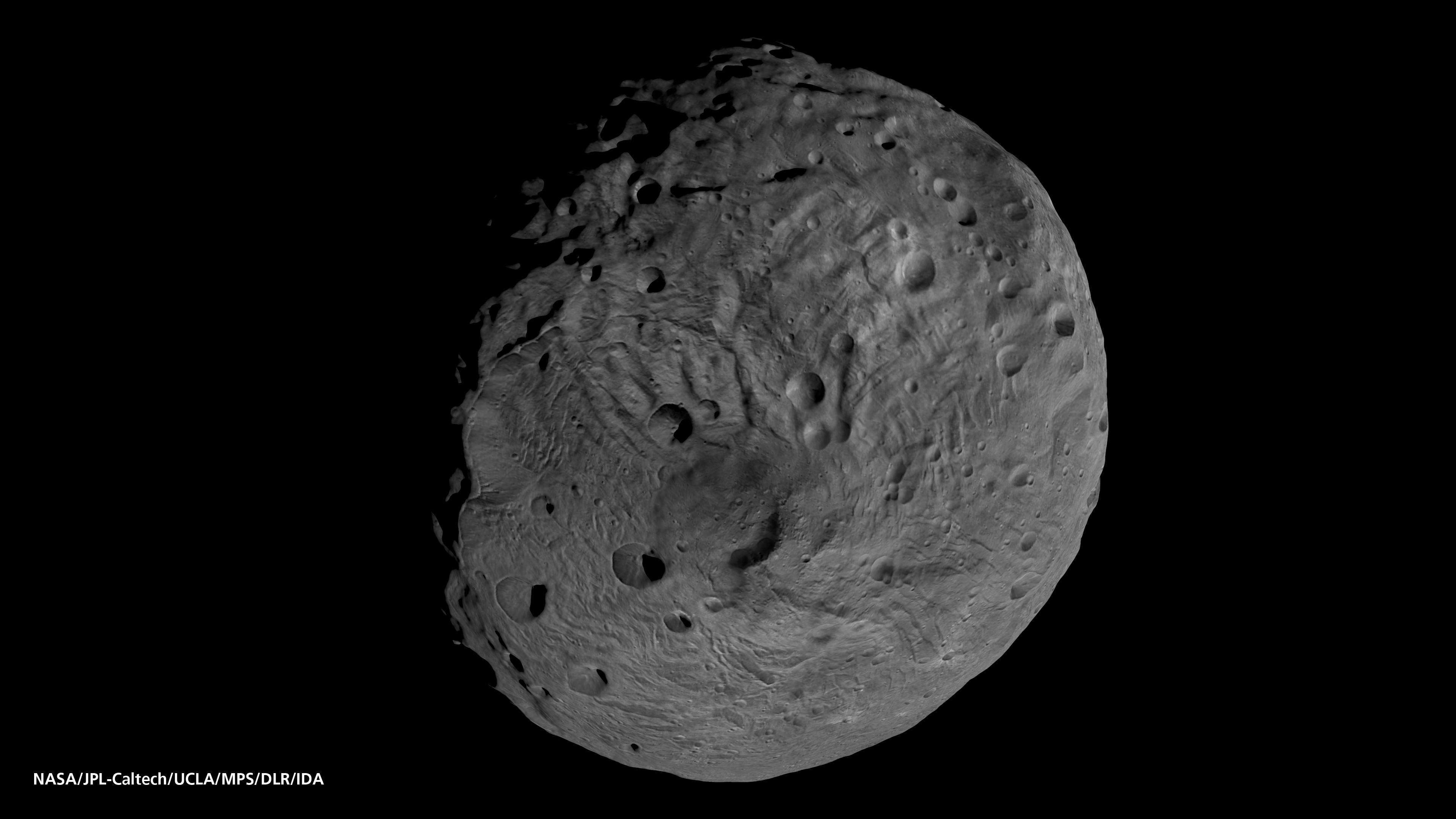
What created the circular structure around the south pole of asteroid Vesta? Pictured above, the bottom of the second largest object in the asteroid belt was recently imaged for the first time by the robotic Dawn satellite that arrived last month. A close inspection of the 260-meter resolution image shows not only hills and craters and cliffs and more craters, but ragged circular features that cover most of the lower right of the 500-kilometer sized object. Early speculation posits that the structure might have been created by a collision and coalescence with a smaller asteroid. Alternatively, the features might have originated in an internal process soon after the asteroid formed. New clues might come in the next few months as Dawn spirals down toward the rocky world and obtains images of increasingly high resolution.
¿Qué originó la estructura circular que rodea el polo sur del asteroide Vesta? La imagen mostrada arriba corresponde a la primera vez que se fotografió la parte inferior del segundo objeto más grande del cinturón de asteroides, captada recientemente por la sonda robótica Dawn, que llegó a su destino el mes pasado. Una inspección detallada de la imagen, con una resolución de 260 metros, revela no solo colinas, cráteres y acantilados, sino también rasgos circulares irregulares que cubren la mayor parte de la región inferior derecha de este objeto de 500 kilómetros de diámetro. Las primeras hipótesis sugieren que dicha estructura podría haberse formado por la colisión y fusión con un asteroide de menor tamaño. Alternativamente, estas características podrían haber tenido su origen en un proceso interno ocurrido poco después de la formación del asteroide. En los próximos meses podrían obtenerse nuevas pistas, a medida que Dawn descienda en espiral hacia este mundo rocoso y capture imágenes de resolución progresivamente mayor.