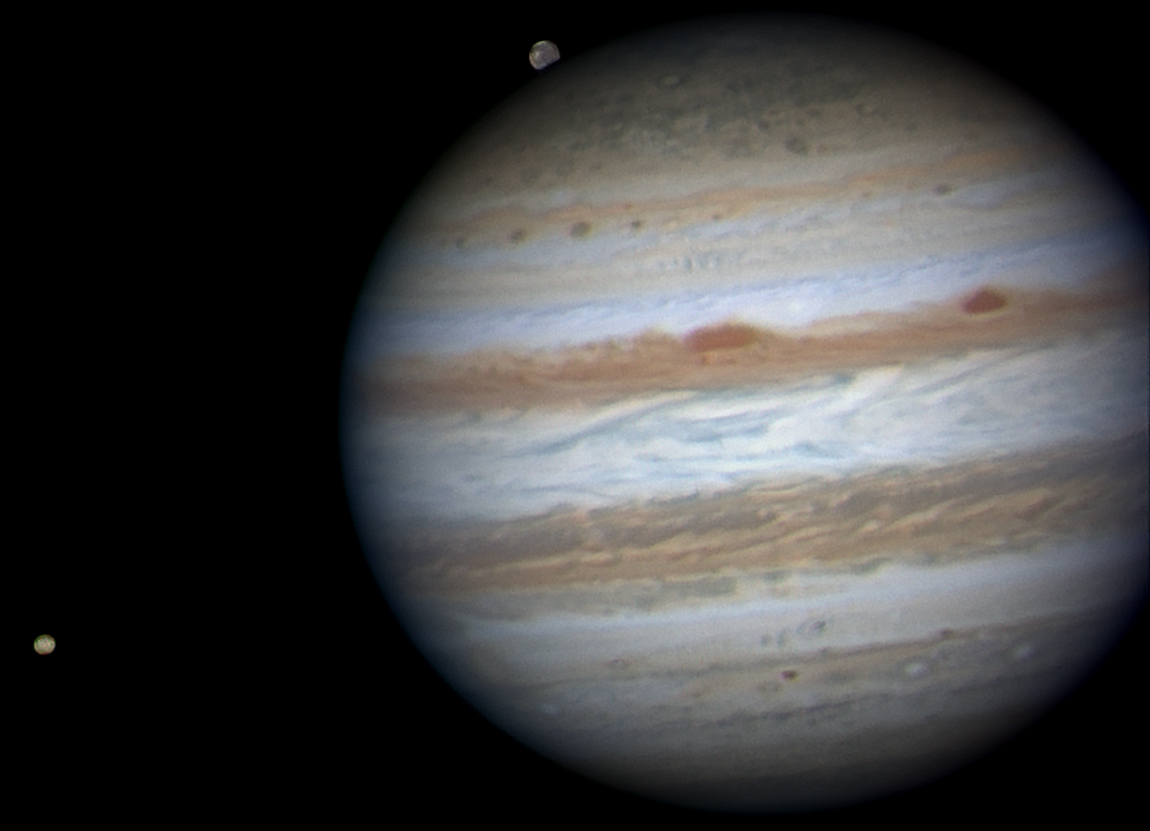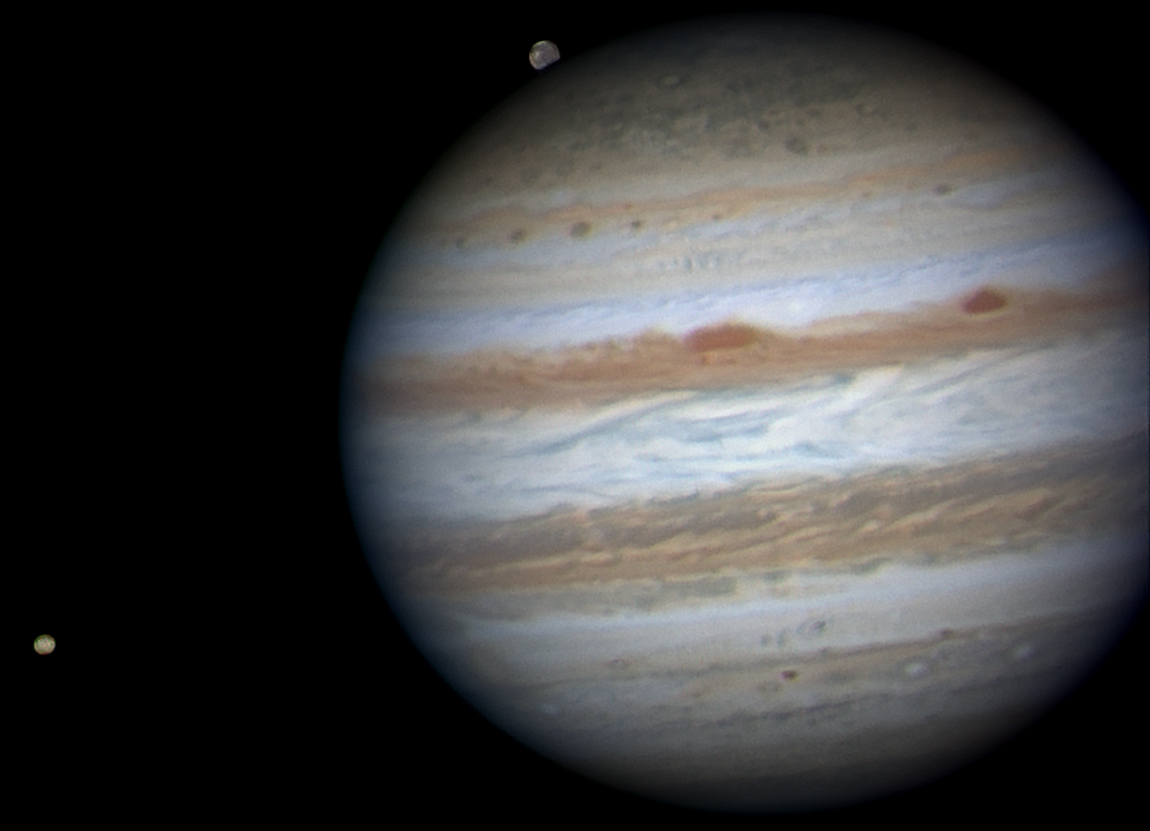
On October 29 (UT), Jupiter, the solar system's largest planet, will be at opposition, opposite the Sun in planet Earth's sky, shining brightly and rising as the Sun sets. That configuration results in Jupiter's almost annual closest approach to planet Earth, so near opposition the gas giant offers earthbound telescopes stunning views of its stormy, banded atmosphere and large Galilean moons. This sharp snapshot of Jupiter was captured on October 13 with the 1 meter telescope at the Pic Du Midi mountain top observatory in the French Pyrenees. North is up in the image that shows off oval shaped vortices and planet girdling dark belts and light zones. Also seen in remarkable detail, Jupiter's icy Ganymede, the solar system's largest moon, is emerging from behind the planet (top) while volcanic Io enters the frame near the lower left edge.
El 29 de octubre (TU), Júpiter, el planeta más grande del sistema solar, estará en oposición, es decir, en dirección opuesta al Sol en el cielo de la Tierra, brillando intensamente y saliendo por el horizonte al ponerse el Sol. Esta configuración da lugar a la aproximación más cercana —casi anual— de Júpiter a nuestro planeta, por lo que cerca de la oposición el gigante gaseoso ofrece a los telescopios terrestres impresionantes vistas de su tormentosa atmósfera de bandas y de sus grandes lunas galileanas. Esta nítida instantánea de Júpiter fue capturada el 13 de octubre con el telescopio de 1 metro del observatorio de montaña del Pic du Midi, en los Pirineos franceses. El norte está en la parte superior de la imagen, que muestra vórtices de forma ovalada, oscuros cinturones que rodean el planeta y brillantes zonas claras. También visible con notable detalle, Ganímedes, la luna helada de Júpiter y la mayor del sistema solar, emerge por detrás del planeta (en la parte superior), mientras que la volcánica Ío entra en el encuadre cerca del borde inferior izquierdo.