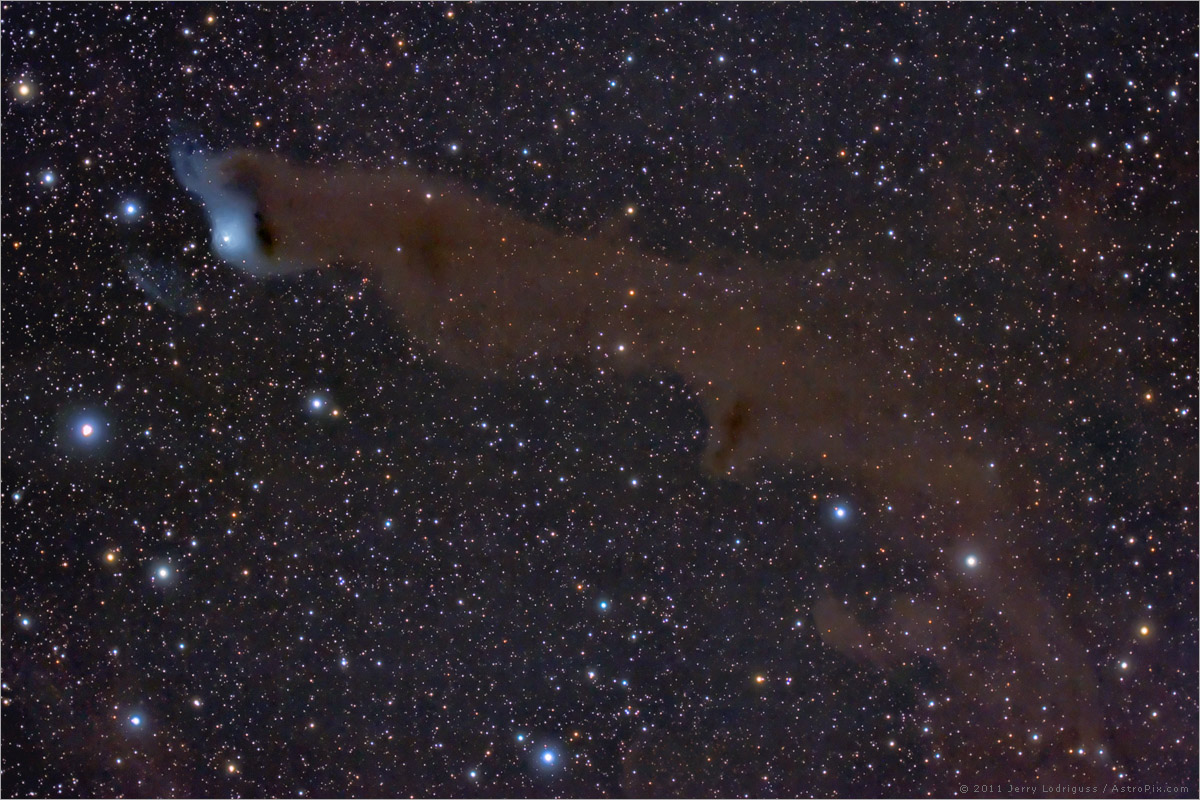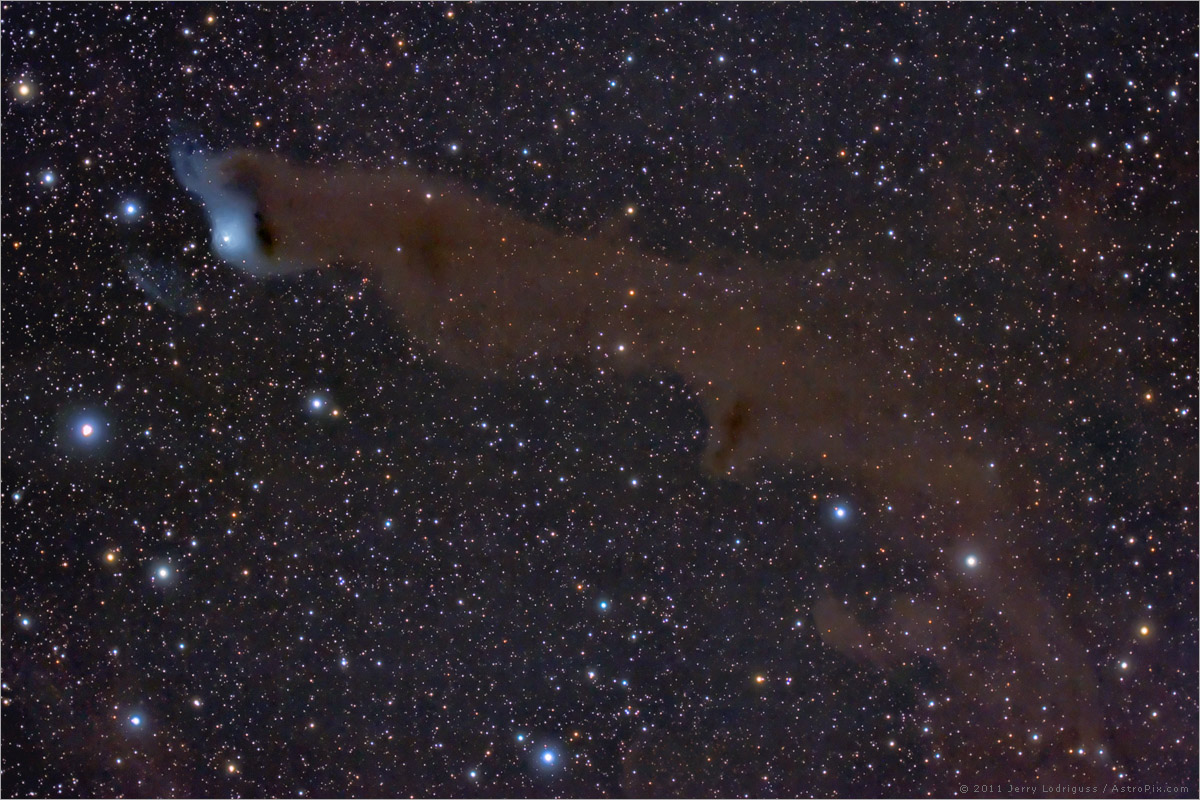
The mysterious blue reflection nebula found in catalogs as VdB 152 or Ced 201 really is very faint. It lies at the tip of the long dark nebula Barnard 175 in a dusty complex that has also been called Wolf's Cave. The cosmic apparitions are nearly 1,400 light-years away along the northern Milky Way in the royal constellation Cepheus. Near the edge of a large molecular cloud, pockets of interstellar dust in the region block light from background stars or scatter light from the embedded bright star giving the the nebula its characteristic blue color. Ultraviolet light from the star is also thought to cause a dim reddish luminescence in the nebular dust. Though stars do form in molecular clouds, this star seems to have only accidentally wandered into the area, as its measured velocity through space is very different from the cloud's velocity. This deep telescopic image of the region spans about 7 light-years. Poll: Which of October's APODs should be the APOM?
La misteriosa nebulosa de reflexión azul catalogada como VdB 152 o Ced 201 es realmente muy tenue. Se encuentra en el extremo de la larga nebulosa oscura Barnard 175, dentro de un complejo de polvo que también ha recibido el nombre de Cueva de Wolf. Estas apariciones cósmicas se hallan a casi 1.400 años-luz de distancia, a lo largo de la Vía Láctea septentrional, en la regia constelación de Cefeo. Cerca del borde de una gran nube molecular, bolsas de polvo interestelar en la región bloquean la luz de las estrellas de fondo o dispersan la luz proveniente de la brillante estrella embebida en la nebulosa, otorgándole su característico color azul. Se cree también que la luz ultravioleta de la estrella provoca una tenue luminiscencia rojiza en el polvo nebular. Aunque las estrellas sí se forman en nubes moleculares, esta estrella parece haber ingresado en la zona de manera accidental, ya que su velocidad medida a través del espacio es muy diferente de la velocidad de la nube. Esta profunda imagen telescópica de la región abarca aproximadamente 7 años-luz.