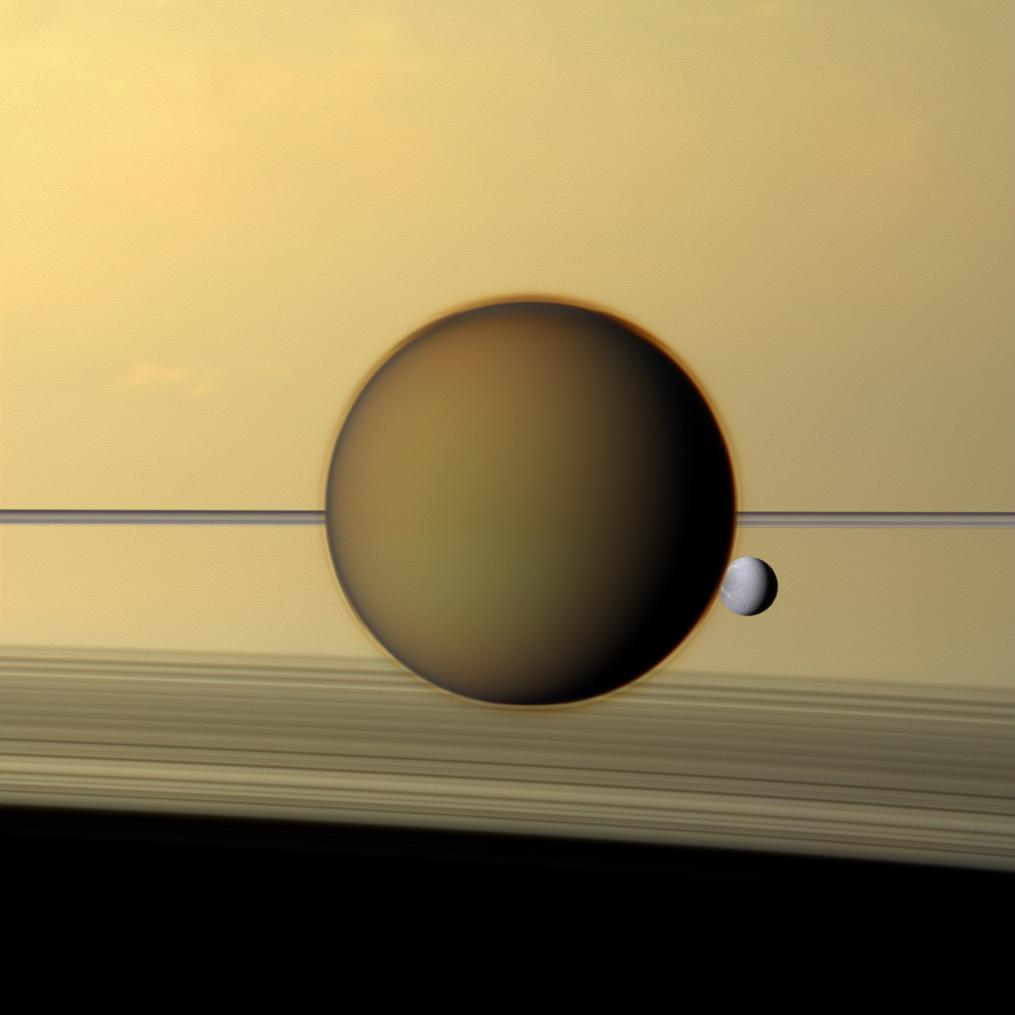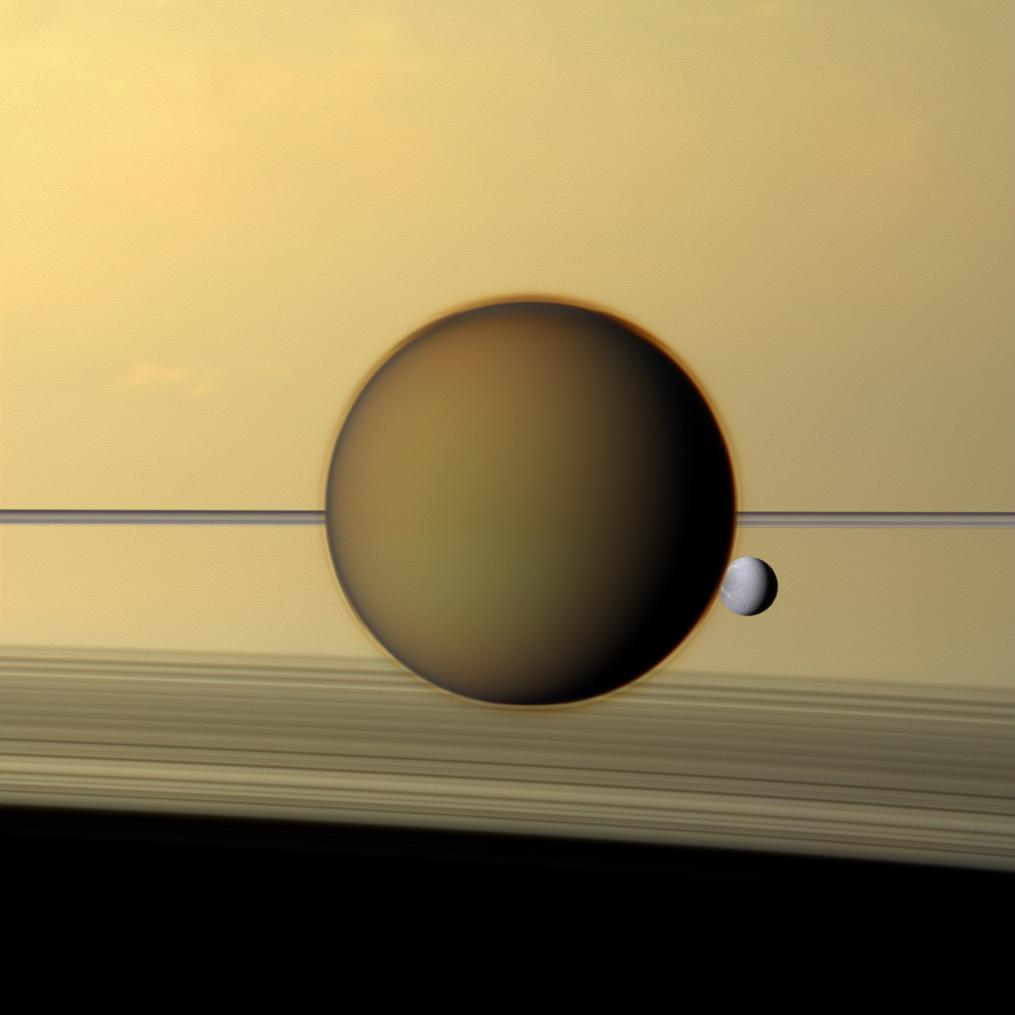
Orbiting in the plane of Saturn's rings, Saturnian moons have a perpetual ringside view of the gorgeous gas giant planet. Of course, while passing near the ring plane the Cassini spacecraft also shares their stunning perspective. The rings themselves can be seen slicing across the middle of this Cassini snapshot from May of last year. The scene features Titan, largest, and Dione, third largest moon of Saturn. Remarkably thin, the bright rings still cast arcing shadows across the planet's cloud tops at the bottom of the frame. Pale Dione is about 1,100 kilometers across and orbits over 300,000 kilometers from the visible outer edge of the A ring. Dione is seen through Titan's atmospheric haze. At 5,150 kilometers across, Titan is about 2.3 million kilometers from Cassini, while Dione is 3.2 million kilometers away. Best Short Astronomy Videos: APOD editor to speak in New York City on Friday, January 6
En órbita en el plano de los anillos de Saturno, las lunas saturnianas tienen una vista perpetua en primera fila del magnífico planeta gaseoso. Por supuesto, al pasar cerca del plano de los anillos, la nave espacial Cassini también comparte esa impresionante perspectiva. Los propios anillos pueden verse cruzando el centro de esta imagen captada por Cassini en mayo del año pasado. La escena muestra a Titán, la luna más grande, y a Dione, la tercera luna más grande de Saturno. Notablemente delgados, los brillantes anillos proyectan aún así sombras arqueadas sobre las capas de nubes del planeta en la parte inferior de la imagen. La pálida Dione mide aproximadamente 1.100 kilómetros de diámetro y orbita a más de 300.000 kilómetros del borde exterior visible del anillo A. Dione se observa a través de la neblina atmosférica de Titán. Con 5.150 kilómetros de diámetro, Titán se encuentra a unos 2,3 millones de kilómetros de Cassini, mientras que Dione está a 3,2 millones de kilómetros.