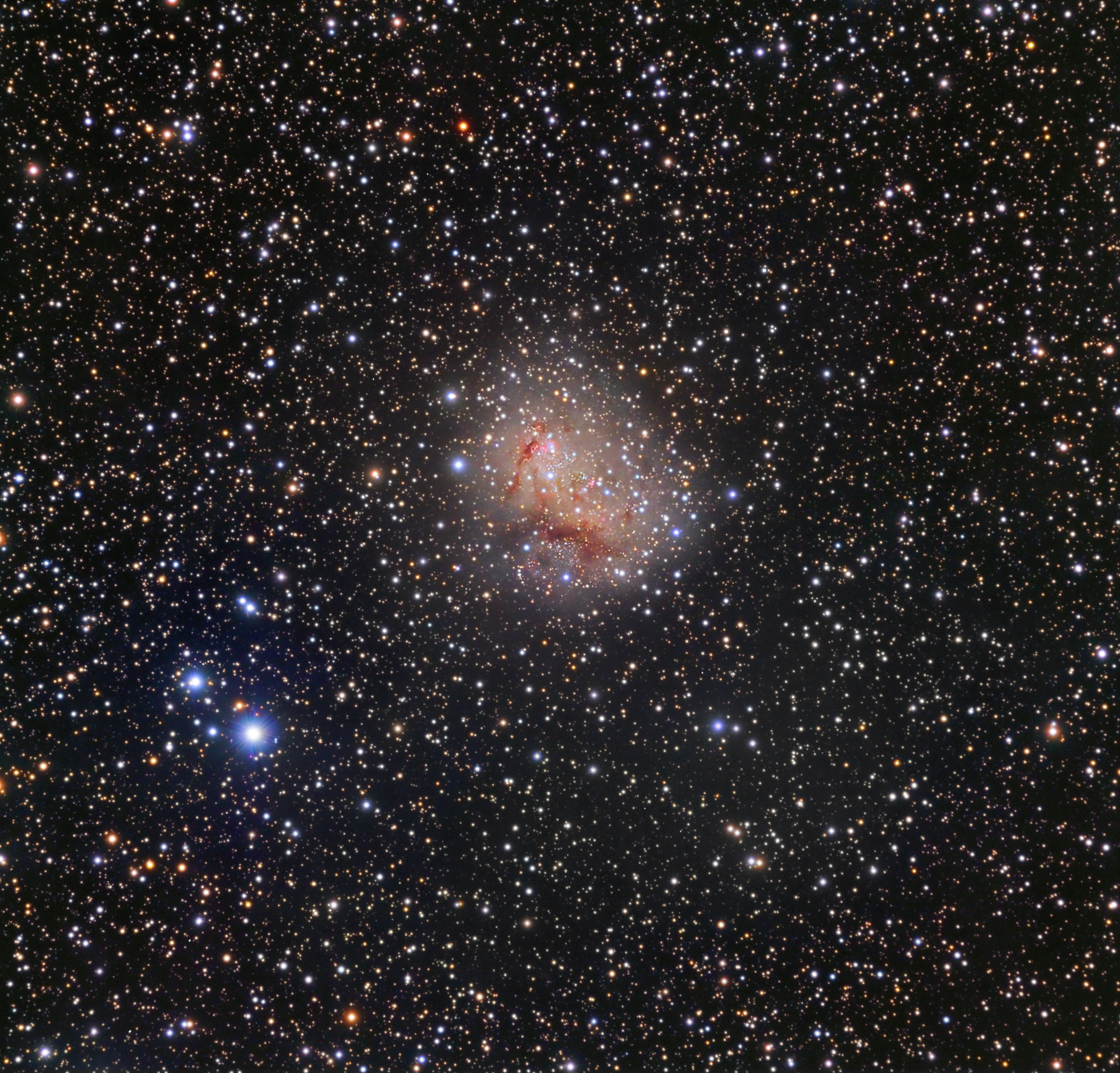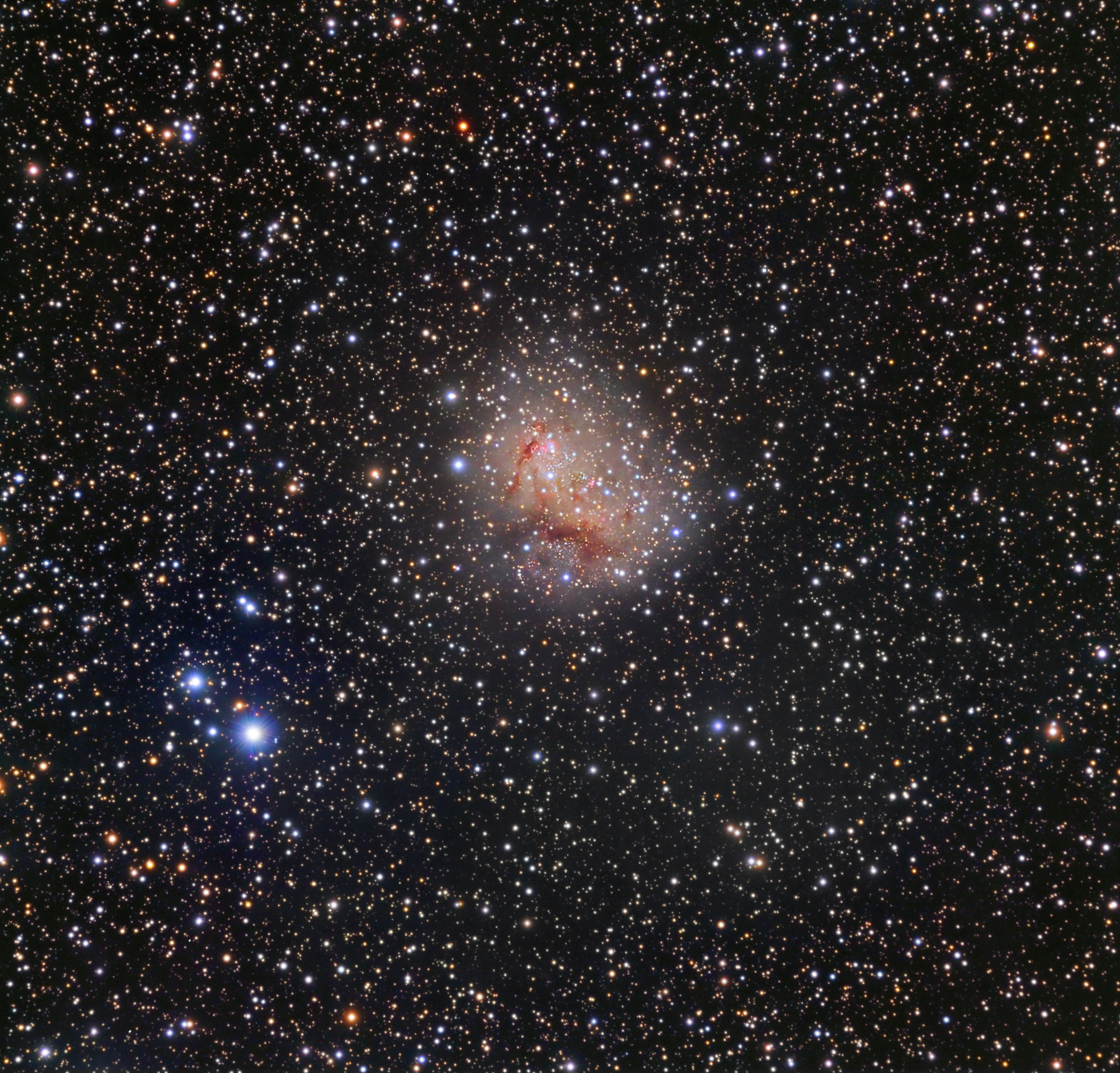
Lurking behind dust and stars near the plane of our Milky Way Galaxy, IC 10 is a mere 2.3 million light-years distant. Even though its light is dimmed by intervening dust, the irregular dwarf galaxy still shows off vigorous star-forming regions that shine with a telltale reddish glow in this colorful skyscape. In fact, also a member of the Local Group of galaxies, IC 10 is the closest known starburst galaxy. Compared to other Local Group galaxies, IC 10 has a large population of newly formed stars that are massive and intrinsically very bright, including a luminous X-ray binary star system thought to contain a black hole. Located within the boundaries of the northern constellation Cassiopeia, IC 10 is about 5,000 light-years across. Best Short Astronomy Videos: APOD editor to speak in New York City on Friday, January 6
Oculta tras el polvo y las estrellas cercanas al plano de nuestra galaxia Vía Láctea, IC 10 se encuentra a tan solo 2,3 millones de años luz de distancia. Aunque su luz se ve atenuada por el polvo interestelar interpuesto, esta galaxia enana irregular exhibe vigorosas regiones de formación estelar que resplandecen con un característico brillo rojizo en este colorido paisaje celeste. De hecho, IC 10, también miembro del Grupo Local de galaxias, es la galaxia de brote estelar más cercana que se conoce. En comparación con otras galaxias del Grupo Local, IC 10 alberga una gran población de estrellas recién formadas que son masivas e intrínsecamente muy luminosas, incluido un sistema binario de rayos X que se cree contiene un agujero negro. Situada dentro de los límites de la constelación septentrional de Casiopea, IC 10 tiene aproximadamente 5.000 años luz de diámetro.