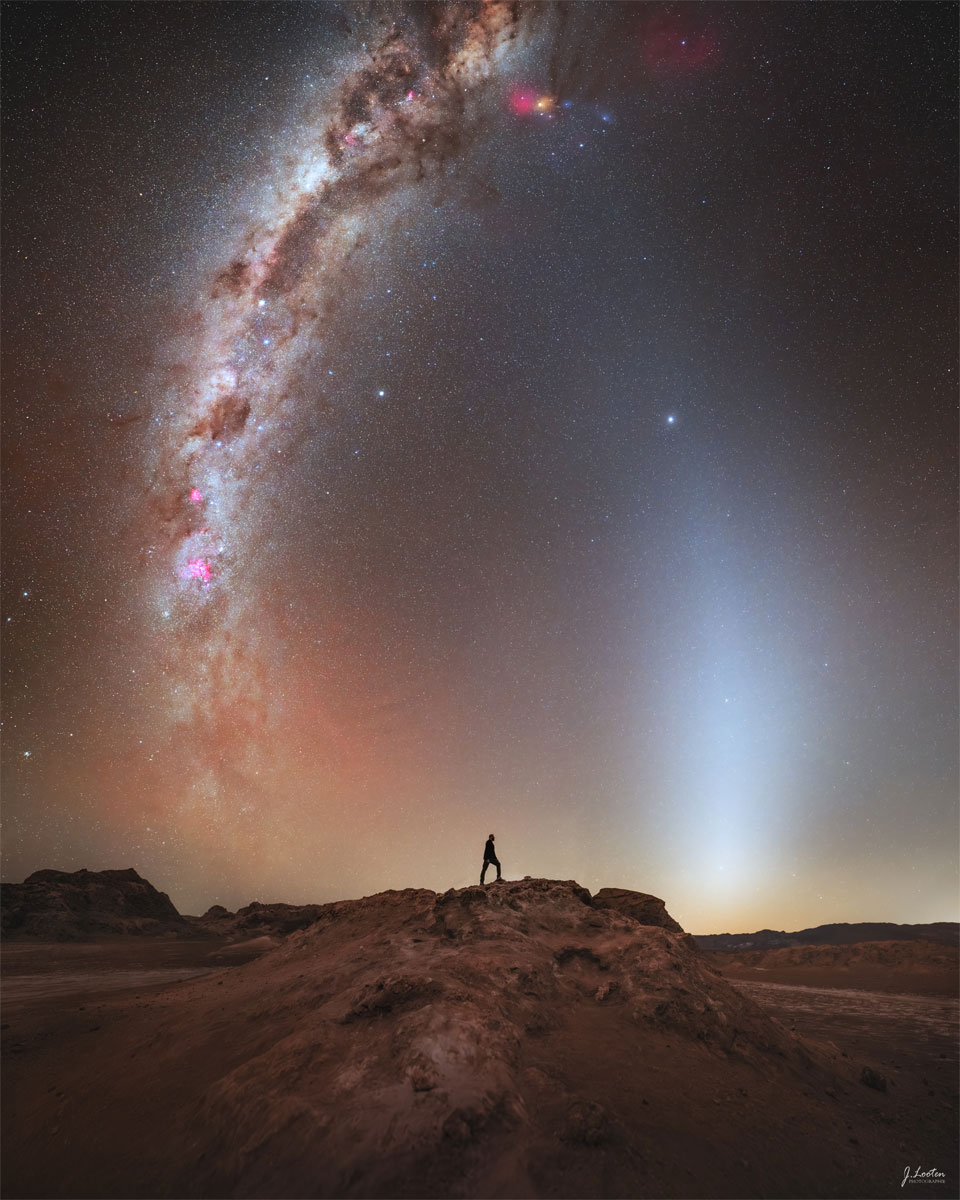
Is it dawn or false dawn? During certain times of the year, the horizon near the rising Sun will begin to glow unusually early. This early glow does not originate directly from the Sun, but rather from sunlight reflected by interplanetary dust. Called zodiacal light, the glowing triangle of light may be mistaken, for a while, for a sunrise, and so may be called a false dawn. Pictured above, two false dawns were recorded in time lapse movies each spanning about five hours from the perch of the highest observatory in the world: Mount Saraswati near Hanle, India. At its brightest, the rising zodiacal triangle on the left glows brighter than even the central disk of our Milky Way Galaxy -- visible as the diagonal band moving left to right across the frame.
¿Es un amanecer o un falso amanecer? Durante ciertas épocas del año, el horizonte cercano al Sol naciente comienza a iluminarse de manera inusualmente temprana. Este resplandor anticipado no proviene directamente del Sol, sino de la luz solar reflejada por el polvo interplanetario. Denominada luz zodiacal, este triángulo luminoso puede confundirse, por un momento, con un amanecer, razón por la cual se le llama falso amanecer. En la imagen, dos falsos amaneceres fueron registrados en películas de lapso de tiempo, cada una abarcando aproximadamente cinco horas, desde el observatorio más alto del mundo: el monte Saraswati, cerca de Hanle, India. En su punto más brillante, el triángulo zodiacal ascendente de la izquierda brilla con mayor intensidad que incluso el disco central de nuestra galaxia, la Vía Láctea, visible como la banda diagonal que se desplaza de izquierda a derecha a lo largo del encuadre.