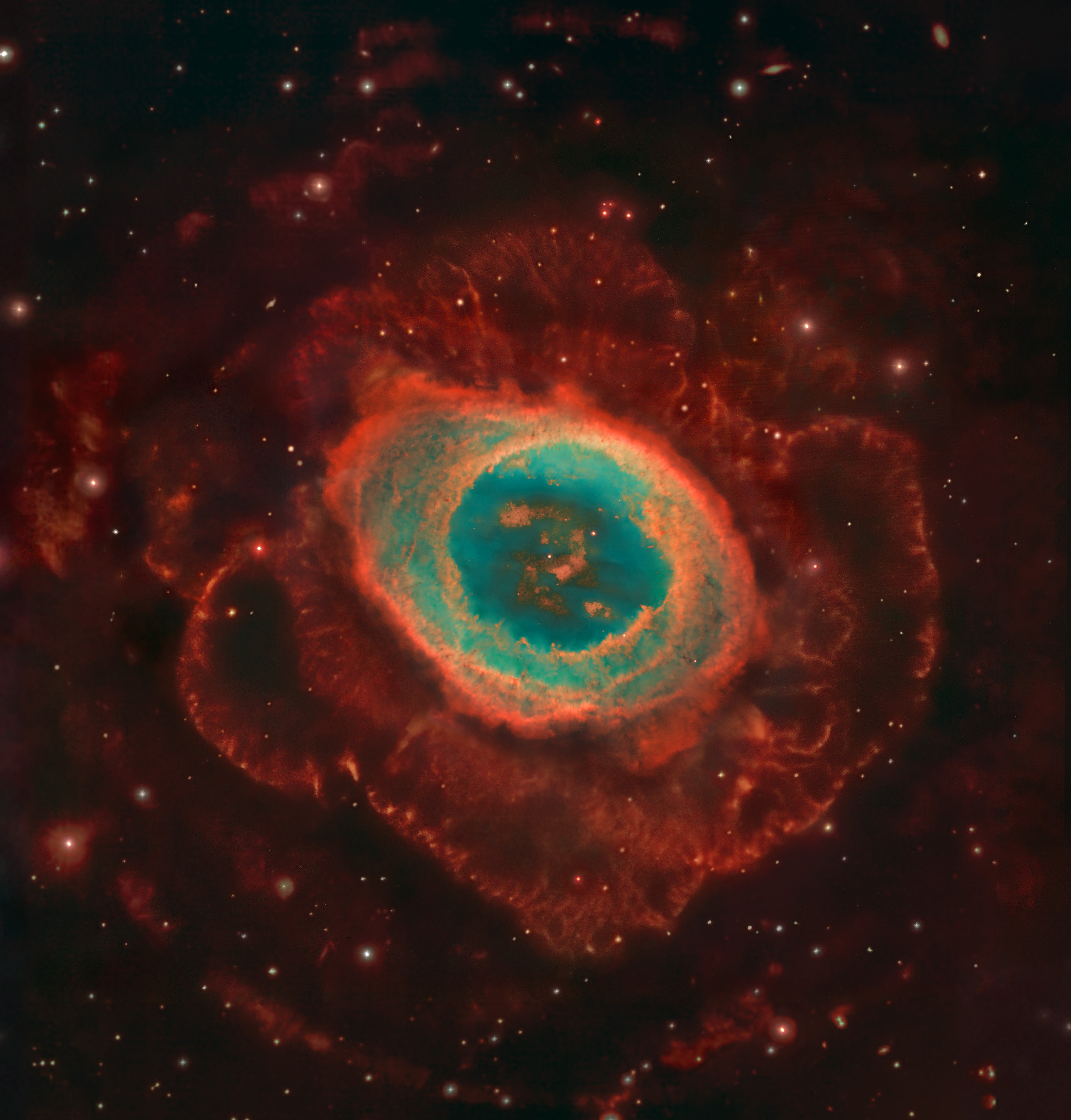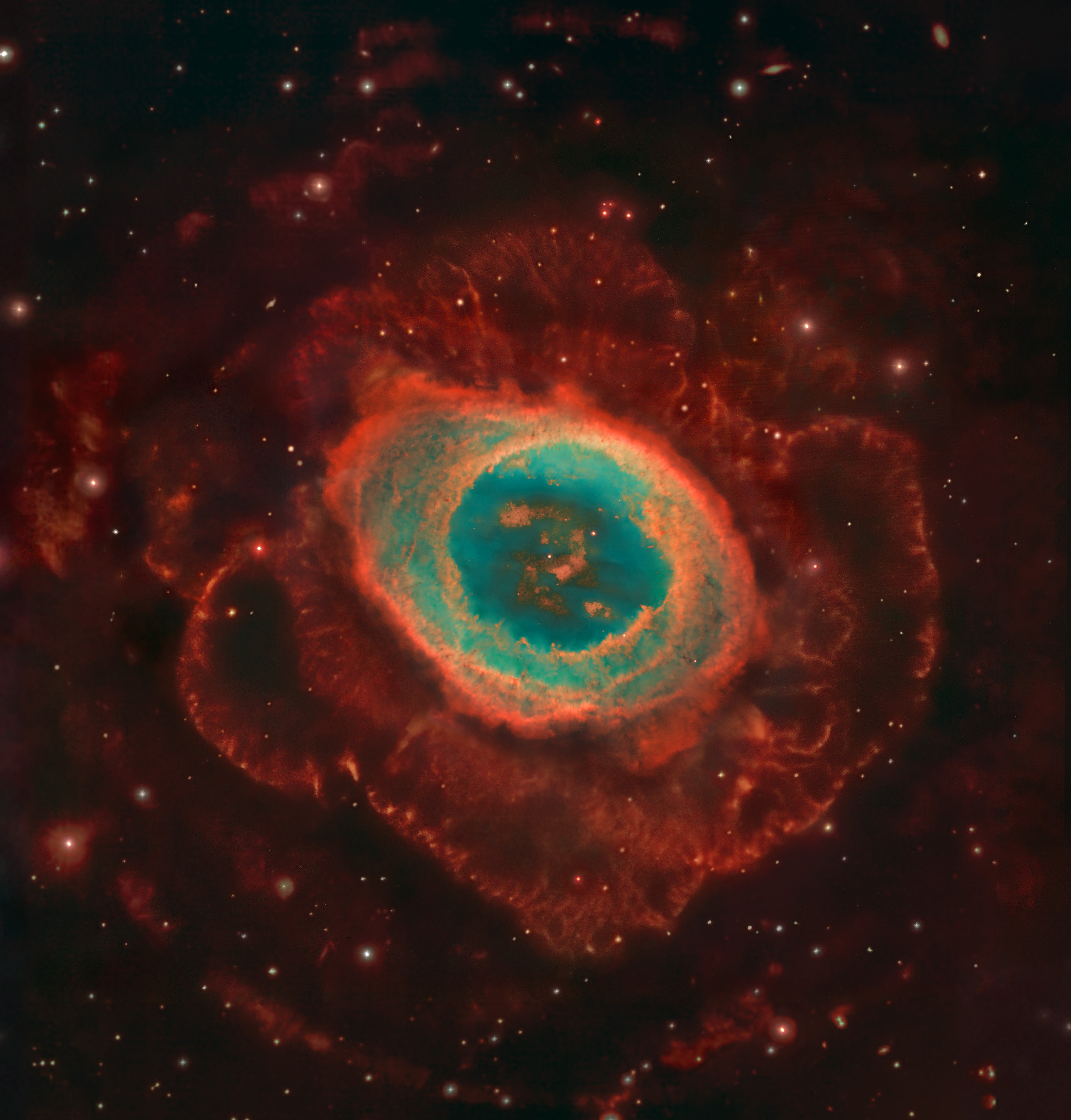
cept for the rings of Saturn, the Ring Nebula (M57) is probably the most famous celestial band. Its classic appearance is understood to be due to perspective - our view from planet Earth looks down the center of a roughly barrel-shaped cloud of glowing gas. But expansive looping structures are seen to extend far beyond the Ring Nebula's familiar central regions in this intriguing composite of ground based and Hubble Space Telescope images with narrowband image data from Subaru. Of course, in this well-studied example of a planetary nebula, the glowing material does not come from planets. Instead, the gaseous shroud represents outer layers expelled from the dying, once sun-like star at the nebula's center. Intense ultraviolet light from the hot central star ionizes atoms in the gas. Ionized oxygen atoms produce the characteristic greenish glow and ionized hydrogen the prominent red emission. The central ring of the Ring Nebula is about one light-year across and 2,000 light-years away. To accompany tonight's shooting stars it shines in the northern constellation Lyra.
Crédito: NASA, Subaru, Telescopio Espacial Hubble La Nebulosa Anular (M57) es probablemente la banda celeste más famosa, exceptuando los anillos de Saturno. Su apariencia clásica se entiende como resultado de la perspectiva: nuestra visión desde la Tierra mira hacia el centro de una nube de gas luminoso con forma aproximadamente cilíndrica. Pero en esta intrigante composición de imágenes terrestres y del Telescopio Espacial Hubble, con datos de banda estrecha del telescopio Subaru, se observan estructuras en forma de bucles que se extienden mucho más allá de las regiones centrales familiares de la Nebulosa Anular. Por supuesto, en este ejemplo bien estudiado de una nebulosa planetaria, el material luminoso no proviene de planetas. En su lugar, la envoltura gaseosa representa las capas externas expulsadas por una estrella moribunda, una vez similar al Sol, ubicada en el centro de la nebulosa. La luz ultravioleta intensa de la estrella central ioniza los átomos en el gas. Los átomos de oxígeno ionizados producen el brillo verde característico, y el hidrógeno ionizado emite la luz roja destacada. El anillo central de la Nebulosa Anular tiene aproximadamente un año luz de diámetro y se encuentra a 2000 años luz de distancia. Para acompañar las estrellas fugaces de esta noche, brilla en la constelación norteña de Lyra.